As of April 15, 16 ministries and agencies are still reporting disbursement rates of public investment capital below 1%, according to the Ministry of Finance. The ministry said some units were assigned large capital funds but disbursed little, slowing overall progress.
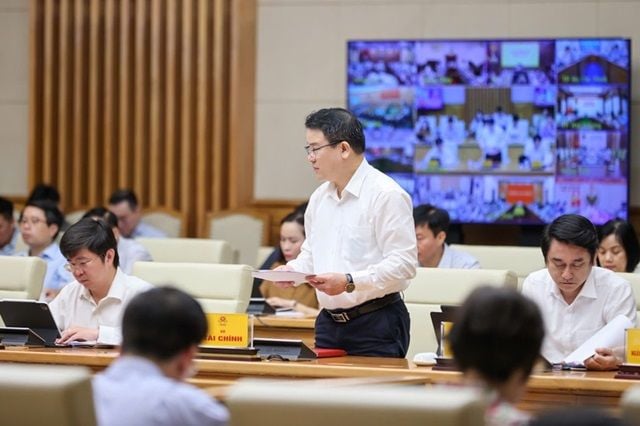
Deputy Minister of Finance Tran Quoc Phuong made the assessment at a conference chaired by Prime Minister Le Minh Hung on April 24, focusing on the distribution and disbursement of public investment capital for 2026.
2026 public investment capital allocation and remaining balance
The total public investment capital for 2026 allocated by the Prime Minister to ministries and central agencies is 1,013,443.4 trillion dong. In addition, under the Public Investment Law, carryover capital from 2025 to 2026 is 55,289.6 trillion dong.
Unallocated capital under government authority totals 79,688.517 trillion dong, including budgets for new project startups, national target programs, science and technology tasks, innovation, and digital transformation, among others.
By April 15, detailed allocations had been made by ministries, central agencies, and localities totaling 976,538.8 trillion dong. The remaining detailed unallocated capital is 50,040.8 trillion dong, equivalent to 4.9% of the Prime Minister’s plan.
Disbursement performance as of April 15
Carryover disbursement from the previous year reached 2,676.5 trillion dong, or 5.8% of the plan. For the 2026 plan, total disbursed capital is 127,390.6 trillion dong, equal to 12.6% of the plan.
Disbursement by budget source shows central budget disbursed at 9.6% and local budget at 14.2%. Seven ministries/agencies and 16 localities have achieved disbursement rates equal to or above the overall average.
Key bottlenecks slowing public investment
Deputy Minister Tran Quoc Phuong said public investment implementation is affected by multiple legal and operational constraints:
- Land-related procedures: determining land prices, approving compensation and resettlement plans, and handling land-use conversion procedures remain lengthy, with some cases lacking clear guidance.
- Construction and project approvals: appraisal, project approval, technical design, and estimates involve many steps and duplication across agencies; guidance is insufficient when adjusting total investment and estimates amid material price fluctuations.
- Environmental requirements: appraisal of environmental impact assessments and licensing for construction materials is slow, affecting construction progress.
- Science and technology and digital transformation: lack of detailed guidance on determining total investment and IT service estimates; quote collection procedures generate additional steps and do not clearly address price differences.
- Land clearance: determining land origin, compensation unit prices, and securing residents’ consent remains difficult; relocation of infrastructure creates additional issues.
- Material supply: supply shortfalls in many localities, rising material prices and transport costs, and resulting impacts on timelines and costs.
- Implementation capacity: limited capacity of some project owners, project management boards, and contractors; weak coordination and low planning quality leading to delays.
- Project management changes: reorganizing, transferring project ownership, and changing management models also affect execution.
Causes of delays and measures to accelerate disbursement
The Ministry of Finance said slow disbursement stems from both objective and subjective factors.
Objective factors include material price volatility, policy changes, land clearance difficulties, and weather conditions.
Subjective factors are described as primary drivers, including poor planning quality, dispersed funding allocation, projects receiving funding before procedures are completed, uneven and insufficiently decisive land clearance, and weak inter-agency coordination. The ministry also cited limited execution capacity among some actors and reluctance by some staff to take responsibility, alongside tight material supply while demand rises due to multiple concurrent projects.
Disbursement discipline and governance measures for 2026
To target 100% disbursement of planned public investment capital in 2026, the Ministry of Finance proposed a set of measures:
- Capital plan execution: ministries, central agencies, and localities are urged to promptly allocate and disburse 2026 plans under regulations, especially for units with large capital allocations. Units are also asked to proactively reallocate internal funds from slow-disbursing projects to those with better progress and greater funding needs. For central government funds not yet allocated in detail by May 15, 2026, units must report handling options and send them to the Ministry of Finance by May 20, 2026.
- Investment efficiency assessment: implement socio-economic accounting-based efficiency assessments consistently, from needs assessment to funding allocation and project operation. Strengthen inspection and supervision, ensure discipline and integrity, and combat corruption and waste in public investment.
- Science, technology, innovation, and digital transformation funding: the Ministry of Science and Technology is tasked with rapidly compiling proposals for more than 20,683 billion dong and submitting them to the Ministry of Finance for Government decision.
- Medium-term planning (2026–2030): the Ministry of Finance has proposed a Government directive on managing and using funds linked to socio-economic impact assessment. After issuance, ministries and localities must select project portfolios based on efficiency and submit consolidated plans to the Ministry of Finance by May 6, 2026 for Government submission.
- Land clearance acceleration: ministries and localities are asked to remove obstacles and strengthen public outreach to residents. The Ministry of Agriculture and Environment is responsible for guiding and addressing difficulties arising under the 2024 Land Law.
- Material price and supply management: tighten price management, strictly handle hoarding, market manipulation, or unjustified price increases. Localities should publish material prices and construction price indices monthly or sooner when needed, while the Construction Ministry should closely monitor market developments and propose policy responses when volatility is large.
- Project execution support for major national projects: for important national projects, especially transportation, the Construction Ministry and localities should direct units and contractors to leverage favorable weather to accelerate construction. The ministry also called for accelerating investment preparation for strategic projects such as the North-South high-speed railway and VN–China rail links.
- Digital and innovation implementation: ministries and localities are required to implement tasks under the 2026 work program, while the Ministry of Science and Technology should quickly issue or submit guidance documents to remove obstacles.
- Administrative and procedural reform: reform public investment administrative procedures toward simplification and transparency by cutting intermediary steps, eliminating overlapping procedures, and expanding IT use and data interoperability to shorten implementation time, reduce compliance costs, and improve efficiency.
Institutional framework review
The Ministry of Finance also emphasized that completing the institutional and policy framework remains urgent. Related ministries are asked to comprehensively review the legal system on construction, land, environment, science and technology, public finance, and public investment, and propose integrated and feasible solutions.