•
•
•
•
•
•
•
•
•
•
•
•
•
•
•
•
•
•
•
•
•
•
•
•
•
•
•
•
•
•
•
•
•


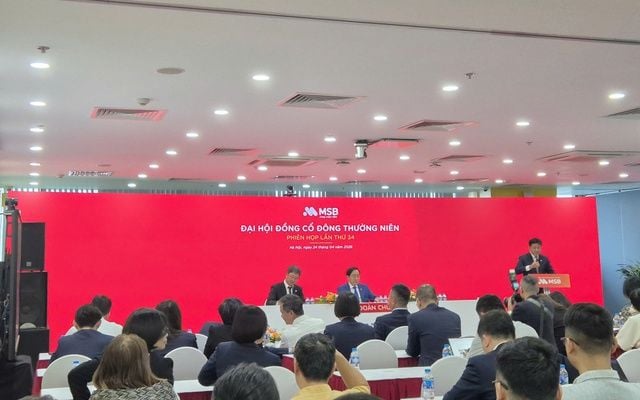
Morning of April 24, 2026, Vietnam Maritime Commercial Joint Stock Bank (MSB) held its 2026 Annual General Meeting of shareholders. The meeting covered the bank’s business plan, profit distribution, and capital-raising plans for 2026.
MSB targets pretax profit of 8,000 billion dong for 2026, about 13% higher than 2025. Total assets are expected to reach 460,000 billion dong, up 13% compared with end-2025.
Deposits in market 1 and bonds are planned at 280,000 billion dong, up 24%. Lending growth is guided to 244,000 billion dong, up 18%, while the non-performing loan (NPL) ratio is expected to remain under 3%.
MSB proposed distributing 2025 profits with pretax profit of over 7,058 billion dong and after-tax profit of around 5,628 billion dong. After setting aside required funds, approximately 4,558 billion dong would remain for a capital increase.
MSB proposed increasing charter capital to more than 37,400 billion dong. The bank plans to issue new shares to existing shareholders at up to 20%, equivalent to up to 624 million new shares. The shares would be freely transferable.
The funding for the issuance would come from retained earnings and the supplementary capital reserve, based on the audited 2025 financial statements as of 31/12/2025. If completed, charter capital would rise from 31,200 billion dong to 37,440 billion dong, an increase of about 6,240 billion dong.
Management said the capital increase is intended to strengthen financial capacity, improve safety indicators, and provide a foundation for medium- to long-term lending growth. The bank also aims to implement international governance standards such as Basel III and IFRS to enhance competitiveness and attract investors.
The AGM also discussed continuing plans to acquire a fund management company to build part of an integrated financial ecosystem, with securities and asset management as core growth areas. MSB cited product plans including open-end funds, retirement funds, equity funds, and bonds.
In addition, the meeting covered the proposed conversion of TNEX Finance into an integrated financial services firm, with TNEX having increased its charter capital to support expansion.
MSB noted long-term macro trends—urbanization and rising middle class—that it expects will support demand for professional and transparent investment products. The board also indicated that while some approaches were approved in 2025, certain methods did not meet investment criteria and would be reconsidered.
The Q&A session addressed topics including cash dividends versus stock dividends, the potential divestment of TNEX, NPLs and credit risk management, quarterly results, interbank rate impacts, and the rationale for entering the securities and asset management space.
Overall, the discussion emphasized MSB’s strategy to build a comprehensive financial services group supported by a strong capital base and robust risk controls, while pursuing opportunities in wealth management and private banking to serve its large customer base.
Premium gym chains are entering a “golden era” that is ending or already in decline, as rising operating costs collide with shifting consumer preferences toward more flexible, community-based ways to exercise. Long-term memberships are shrinking, margins are pressured by higher rents and facility expenses, and competition from smaller, more personalized…