•
•
•
•
•
•
•
•
•
•
•
•
•
•
•
•
•
•
•
•
•
•
•
•
•
•
•
•
•
•
•
•
•


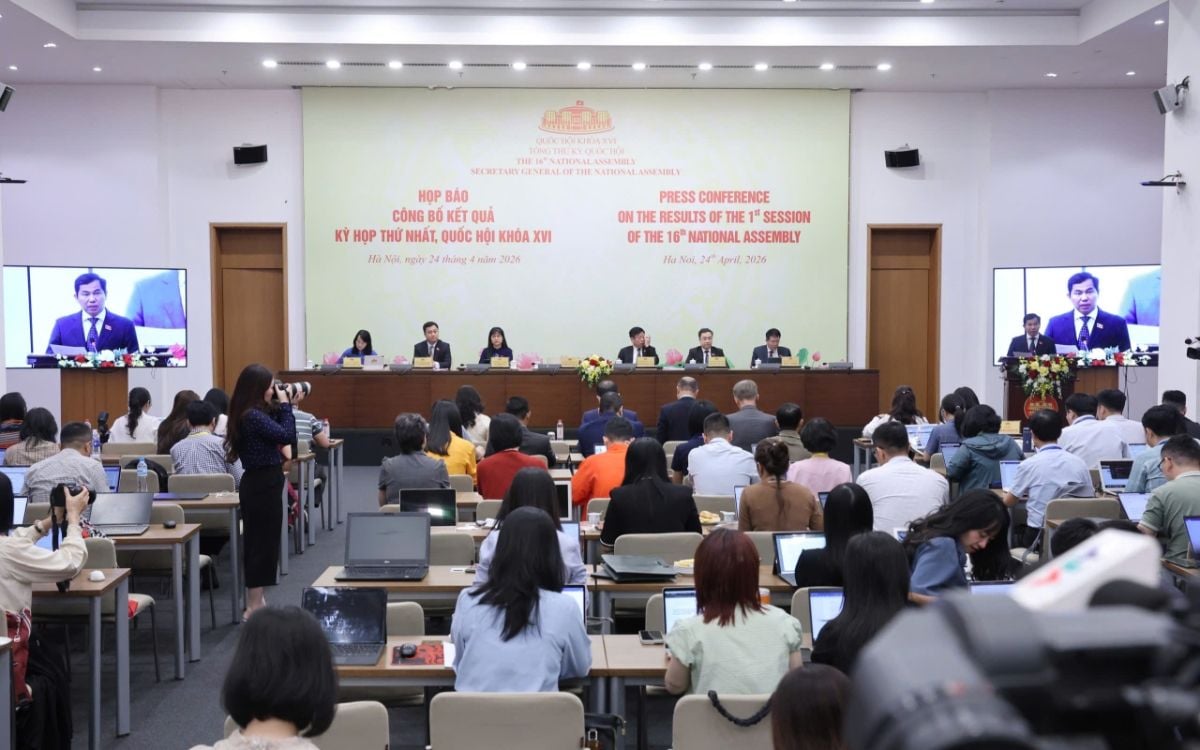
A draft law passed by the National Assembly would allow the government to set taxable thresholds for households and individuals engaged in business through regulations, rather than hard-coding the thresholds in law. The proposal is intended to enable faster policy adjustments, reduce the tax burden on economic actors, facilitate savings, and expand production and business activities.
At a press conference, Le Quang Manh, Secretary-General of the National Assembly and head of the Office of the National Assembly, said the first session of the XVI National Assembly demonstrated a clearer direction for reforming parliamentary operations to be more professional and efficient, while strengthening the link between lawmaking, supervision, and enforcement.
The session also reflected the spirit of the 14th Party Congress and directives from the Politburo, including guidance from General Secretary and President To Lam on reforming thinking in lawmaking, reforming institutions, unlocking resources, and placing people at the center of socio-economic development.
Several draft laws amending and supplementing provisions of the Personal Income Tax Law, the Value-Added Tax (VAT) Law, the Corporate Income Tax Law, and the Special Consumption Tax Law attracted significant attention from voters.
Pham Thi Hong Yen, a full-time member of the Economic and Finance Committee of the National Assembly, said the draft law specifies that, based on macroeconomic indicators and the feasibility of the state budget balance, the government will be empowered to regulate three threshold items:
Under the current Personal Income Tax and VAT regimes, the non-taxable revenue for individuals and households engaged in business is 500 million dong per year, and the revenue for households and individuals not subject to VAT is also 500 million dong.
In the context of global and domestic economic difficulties, Yen said tax policy adjustments and incentives are needed to support individuals, households, and micro and small enterprises, safeguard livelihoods and social security, and ensure fairness in policy application while motivating taxpayers to choose appropriate business models.
She added that the government plans to set the threshold for not having to pay personal income tax for individuals and households engaged in business at 1 billion dong. This level is intended to align with the revenue threshold using electronic invoices for individuals and households engaged in business, and to align with the revenue threshold not subject to VAT under the VAT Law.
The draft law is expected to help economic actors—from households (about 5 million households) to enterprises and cooperatives—reduce the tax burden, enabling them to accumulate and expand production and business.
It is also described as a policy aimed at ensuring livelihoods, social security, and fairness in applying tax policies, while providing additional incentives for taxpayers to choose suitable business models and encouraging household businesses to transition into enterprises to increase scale and efficiency.
The session results report said it was an important session marking the start of a new term of the National Assembly with heavier duties than usual. It said the National Assembly completed organizing the state apparatus in line with the Constitution, focusing on institutionalizing resolutions of the 14th Party Congress and laying legal and institutional foundations.
On lawmaking, the National Assembly approved 9 laws and 31 resolutions, including 5 important legal normative resolutions.







Premium gym chains are entering a “golden era” that is ending or already in decline, as rising operating costs collide with shifting consumer preferences toward more flexible, community-based ways to exercise. Long-term memberships are shrinking, margins are pressured by higher rents and facility expenses, and competition from smaller, more personalized…