•
•
•
•
•
•
•
•
•
•
•
•
•
•
•
•
•
•
•
•
•
•
•
•
•
•
•
•
•
•
•
•
•
After the completion of the two-tier arrangement of local government, the number of non-professional commune-level officials has fallen sharply. The country previously had about 100,000–120,000 people in this category, but now there are nearly 60,000, roughly half of the earlier figure.
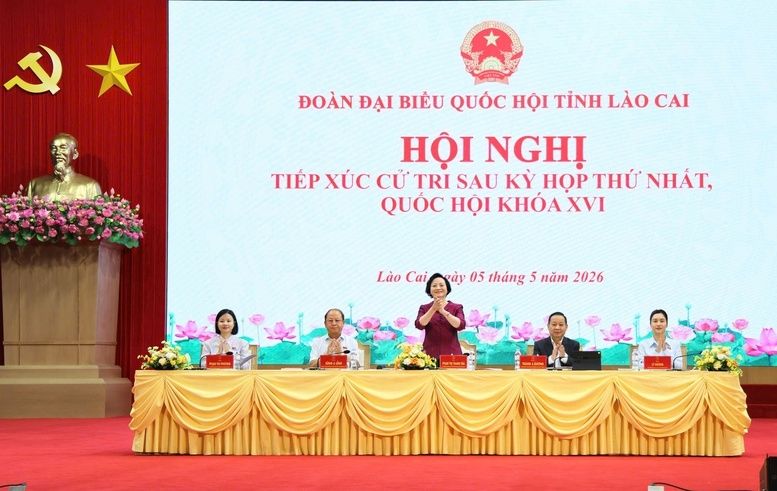
On the morning of May 5, Party Central Committee Secretary and Deputy Prime Minister Pham Thi Thanh Tra, together with the Lao Cai Province National Assembly Delegation No. 01, held a citizens’ meeting after the first session of the 16th National Assembly. The meeting was held in person at the provincial conference center with about 350 voters from Yen Bai, Nam Cuong, Van Phu, and Au Lau wards, and connected online to 47 commune-level reception points across the southern part of the province.
At the meeting, many voters praised socio-economic development results despite difficulties, including price-stabilizing measures for petrol and oil that helped stabilize production and living standards. However, voters also highlighted obstacles in organizational setup and policy implementation, and called on the central authorities to promptly完善 the legal framework.
Key recommendations focused on staffing norms and job positions. Voters said staffing-related rules are not synchronized, creating challenges for management and human-resource utilization. They urged the early issuance of specific regulations tied to population size, area, and local characteristics, and to完善 the catalog of job positions, job descriptions, and a unified competency framework.
On remuneration, voters argued that commune-level leadership cadre allowances remain low and do not match workload, affecting motivation. They proposed adjustments aligned with administrative-unit classifications and urged faster wage reform, along with a support mechanism for part-time officials.
In response to questions about commune-level staffing and job positions, the Government instructed the Ministry of Home Affairs to closely follow criteria on administrative-unit classification, population size, area, and economic scale. The Ministry is to report to the Party Organization Commission and submit to the Politburo for consideration, aiming to ensure unified and coherent staffing management across the political system.
The Party Organization Commission is currently focusing on完善 the criteria, using them as a basis for allocating staffing to localities. Based on that, localities will be able to train, re-train, recruit, and restructure cadres to improve quality, especially at the commune level. In the near term, the Government will submit to competent authorities to decide the number of staff for localities.
Regarding positions, Decree No. 361/2025/NĐ-CP dated 31/12/2025 on civil-servant positions states that there are 45 positions at the commune level, including 8 leadership titles and 3 support, service, and professional positions.
Under Decree 361, the approach is described as more flexible. Ministries and sectors no longer issue detailed guidelines on staffing positions as before. Voters and officials noted that separate guidance previously led to a lack of uniformity, with each locality adopting its own approach and making it difficult to ensure consistency from central to local levels.
Therefore, under Decree 361, staffing positions are defined based on a government-wide framework, while decentralization allows localities to develop and describe positions that fit local reality, improving staffing efficiency.
In the near term, the Government will focus on adjusting the base salary from July 1, 2026 for civil servants, public employees, the armed forces, and social-welfare beneficiaries, with an 8% increase. The Ministry of Home Affairs is also tasked with studying and完善 salary policies and reporting to the Politburo in June, with a view toward comprehensive reform and expanding wage relations. On that basis, adjustments to allowances, including official allowances, will be considered, especially for commune-level work.
The Deputy Prime Minister emphasized that salary reform is a major issue—both a resource and a driver of development—but must be balanced with the state budget’s capabilities. Adjustments should be implemented cautiously and gradually, in step with economic and social development conditions, to meet practical expectations.
Multiple options for reorganizing non-professional staff will be considered, including allowances for dual-role positions at the commune level. The Deputy Prime Minister noted that because administrative-unit rearrangement and the two-tier local government model have just been completed, remaining issues require continued study within the broader policy framework.
For non-professional commune-level staff, according to the Politburo’s Conclusion 210, this force will cease activities by May 31, 2026. The Government added provisions in the decree allowing direct recruitment into commune-level civil service if standards are met, without going through competitive exams.
After the two-tier local government rearrangement, the number of non-professional commune-level staff has fallen significantly. Previously, the country had about 100,000–120,000 people, including those directly recruited into commune-level civil service and those who left under policy. Currently, nearly 60,000 people remain, about half of the previous level.
The Government outlined three options for handling the remaining staff:
The Deputy Prime Minister urged localities to implement the options in a unified, timely, and practical manner. While the commune level still faces a shortage of specialized staff, further updates are expected as policies evolve.
Premium gym chains are entering a “golden era” that is ending or already in decline, as rising operating costs collide with shifting consumer preferences toward more flexible, community-based ways to exercise. Long-term memberships are shrinking, margins are pressured by higher rents and facility expenses, and competition from smaller, more personalized…