•
•
•
•
•
•
•
•
•
•
•
•
•
•
•
•
•
•
•
•
•
•
•
•
•
•
•
•
•
•
•
•
•


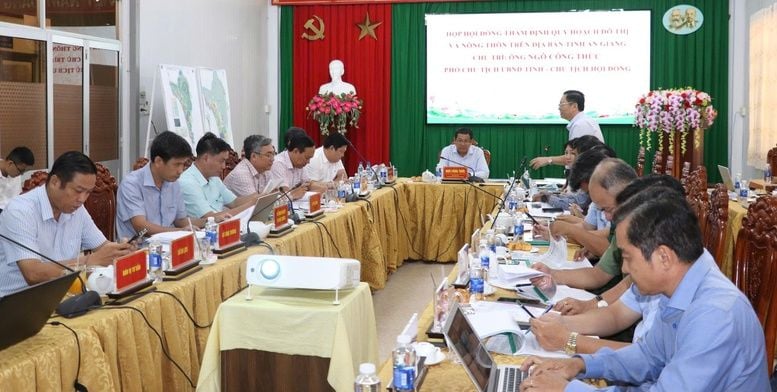
Five coastal-zone subdivision plans for Phu Quoc Special Economic Zone require strict development controls, protection of public space, and promotion of sustainable tourism linked to clean energy.
On April 16, in Phu Quoc, Ngo Cong Thuc, Vice Chairman of the An Giang Provincial People’s Committee, chaired a meeting of the Appraisal Council for planning tasks and urban-rural planning within the authority of the An Giang Province People’s Committee. The council reviewed five coastal-zone subdivision plans: the Sao Beach area in An Thoi; the eastern coastal area; the Ong Lang-Cua Can area; the northwestern coastal area; and Bai Truong.
For the Sao Beach subdivision (within Sub-zone 5), scale 1/2,000, the area is about 436.31 hectares. The plan identifies the area as a mixed-use tourism urban zone, combining an upscale eco-resort with marine sports.
The Appraisal Council said the plan is essentially aligned with the approved planning task, consistent with the living-tourism and resort-oriented direction, and supportive of the island’s master plan.
Vice Chairman Ngo Cong Thuc requested the planning unit to continue closely reviewing land-use indicators—especially residential and tourist housing—to ensure the project does not deviate from the “sustainable tourism” direction. He also asked for clear specifications on the width of the public beach park, the number and location of public access points to the sea, and controls on the density and height of coastal buildings.
He further urged adding requirements on solar energy use and green buildings in the project regulations.
For the eastern coastal subdivision (within Sub-zone 9), scale 1/2,000, the area is about 1,673.8 hectares. The plan defines functions including tourism services, mixed urban-tourism, eco-resort, coastal recreation, and golf.
The council assessed that the plan clearly positions Phu Quoc’s role as a tourism-service center, forming a coastal landscape axis and open space connected to the protective forest.
For the Ong Lang-Cua Can subdivision (Sub-zone 3), scale 1/2,000, the area is about 4,431.43 hectares. The plan orients the area toward a northern urban-tourism mixed zone, integrating commercial and services, professional education, high-tech, eco-city, golf, and resettlement.
To preserve the ecological character, the council urged tightening indicators on green-space ratios and non-buildable areas, as well as setbacks along rivers and coastlines. It also called for limiting density and building height in sensitive areas.
The council said the open-space network should be continuous, linking the protective forest with beaches and natural viewpoints. It also recommended including solar energy use and eco-friendly materials for resorts and service facilities.
For the northwestern coastal subdivision (Sub-zone 11), scale 1/2,000, the area is about 1,171.27 hectares, including Hon Doi Moi island (about 1.74 hectares) and adjacent beaches and rocky shores. The plan envisions high-end tourism services, luxury resorts, a casino-linked golf course, and craft villages.
The deputy urged careful review to avoid “cementing” the coastline and to strictly control density, height, and overall scale. The plan should expand open space, greenery, and water bodies, and require solar energy for golf lighting, technical infrastructure, and service facilities.
Erosion prevention and climate-change adaptation measures should be fully incorporated.
For the Bai Truong subdivision (Sub-zone 2), scale 1/2,000, the area is about 2,326.83 hectares (excluding defense land and protective forest). The plan designates the area as a central mixed-use urban-tourism zone, including commercial, services, entertainment, public facilities, and resettlement.
The council advised reassessing population targets, land-use indicators, and building heights to ensure compliance with the master plan. It emphasized protecting continuous coastal park space, public spaces, and sea views to ensure fair access to the sea.
It also recommended adding social housing, social infrastructure, public transport, parking, and a green-smart city framework linked to solar energy.
The council urged consulting units and planning authorities to promptly incorporate green development and clean-energy solutions to help Phu Quoc grow rapidly but sustainably, consistent with its status as the nation’s island jewel.
Source: Le Son, Government Portal
Premium gym chains are entering a “golden era” that is ending or already in decline, as rising operating costs collide with shifting consumer preferences toward more flexible, community-based ways to exercise. Long-term memberships are shrinking, margins are pressured by higher rents and facility expenses, and competition from smaller, more personalized…