•
•
•
•
•
•
•
•
•
•
•
•
•
•
•
•
•
•
•
•
•
•
•
•
•
•
•
•
•
•
•
•
•


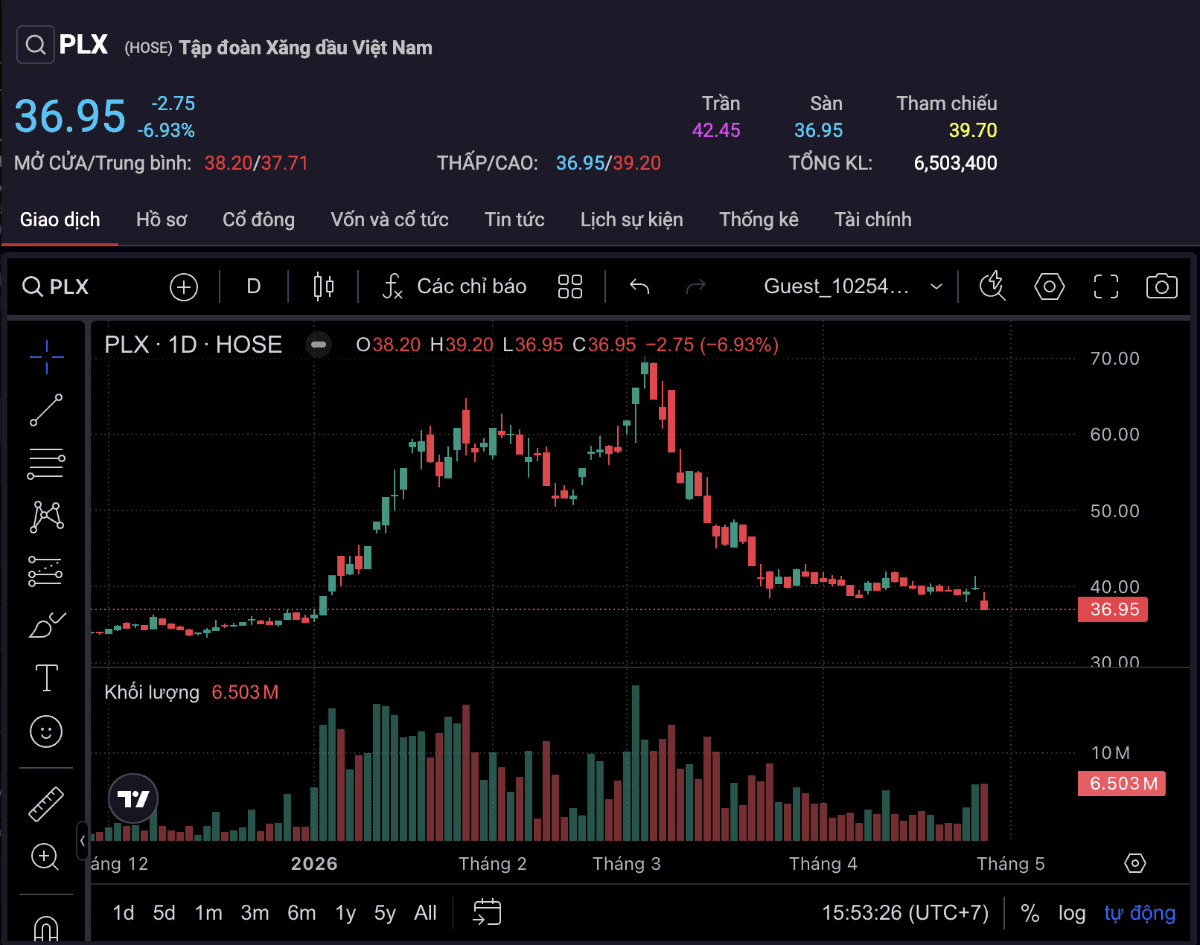
On April 28, PLX shares of Petrolimex fell to the floor price of 36,950 dong per share, with trading volume of nearly 14.4 million shares, among the market’s top volumes. The stock had traded positively for two consecutive sessions after a period of declines.
The decline came after Petrolimex held its 2026 ordinary general meeting of shareholders, where management presented several notable updates.
Petrolimex CEO Luu Van Tuyen said the group could incur a loss of about 1,000 billion VND in Q1 related to gasoline and diesel. The company is working to calculate inventory and cost of goods sold to ensure financial safety if prices continue to fall after March 31.
Tuyen also noted that refined product prices in March rose sharply when supply was plentiful, while demand and prices weakened in April.
According to the CEO, since February 28, the Middle East conflict involving the US, Israel and Iran has reignited volatility in energy markets. He said that while Brent crude prices did not move much, refined fuel prices fluctuated in unusual ways.
Tuyen stated that at times refined gasoline and diesel prices jumped by as much as 50 USD per barrel in a single day. He added that the diesel market premium reached 30–37 USD per barrel, described as unprecedented. Diesel prices in March peaked at 292 USD per barrel, up 329% from February. Including surcharges and freight, the effective cost per barrel rose to 340 USD.
By April, oil prices fell sharply to around 140 USD per barrel, creating difficulties for the company in managing inventory and cost of goods sold.
The CEO said that previously, importing a 40,000-ton batch required about 25–26 million USD. With the recent volatility, the same vessel would cost about 85–87 million USD, adding significant pressure on the group.
In a separate development, Petrolimex currently does not meet the conditions to be a public company under the Securities Law. Board member Tran Tuan Linh said the shareholder structure includes the State holding 75.87%, a strategic shareholder 13.08%, and other retailers 9.41%, which is below the 10% free-float requirement. The group is awaiting detailed guidance from the State Securities Commission.



Premium gym chains are entering a “golden era” that is ending or already in decline, as rising operating costs collide with shifting consumer preferences toward more flexible, community-based ways to exercise. Long-term memberships are shrinking, margins are pressured by higher rents and facility expenses, and competition from smaller, more personalized…