•
•
•
•
•
•
•
•
•
•
•
•
•
•
•
•
•
•
•
•
•
•
•
•
•
•
•
•
•
•
•
•
•


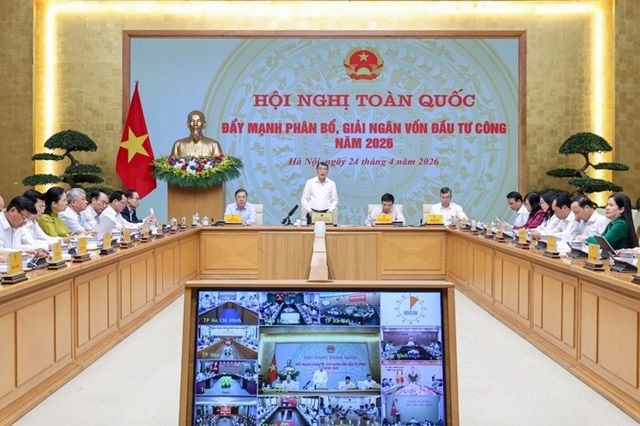
On the morning of April 24, 2026, Prime Minister Le Minh Hung chaired a nationwide conference on accelerating the allocation and disbursement of public investment capital in 2026. He criticized 28 ministries and agencies and 18 localities for disbursement rates below the national average, and called for maintaining discipline in public investment, strengthening the accountability of agency leaders, and ensuring that every investment decision and capital allocation is accounted for and evaluated for effectiveness.
The conference was held online from the Government headquarters to provinces and centrally governed cities, with the Deputy Prime Minister and other senior officials, as well as leaders of ministries and central agencies and chairmen of provincial and municipal People’s Committees.
The meeting reviewed the current situation and examined difficulties and bottlenecks in disbursing public investment capital. It identified both objective and subjective causes, including legal provisions and implementation arrangements, and discussed lessons learned. Participants proposed breakthrough, feasible and effective solutions to remove obstacles and accelerate capital allocation and disbursement, while assigning responsibilities and authorities to resolve bottlenecks with specific deadlines. The outcomes are intended to serve as a basis for inspection, supervision and evaluation of officials under the Politburo’s Directive 366.
According to the Ministry of Finance, the total public investment plan for 2026 assigned by the Prime Minister is over 1 million billion VND, accounting for nearly 35.5% of total state budget expenditures, higher than in 2025 (30.6%).
By the end of Q1 2026, disbursement of public investment capital reached 11% of the plan, up from 9.7% in the same period in 2025. By April 15, disbursement stood at about 127.4 trillion VND, reaching 12.6% of the plan—central budget over 34.8 trillion VND (9.6%) and local budgets over 92.5 trillion VND (14.2%).
In his remarks, the Prime Minister emphasized that public investment is a key political task for 2026 and for the entire term. He described it as a macro-management tool and an important driver for achieving the two-digit growth target, developing infrastructure in a synchronized and modern manner, and opening new development space for the country.
He also cited Conclusion No. 18-KL/TW from the Second Central Committee meeting, which focuses on enhancing the economic and social efficiency of public investment projects and clearly defines responsibilities for ministers, Secretaries, and provincial chairmen.
The Prime Minister stressed that accelerating disbursement must be paired with ensuring project quality and efficient capital use, and with implementing economic-social accounting in capital allocation in line with Conclusion 18. Disbursement results are to be publicly disclosed on the Government portal to support inspection, supervision and evaluation of officials. Ministers and local leaders were urged to scrutinize and direct efforts decisively to promptly resolve bottlenecks.
Regarding 2026 disbursement, the Prime Minister commended seven ministries/agencies and 16 localities for disbursing above the national average. He also criticized 28 ministries/agencies and 18 localities for disbursing below the average. Disbursement performance results will be published on the Government Portal, with monthly updates continuing, and ministers and local leaders were asked to monitor progress and take immediate corrective action.
The Prime Minister noted that public investment remains over-distributed and that evaluation of economic-social efficiency and macro accounting is not sufficiently emphasized. He pointed to weak pre-investment preparation, burdensome procedures, slow allocations, and untimely land clearance. He also cited uncertain material supplies, incomplete coordination, and leadership roles that are not always fully realized. Disbursement is slow, and unused funds persist.
He said the causes include both subjective and objective factors, with the subjective factor considered primary. He cited inconsistent administrative discipline and practice, limited inspection and monitoring, and insufficient accountability. He also referenced limited audit, inspection and follow-up actions, weak inter-agency coordination, and limited capacity among some project owners, project management units (PMUs), and contractors.
Investment preparation bottlenecks include planning, price adjustments, contract acceptance and payment procedures, particularly for ODA projects and digital transformation initiatives. Land clearance delays in some localities and ongoing material supply problems were also highlighted, along with fluctuations in material and labor prices and guidance on price adjustments that is not timely.
Based on recommendations from the conference, the Prime Minister asked ministries and agencies to study and respond in writing by May 10. He added that measures to address difficulties are being pursued vigorously. The meeting also covered discussions on lingering projects, along with Politburo and National Assembly activities in April, and the Government requested provincial Secretaries and ministers to take decisive responsibility for resolving outstanding issues related to lingering projects.
The Prime Minister emphasized that hard, complex tasks can be resolved quickly with strong determination and proactive leadership, and that without such leadership, progress cannot be accelerated.
Localities were directed to ensure adequate material supplies for projects. The Prime Minister also required continued strict implementation of central resolutions and conclusions, and stated that public investment disbursement should be treated as a top political priority in 2026. He instructed that KPI metrics be developed by May 15 and that 100% of the planned public investment capital for 2026 should be disbursed to contribute to two-digit growth.
He further directed authorities to promptly reallocate funds from projects with weak disbursement to those with stronger disbursement needs and to closely monitor implementation at the local level.
The Prime Minister tasked the Ministry of Finance with leading efforts to unify Investment and State Budget laws, revise procurement regulations, and present a concrete plan to the National Assembly. Other ministries were urged to accelerate standard-setting, pricing adjustments and project preparation to support timely project implementation.
He also stressed reforms to administrative procedures in public investment to shorten preparation and execution times and reduce compliance costs for stakeholders involved.
Overall, the Government reiterated that public investment disbursement is a priority for 2026, calling for accountability, rigorous oversight and disciplined execution to achieve the two-digit growth target and upgraded infrastructure.

Premium gym chains are entering a “golden era” that is ending or already in decline, as rising operating costs collide with shifting consumer preferences toward more flexible, community-based ways to exercise. Long-term memberships are shrinking, margins are pressured by higher rents and facility expenses, and competition from smaller, more personalized…