•
•
•
•
•
•
•
•
•
•
•
•
•
•
•
•
•
•
•
•
•
•
•
•
•
•
•
•
•
•
•
•
•


In a new phase of development, the boundaries between state and private roles are gradually shifting as private enterprises take on a more visible part in foundational sectors. The participation of T&T Group in infrastructure is therefore not only an investment decision, but also reflects a broader economic movement: once sufficient capital and capability are accumulated, the question becomes which complex sectors private firms choose to enter—particularly the “hard” parts of the economy that require different approaches and long-term commitment.
Former CIEM Senior Advisor Raymond Mallon said Vietnam has moved from a mainly outsourcing, labor-intensive economy serving foreign groups to a stage where private enterprises with stronger competitive capacity have emerged. The appearance of these firms indicates that the private sector has accumulated enough capability to enter more complex fields such as infrastructure and energy, which demand higher capital, organizational ability, and a long-term vision.
Mallon also noted that, when mobilizing private participation in infrastructure, Vietnam should prioritize sectors that can generate clear and stable revenue streams—an important factor for attracting private firms, especially in areas such as airports and seaports.
The case of T&T Group is presented as a representative example of this trend. Starting from trade and import-export, the company expanded into finance, real estate, and large-scale investment, building the capacity to implement complex projects. Based on that foundation, T&T has become involved in multiple infrastructure areas.
In energy, the group has developed wind and solar projects domestically and implemented the Savan 1 wind project in Laos with a capacity of nearly 500 MW, alongside cross-border transmission. The group is also participating in the Hai Lang LNG Power Center in Quảng Trị and expanding into large-scale energy infrastructure.
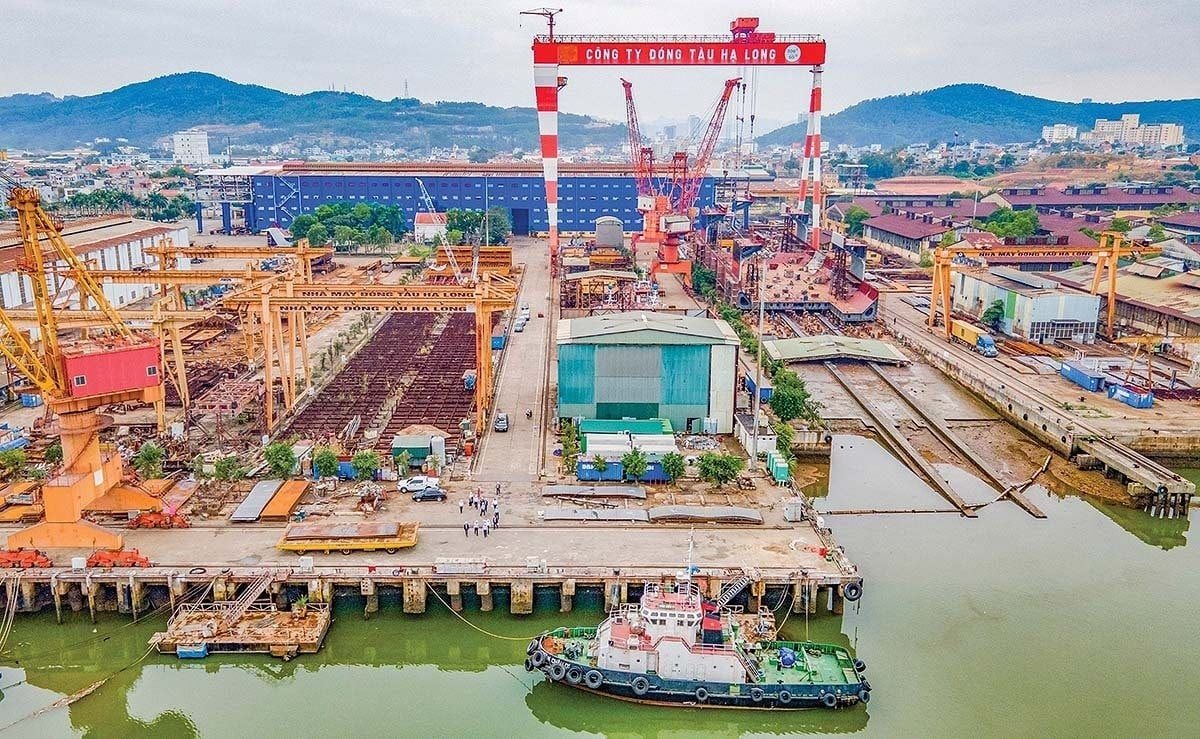
T&T is investing in Quảng Ninh Port and developing the ICD Vĩnh Phúc (SuperPort) multi-modal logistics hub, described as a large-scale logistics project connecting domestic supply chains with the region. The group is also actively pursuing the construction of Quảng Trị Airport, the Bao Lộc – Liên Khương expressway, and proposing and studying smart urban-industrial infrastructure projects in multiple locations.
These activities are characterized as more than single-project investments, showing a gradual move into foundational components of the economy.
The increasing presence of private groups in sectors such as energy, logistics, and transport infrastructure is described as a shift rather than isolated steps. As enterprises participate in shaping the conditions for long-term growth, infrastructure is framed as the “hard part” of the economy—where the challenge is not only scale and long investment cycles, but also the ability to organize and execute projects with many interdependent components.
The article highlights T&T Group’s operating principle of “thorough preparation, fast execution,” emphasizing that the difference is not merely construction speed, but the preparation stage that comes earlier. According to the content, preparation is advanced from the outset—covering technical plans, connectivity issues, and resource organization to execute—while key factors such as the financing plan and output and transmission infrastructure are defined early rather than emerging during implementation.
When these elements are coordinated from the beginning, the implementation phase can enable faster decisions and reduce delays between stages, a problem that often causes infrastructure projects to drag in practice.
The Savan 1 wind project in Laos is cited as a typical example of this approach. Instead of following a traditional sequence of building the plant first and then waiting for transmission, T&T Group is described as developing both components in parallel—simultaneously constructing the plant and investing in the transmission line to bring power to Vietnam.
By locking in output, transmission, and financing from the start, the project is described as operating as a continuous chain, with the entire cycle from construction to commercial operation completed in about 16 months—described as a milestone rarely seen for a cross-border energy project.
The approach is also said to be applied to other initiatives, including progressing the Quảng Trị Airport while researching logistics projects, described as an aviation–space complex linked to infrastructure, with the goal of forming a synchronized operating ecosystem. In this model, components are organized in parallel to reduce idle time across the project lifecycle.
In this context, “fast execution” is presented as more than a scheduling advantage. As projects come online earlier and timelines shorten, financial risks and uncertainty—identified as two bottlenecks that often deter firms from infrastructure—are reduced.
Speaking at a major event early in 2026, Đỗ Quang Hiển, Chairman and CEO of T&T Group, emphasized a message that “businesses are the center, infrastructure is the foundation, institutions are the driver; speak little, do much, deliver real results; clarify people, tasks, responsibilities, outputs, results, and timing.” The article frames this as a mandate for private enterprises, including T&T Group, in the new context.
Đỗ Quang Hiển is described as noting that a private entrepreneur is a co-driver with the State in building development, where large commitments must be realized through projects and tangible value. He also points out that sectors such as energy, ports, and transport infrastructure share common features: large scale, long investment cycles, and heavy dependence on planning—requiring a higher level of commitment than typical businesses.
Unlike sectors with quick capital turnover, infrastructure requires a long-term, multi-year, even multi-decade outlook. As a result, each investment decision is not only a financial efficiency question, but also whether the enterprise can sustain its commitment throughout the project lifecycle.
On a broader level, when private firms enter foundational sectors, their impact extends beyond individual projects. Investments in energy, ports, and transport infrastructure are described as directly affecting how the economy operates—from power supply to the capacity to move goods. This shifts the private sector’s role from market participant to shaping the conditions for growth. When commitments are realized through projects and maintained over time, private sector maturity is presented as strengthening its role in forming foundations for long-term growth.
The growing presence of private groups like T&T Group in the “hard” sectors is described as reflecting a deeper transformation in Vietnam’s economy: private enterprises are not only seeking business opportunities, but are contributing directly to building the operating foundations of the economy. The article frames this as a commitment to make the private sector a major growth engine shaping the economy in the coming decades.
Premium gym chains are entering a “golden era” that is ending or already in decline, as rising operating costs collide with shifting consumer preferences toward more flexible, community-based ways to exercise. Long-term memberships are shrinking, margins are pressured by higher rents and facility expenses, and competition from smaller, more personalized…