•
•
•
•
•
•
•
•
•
•
•
•
•
•
•
•
•
•
•
•
•
•
•
•
•
•
•
•
•
•
•
•
•


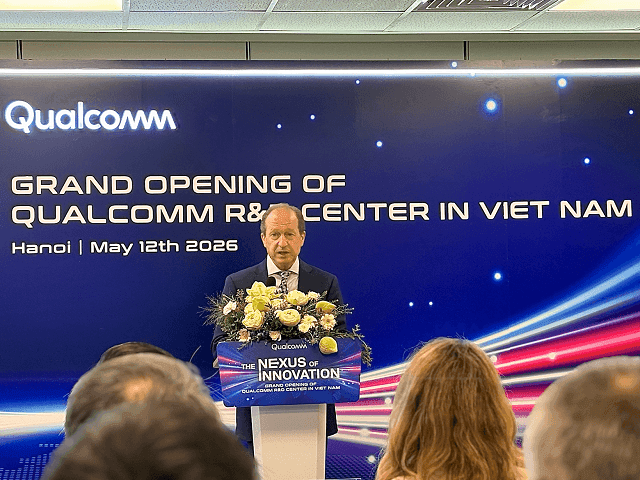
Qualcomm is expanding its research and development (R&D) activities in Vietnam to support chip design and other advanced technology work, as the US semiconductor group accelerates the build-out of its large-scale technical center amid intense competition for skilled tech talent.
The Hanoi AI R&D center, announced last year and now operational, is intended to serve as a platform for a broader technology ecosystem covering artificial intelligence (AI), system-on-chip (SoC) development, Internet of Things (IoT) and automotive technology, the company said.
An Mei Chen, Qualcomm AI Research’s Vice President of Engineering, said the company aims to develop local talent and integrate them into its global teams to address complex technical problems. She added that Qualcomm plans to continue expanding its AI team while building capabilities across semiconductors, software and system-level solutions.
Qualcomm currently employs about 150 engineers in Vietnam and plans to hire more to support the expansion. Chen said it is possible to recruit as many engineers as needed in Vietnam, signaling “positive momentum.”
Qualcomm’s expansion follows its acquisition of Movian AI last year, when it announced the Hanoi center. The company is also expanding its presence in Ho Chi Minh City, aiming to leverage local semiconductor talent as Vietnam promotes the sector through supportive government policies.
Chen said there is substantial semiconductor talent in Ho Chi Minh City and described it as a growth driver in the coming years.
The move comes as Vietnam targets tech and digital sectors to contribute around 30% of GDP growth by 2026. Vietnam recorded 8% economic growth last year, the fastest in Southeast Asia, and is targeting double-digit growth this year.
Qualcomm said its wider footprint in Vietnam includes 5G infrastructure, AI devices, automotive technology and startup support, reflecting its commitment to the country. The company emphasized that talent quality—not only cost advantages—is a key driver of its expansion, adding that top-tier talent is required to develop new technologies and that compensation must match their value.
Thiều Phương Nam, General Director of Qualcomm Vietnam, Cambodia and Laos, said Vietnam is Qualcomm’s top-priority market in Southeast Asia due to the fast-growing tech ecosystem, particularly in design. He said Qualcomm’s business model supports this trend by providing core technology, chipsets and software platforms to domestic firms to help them develop their own products.
Qualcomm has partnered with major Vietnamese companies including Viettel on 5G and AI, VNPT on AI devices and Wi-Fi 7, and VinFast on automotive technology.
In the startup space, Qualcomm’s startup-support program has helped about 50 Vietnamese companies over six years. The company said annual support increased from about 10 to 28.
Nam said expanding the Hanoi R&D center will help Qualcomm support domestic partners faster and more effectively, strengthening Vietnam’s role in the global technology value chain.
However, recruitment remains a major challenge, particularly for roles requiring deep specialization. Chen said the company has many positions to fill but cannot fill them quickly, especially in specialized fields such as AI, new technologies and chip design.
She noted that while Vietnam has built a robust AI talent pool—especially in Hanoi and Ho Chi Minh City—the government aims to train about 50,000 engineers in coming years, but supply still lags demand in high-skill areas such as chip design. This creates a bottleneck for global technology groups expanding operations.
Chen also pointed to a gap between potential and readiness: there is talent, but many candidates are not yet trained to work in a global environment like Qualcomm. She said the company selects promising candidates and assigns mentors to help them grow.
Chen cautioned that expecting immediate access to high-quality talent is unrealistic, but said there is a positive trend as more Vietnamese professionals abroad return home due to attractive career opportunities and a desire to contribute to their homeland.
Premium gym chains are entering a “golden era” that is ending or already in decline, as rising operating costs collide with shifting consumer preferences toward more flexible, community-based ways to exercise. Long-term memberships are shrinking, margins are pressured by higher rents and facility expenses, and competition from smaller, more personalized…