•
•
•
•
•
•
•
•
•
•
•
•
•
•
•
•
•
•
•
•
•
•
•
•
•
•
•
•
•
•
•
•
•


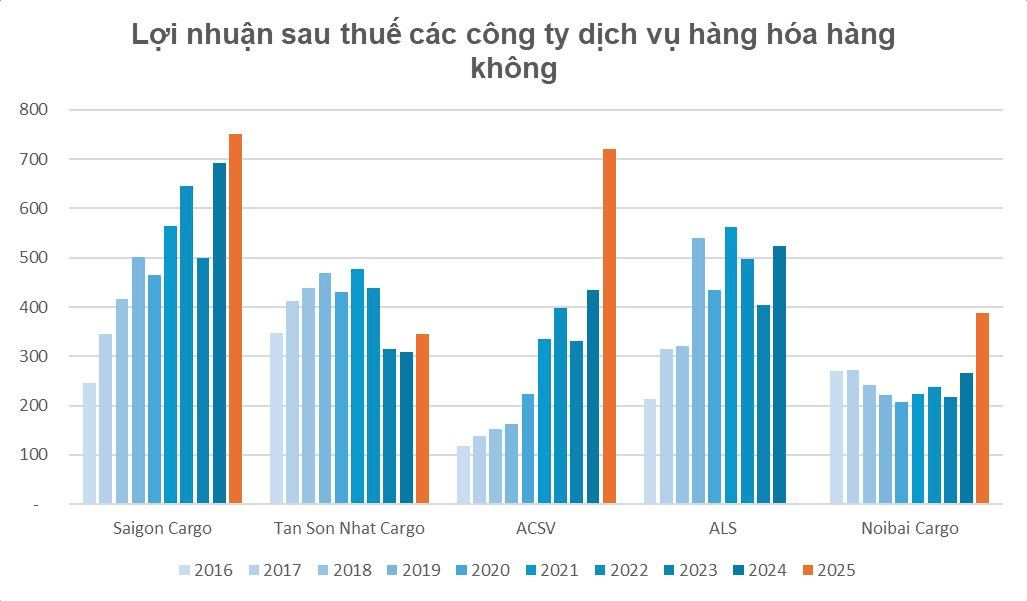
Red Sea tensions and occasional port congestion at certain times have unexpectedly benefited air-cargo service providers, alongside major manufacturers such as Samsung, Apple, and Foxconn launching new products. After years affected by the pandemic and a downturn in global trade, Vietnam's air-cargo and logistics services sector is entering a clearly evident recovery. In 2025, revenues and profits of air-cargo service companies all posted growth year over year. Record at Tan Son Nhat Operating at Tan Son Nhat Airport, Saigon Cargo Service Joint Stock Company (Saigon Cargo, SCSC) posted 2025 net revenue of VND 1,197 billion, up 15% year on year, and after-tax profit of VND 751 billion, up 8.4%. This was a record profit year in the company’s history and the Vietnamese aviation-cargo service company with the largest profit for the year. The company currently manages 14 hectares of land at Tan Son Nhat with usage rights until 2057. Of these, 5 hectares are leased by ACV for aircraft parking and more than 1 hectare is used as a football field. After Long Thanh comes online, ACV is expected to return the leased airfield portion. SCSC has a net margin as high as 62.7%. Also operating at Tan Son Nhat, Tan Son Nhat Cargo Services Joint Stock Company (TCS), a subsidiary 55% owned by Vietnam Airlines, recorded 2025 business results with throughput of 252,300 tons; total revenue of VND 1,005.8 billion and pre-tax profit of VND 432.3 billion, up 12%. Surge at Noi Bai However, the most notable development occurred at Noi Bai. In 2025, both air-cargo service companies at Noi Bai recorded sharply higher profits. Specifically, Vietnam Air Cargo Services Joint Stock Company (ACSV) posted 2025 after-tax profit of VND 721 billion, up 66% year on year. Noi Bai Cargo Services Joint Stock Company (NCTS) reported revenue up 32% and after-tax profit up 45% versus the prior year. Noi Bai has three main cargo terminals: NCTS, ALS and ACSV. ACSV’s total land area for building Noi Bai’s cargo terminal is 60,000 m2, including 44,500 m2 of cargo terminal CT1 and 14,500 m2 of cargo terminal CT2. The current service area for handling cargo is at CT1, covering 20,000 m2, including the terminal and vehicle parking area. ACSV-CT2 is the only expansion project at Noi Bai International Airport; ACSV has been authorized by the Ministry of Transport and the Airports Corporation of Vietnam (ACV) to construct it, with operation planned for Q2 2019. The terminal has a total capacity of 200,000 tons per year, with a two-story structure comprising two separate cargo-handling facilities. Level 1 is planned for international cargo and is fully leased by ACSV to support international cargo operations. Level 2 is used by ACSV to support domestic cargo and to lease part of the space. NCTS says that in 2025, cargo volumes at Noi Bai, as well as those of the service providers, grew strongly versus plan. Domestic cargo volumes, per NCTS, reflect a positive economic recovery; the domestic logistics market is stabilizing and the supply chain is improving, boosting demand for cargo transport, especially for high-value, fast-moving goods. International cargo volumes have grown due to factors including large companies such as Samsung, Apple, and Foxconn operating in Bac Ninh and Thai Nguyen; the launch of new product lines (smartphones, computers, and electronic components) continues to require air transport to meet launch timelines. Notably, tensions in the Red Sea and periodic port congestion have lengthened sea shipments, prompting many goods to shift from sea to air; many suppliers have chosen air transport to meet delivery deadlines. Ngọc Điệp Source: Nhịp sống thị trường; 05/10/2026 22:43 (GMT+7) Original link: https://markettimes.vn/ky-luc-tai-tan-son-nhat-va-cu-dot-bien-tai-noi-bai-dieu-gi-da-xay-ra-117718.html

Premium gym chains are entering a “golden era” that is ending or already in decline, as rising operating costs collide with shifting consumer preferences toward more flexible, community-based ways to exercise. Long-term memberships are shrinking, margins are pressured by higher rents and facility expenses, and competition from smaller, more personalized…