•
•
•
•
•
•
•
•
•
•
•
•
•
•
•
•
•
•
•
•
•
•
•
•
•
•
•
•
•
•
•
•
•


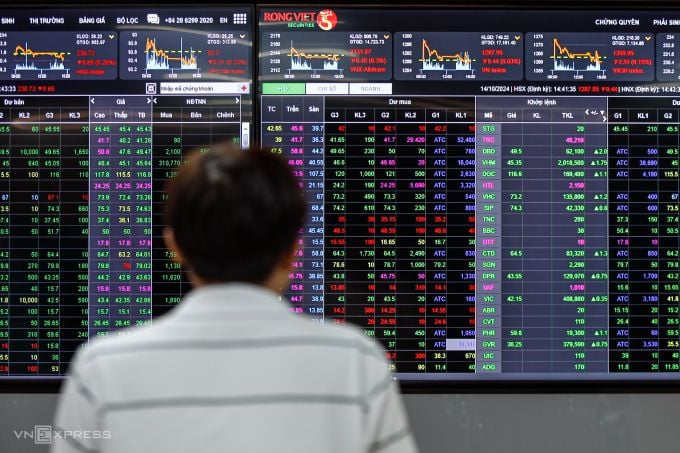
Experts say many investors act on intuition because the brain’s default processes generate biases that can lead to losses. Statistics cited at a conference earlier this year by Dragon Capital’s leadership indicate that more than 90% of investor accounts show no profits or profits under 10%. Profits above 20%—matching or exceeding the market rise of the VN-Index—are described as very rare.
At a weekend seminar, Mr. Nguyen An Huy, co-manager of the Hub Dong Hanh wealth management arm of FIDT, referenced behavioral psychology research associated with Daniel Kahneman. The research highlights that investing behavior is often influenced by systematic irrational patterns, rather than the fully rational “economic man” model.
The framework distinguishes between two modes of thought: System 1 (fast, automatic, intuitive) and System 2 (slow, analytical, logical). In everyday decisions, System 1 typically dominates because it relies on experience and habits. However, this speed can create biases when applied to the complexity of financial markets.
Confirmation bias: Many investors form a view using intuition first, then look for evidence that supports it. This can cause them to ignore information that contradicts their position, and when faced with countervailing data, their initial belief can strengthen further. The result is a loop of wishful thinking followed by unconscious information gathering to reassure the investor.
Hindsight bias: After an event, investors may believe they could have predicted the outcome. The expert noted that phrases such as “the market would have collapsed” or “the signs were obvious” reflect a brain-driven desire for control over randomness, even when the outcome was already reflected in prices.
Ambiguity aversion: The expert described this as the strongest bias among Vietnamese investors. While people may not fear risk when probabilities are known, they can be highly fearful of what is unclear. This can narrow portfolios to familiar channels and close off opportunities when the underlying patterns are not “felt.”
The expert argued that avoiding emotional mistakes before decisions can improve the success rate. He also echoed Charlie Munger’s view: “People try to look smart; I just try not to be stupid, and that’s harder than most people think.”
As a starting point, experts say investors should name the biases and understand how they operate. Scientific research cited in the seminar suggests System 1 cannot be turned off and biases cannot be fully erased; instead, the remedy is to slow down and engage System 2 for analysis.
Practical steps mentioned include reading longer-form content rather than scrolling through short social media posts, which can reinforce fast-thinking habits. Meditation was also recommended as a tool linked to neuroscience to observe one’s own thoughts and create calm before placing trades.
The seminar also emphasized using tools rather than relying on willpower. Investors are advised to set hard principles and delegate execution to a third party or an automated system to reduce the influence of momentary emotions. For example, to counter loss aversion, a predefined filter or a long-term financial plan can serve as an objective yardstick, guiding decisions based on numbers rather than feelings.
While experience can improve skill in many fields, the expert cautioned that in the stock market it can be a double-edged sword. A wrong decision that happens to succeed can create overconfidence and lead to future losses.
To use experience more intelligently, An Huy advised investors to distinguish between outcomes driven by skill and those driven by luck. After a win, investors should pause to analyze what truly produced the result. He also suggested looking at others’ failures—not only winners—to reduce survival bias and build a more realistic view.
“Seeking evidence that disproves your own argument is the most effective way to test the true value of your experience,” he emphasized.
Before each major decision, the expert recommended asking three questions: Which financial objective does this decision serve? Where could my investment argument be wrong? and If this investment falls by 30%, what would I do?
Premium gym chains are entering a “golden era” that is ending or already in decline, as rising operating costs collide with shifting consumer preferences toward more flexible, community-based ways to exercise. Long-term memberships are shrinking, margins are pressured by higher rents and facility expenses, and competition from smaller, more personalized…