•
•
•
•
•
•
•
•
•
•
•
•
•
•
•
•
•
•
•
•
•
•
•
•
•
•
•
•
•
•
•
•
•


Amid risks of a breakdown in Middle East peace talks and new clashes emerging over the weekend, markets feared a weak start to the week. Vietnam’s VN-Index did fall early in the morning session, but market breadth did not show a sustained dominance of declining stocks. Liquidity was light, and prices recovered quickly, suggesting selling pressure remained limited.
The VN-Index reached its intraday low at 9:47, down 17.6 points, or -0.81%. At that time, breadth stood at 132 gainers versus 112 decliners. By 10:20, the index had moved back above the reference level, with breadth improving to 156 gainers versus 104 decliners.
At the close, the VN-Index rose 0.5%, or +9.16 points. Breadth finished with 156 gainers and 133 decliners.
The ability to sustain stock dispersion appeared largely independent of VN-Index movement. This was viewed as a positive signal given the new developments that increased the risk of peace talks breaking down.
The only notable market-moving factor at the open was the rise in crude oil futures following news that Hormuz talks had ended and Iran may not plan to resume negotiations with the United States. Most Asian markets rose, with South Korea’s Kospi the only major index up by more than 1%.
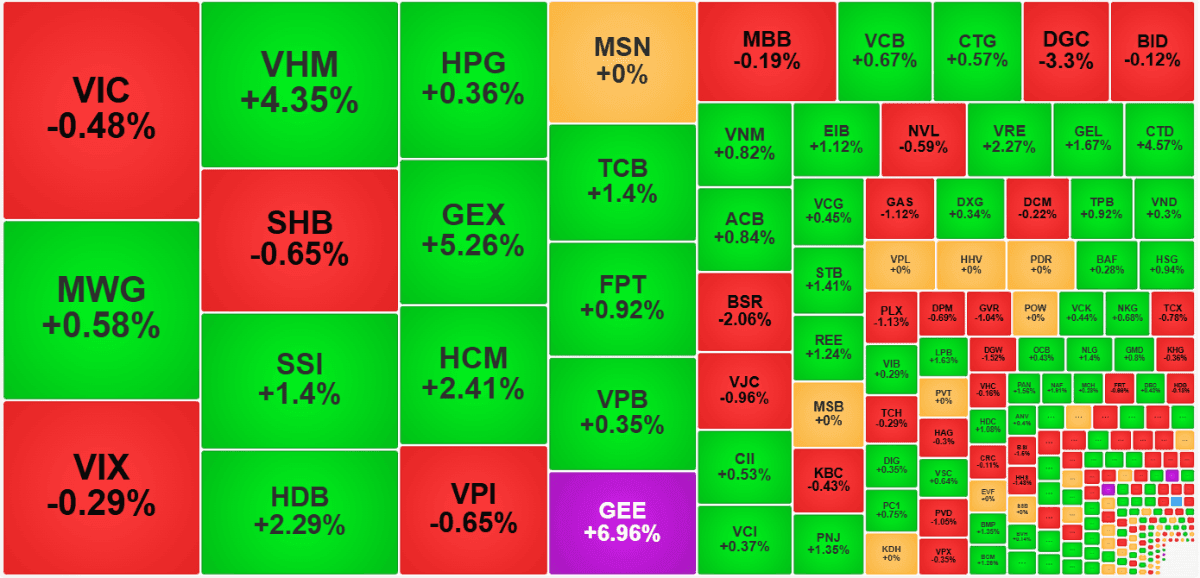
On the Vietnamese market, the morning decline was largely driven by large-cap stocks. VIC fell as much as 5.22%, while VHM dropped 3.1%. Other large caps were also weak earlier, including GAS (-1.37%), GVR (-1.19%), PLX (-1.63%), and VPL (-2.05%).
However, many of these names recovered in the latter half of the session. VHM, for example, swung to a strong gain of +7.68% by the end of trading.
For the VN30 basket, breadth at the weakest point had only 9 green names. The close showed 17 stocks up and 10 down. The VN30-Index rose 0.66%, while liquidity fell 23% versus the previous Friday morning, reinforcing the view that low liquidity combined with persistent red-price pressure was not durable.
Across the HoSE exchange, the potential for price recovery was supported by breadth changes. At the lowest price levels, only 97 stocks fell more than 1% (about 26.8% of traded issues), and the close left 46 stocks higher.
HoSE overall liquidity fell about 12% versus the prior session, consistent with relatively light selling pressure.
Among the 46 worst performers, only 9 posted turnover above 10 billion dong. Examples included:
Even the combined turnover of this weakest cohort accounted for less than 5% of the floor’s matched value.
On the gain side, although advances were not very strong overall, among 156 advancers, 61 stocks rose more than 1%. Within that group, 21 stocks recorded turnover above 10 billion dong.
Blue chips led the rebound, including VHM, SSI, HDB, and TCB. Other notable gainers with substantial liquidity included GEX (+5.26%), HCM (+2.41%), GEE (+6.96%), and EIB (+1.12%).
With dispersion and price recovery maintained despite negative news, the market showed signs of sentiment stability. The backdrop was also consistent with a short-term uptrend that had been strong and had shifted into profit-taking since the end of last week. In that context, a sharp sell-off would be less typical; resilience would be indicated by the opposite outcome.
Foreign investors sold net 326.7 billion dong on HoSE this morning, and no single stock showed unusually active trading. The largest net sellers were VPB (-84.6 billion dong), VIC (-67.9 billion dong), and BSR (-45.6 billion dong).
On the buy side, foreign investors were net buyers of SSI (+75.9 billion dong), MWG (+31.3 billion dong), and VCB (+27 billion dong).

Premium gym chains are entering a “golden era” that is ending or already in decline, as rising operating costs collide with shifting consumer preferences toward more flexible, community-based ways to exercise. Long-term memberships are shrinking, margins are pressured by higher rents and facility expenses, and competition from smaller, more personalized…