•
•
•
•
•
•
•
•
•
•
•
•
•
•
•
•
•
•
•
•
•
•
•
•
•
•
•
•
•
•
•
•
•


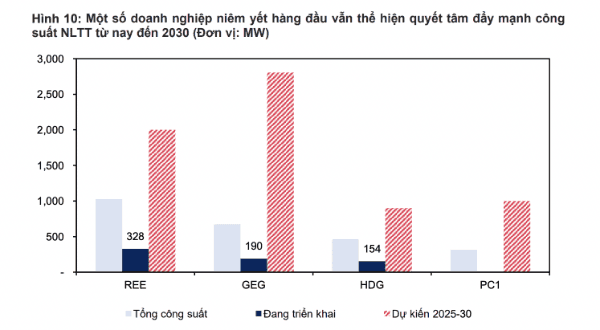
Many alternative electricity supply options are being proposed to offset the risk of power shortages in 2025–2030, with renewable energy highlighted as a key part of the response.
MBS said the electricity sector has faced a major shock since the Middle East conflict, with prices of energy commodities including oil, LNG and thermal coal rising sharply. These commodities make up an increasing share of Vietnam’s energy imports, increasing energy security risks as Vietnam remains committed to double-digit growth through 2030.
On the supply side, coal remains relatively self-sufficient for electricity generation. Natural gas is viewed as more vulnerable because domestic gas production capacity is declining. New gas fields such as Ca Voi Xanh and Bao Vang have not yet defined development plans, and LNG-fired power plants coming online are expected to rely entirely on imported fuel—an elevated risk given that LNG is the electricity source targeted for promotion.
According to the Energy Institute, progress under the 8th Electricity Planning (Quy hoạch Điện 8) issued in 2023–2025 has not met targets and still carries risks of electricity shortages in the coming years. Gas-fired power sources are also facing significant delays.
Among 13 LNG gas-fired power projects totaling 22,400 MW, only 3 projects with 2,824 MW have been constructed (Nhon Trach 3,4 and Hiep Phuoc). MBS noted that if the remaining projects cannot sign Power Purchase Agreements (PPA) and Gas Sales Agreements (GSA) before 2026, it will be difficult to meet the operating schedule before 2030.
For domestic gas projects, Bao Vang and Ca Voi Xanh have unclear reserves and uncertain onshore gas arrival timelines, creating schedule risks. MBS also said recent volatility in oil and gas prices further worsens input risks.
On the policy side, while the mechanism is described as clear, MBS said the pricing framework issued in 2025 and a minimum 65% offtake target are not sufficiently attractive amid rising costs.
Since the beginning of the year, the Ministry of Industry and Trade has been drafting a resolution to remove obstacles to national energy development for 2026–2030. The draft proposes raising the offtake ratio from 65% to 75% for projects commissioned before 2031, but it has not yet been approved.
To address capacity risks in 2025–2030, multiple alternative electricity supply options have been proposed, with renewables emphasized. Decision 363/QD-BCT on adjusting the national energy plan issued in March 2025 preserves many viewpoints consistent with Resolution 70-NQ/TW on energy security and the implementation plan for the adjusted Electricity Plan 8 approved in 2025.
Specifically, to offset risks for base-load power sources such as coal and gas-fired plants, the government is restarting the nuclear program (Ninh Thuan 1&2). It is also increasing flexible sources including Battery Energy Storage Systems (BESS), pumped storage hydropower, biomass, and—particularly—accelerating renewable energy development (wind and solar).
In the long term, LNG gas-fired projects are expected to remain a main focus alongside renewables. MBS said policy shifts are intended to offset power shortages from now to 2030, supported by a clearer policy direction and a gradually open policy framework.
With policy direction and positive signals from reforms, companies on the stock market such as REE, HDG and GEG are restarting project development. MBS said demand for renewables is rising, creating opportunities for contractors including PC1 and TV2.
Within this group, HDG and REE are described as more resilient to interest-rate risk due to strong balance sheets. PC1 faces financial risks linked to high leverage, but has positive growth prospects tied to national energy infrastructure development.
For GEG, although it is highly leveraged, MBS said revenue is entirely electricity-based with good cash flow. It also noted that significant debt repayment in 2025 supports ongoing operations, and that GEG is fairly priced on a price-to-book ratio below the industry average.







Premium gym chains are entering a “golden era” that is ending or already in decline, as rising operating costs collide with shifting consumer preferences toward more flexible, community-based ways to exercise. Long-term memberships are shrinking, margins are pressured by higher rents and facility expenses, and competition from smaller, more personalized…




