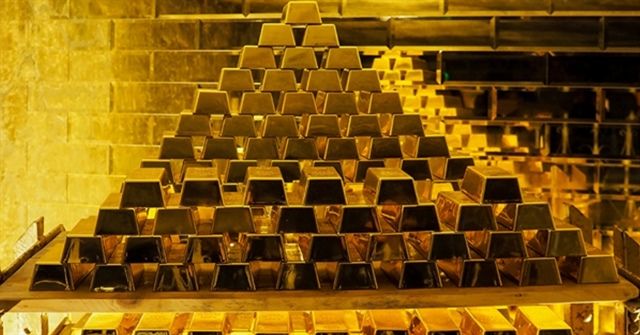
Russia, Turkey and Azerbaijan sold gold in unison as prices remained near elevated levels, prompting investors to ask whether the gold trend is turning or whether central banks are stepping in with emergency liquidity measures. Gold prices have fallen from record highs after a string of central banks unexpectedly became net sellers. Analysts say this does not represent a long-term reversal, but rather an emergency liquidity response.
Russia’s central bank posted a net sale of 21.8 tonnes of gold in Q1 2026, according to The Economic Times. In January alone, it sold 300,000 ounces (about 9.3 tonnes) when gold prices surpassed 5,500 USD per ounce, generating an estimated 1.4–1.68 billion USD.
As of April 1, Russia’s gold reserves stood at 2,304.76 tonnes. The cited reason for the sales was to cover a budget deficit that had reached 61.2 billion USD by the end of March.
Meanwhile, Azerbaijan’s State Oil Fund (SOFAZ), one of the world’s largest gold holders, sold about 22 tonnes of gold in Q1 2026, equivalent to more than 3 billion USD. This was SOFAZ’s first gold sale since it began buying in 2012.
Turkey’s central bank saw its gold reserves fall sharply. In March 2026, Turkey’s gold reserves dropped by about 127 tonnes, from just over 800 tonnes to around 693 tonnes. In the last week of March alone, the decline was 50 tonnes—the largest weekly drop since 2018.
Of the total movement, about 22 tonnes were sold outright and 31 tonnes were used in swap contracts to obtain foreign currency. Some sources estimate total mobilized gold reached up to 8 billion USD.
Poland also drew attention after the chair of the National Bank of Poland, Adam Glapiński, proposed selling part of its 550-tonne reserve to support a defense-spending program valued at about 130 billion USD. However, Finance Minister Andrzej Domański called the plan an “illusion” and said it would not be implemented. Poland remained on the sidelines until an official decision.
Analysts describe the activity as a “lifeline,” arguing that gold is performing its historic role during periods of stress.
Turkey’s sales are linked to a genuine energy crisis. When the Hormuz Strait is blocked, oil prices surge and the lira weakens further by about 15%. Central banks need USD quickly to import energy and to intervene in the currency. They have used gold—described as the most liquid asset—to obtain USD through swap contracts.
Russia’s sales are driven by rising military spending that widens the budget deficit. When oil and gas revenue declines, selling gold is described as the quickest way to raise cash without printing more money and fueling inflation.
Azerbaijan’s sales are attributed to gold rising too fast. In this case, the share of gold in the fund had exceeded the permitted threshold (38% versus 35%), leading SOFAZ to sell to rebalance the portfolio, similar to profit-taking by an investment fund.
“There is no change to the long-term argument. What has changed is that the crisis they prepared for has ultimately occurred. Gold is behaving as designed,” Nicky Shiels, chief strategist at MKS Pamp, said, as cited by Holland Gold.
Despite the selloffs, the wider data points to continued demand. In Q1 2026, central banks globally remained net buyers, accumulating 244 tonnes of gold—up 3% from the same period a year earlier and above the five-year average. China continued buying for the 17th consecutive month. Poland remains focused on a future target of 700 tonnes, while the Czech Republic, Uzbekistan and India continued to buy steadily.
Major financial institutions remain optimistic. Goldman Sachs projects gold at 5,400 USD per ounce by year-end 2026, while Morgan Stanley’s projection is slightly lower at 5,200 USD per ounce. UBS expects the year-average price around 5,000 USD per ounce. JP Morgan is the most optimistic, projecting gold could reach 6,000–6,300 USD per ounce.
“This is the clearest correction in a long period—a signal that central banks are starting to buy more decisively,” said John Reade, chief market strategist at the World Gold Council.
Stefan Gleason, president of Money Metals Exchange, said: “Don’t misinterpret. Some banks selling gold due to a crisis does not imply a trend reversal. Rather, these episodes underscore why gold remains a strategic reserve asset.”
Tử Huy (Source: WGC, The Economic Times, Holland Gold).