•
•
•
•
•
•
•
•
•
•
•
•
•
•
•
•
•
•
•
•
•
•
•
•
•
•
•
•
•
•
•
•
•


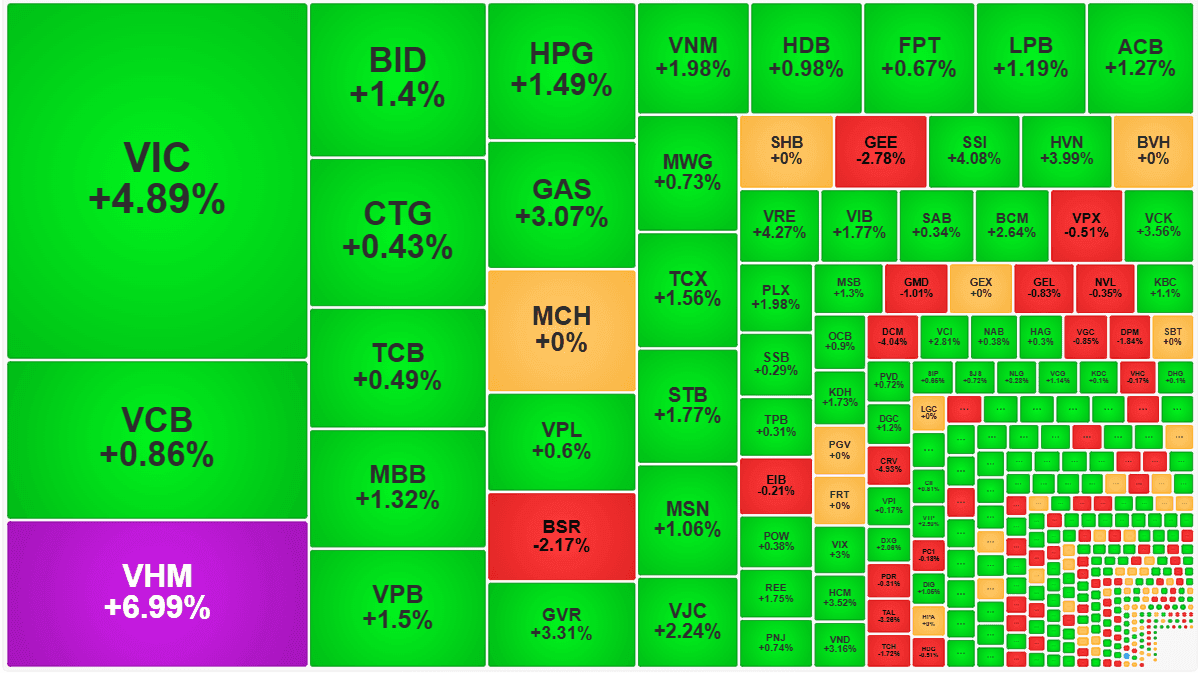
Vietnamese stocks rose strongly in line with positive news on easing tensions and even the possibility of ending the conflict, with the VN-Index jumping to 1,704.9 points, up 1.82% or 30.41 points. The securities and real estate groups led the gains. The intraday gains were somewhat tempered by selling pressure, as the market was strongest at the opening. The VN-Index rose to as high as 40.72 points (+2.43%). Although profit-taking after trades held over 2-3 days appeared, the breadth remained broad, with 217 advancers, 95 decliners, and 102 stocks rising more than 1%, confirming the market’s strength and that money continued to support liquidity. Global markets breathed a sigh of relief as the parties in conflict indicated potential negotiations and a path for withdrawal by the US. Last night the S&P 500 rose 2.91%, Dow Jones up 2.49%. Asian stocks were also strong this morning, with Nikkei 225 up 4.57% and Kospi up 7.81%, among others, supporting the view that the key risk of conflict may have passed. Domestically, securities and real estate stocks rose impressively. The sector had been strong since yesterday, helped not only by reduced geopolitical risk but also by FTSE’s mid-year upgrade expected in a few days. This morning nearly the entire group rose, with the exceptions of VPX, IVS, and VFS in the red. Highly liquid movers included SSI up 4.08% on 736.6 billion, VIX up 3% on 440.7 billion, VCI up 2.81% on 249.8 billion, HCM up 3.52% on 226.3 billion, VND up 3.16% on 139.3 billion, and VCK up 3.56% on 136.8 billion. In real estate, VHM hit the ceiling, VIC rose 4.89%. The VNReal index on HoSE representing real estate rose about 4.4%. Smaller names were also impressive, with VRE up 4.27%, NLG up 3.28%, DXG up 2.06%, KDH up 1.73%, OGC up 1.66%. The missing catalyst this morning was the banking sector. The big banks were rather weak: VCB up 0.86%, CTG up 0.43%, TCB up 0.49%. The smaller banks were stronger but did not contribute as much: BID up 1.4%, MBB up 1.32%, VPB up 1.5%, LPB up 1.19%, ACB up 1.27%, STB up 1.77%. Nevertheless, with the VN30 basket broadly strong, there is enough support to push the VN-Index above 1,700. The basket had no decliners, only SHB was flat. Nineteen VN30 stocks rose by 1% or more, with seven up more than 2%. VN30-Index closed the morning up 1.88%. Expanding to the HoSE board, breadth confirmed the uptrend. 102 stocks rose more than 1%, accounting for 54.6% of total liquidity on the exchange. Active demand remained strong, especially after a prolonged slide as sellers began to exit. Some VN30 stocks faced downward pressure, for example CTG slipped about 1.56% but was still up slightly. MWG fell 1.79% but rose 0.73%. TPB fell 2.39% but rose 0.31%. VPL fell 3.01% but rose 0.6%. Thirteen stocks in the basket were dragged back more than 1% from their intraday highs. In total, about 47.4% of HoSE stocks traded lower by a similar margin. This reflects a growing supply while buyers remained able to absorb prices in the green. Among the 95 stocks in the red, trading activity was not notable as most liquidity was weak or declines were modest. Only six stocks fell more than 1%, including GEE down 2.78% on 304.8 billion; BSR down 2.17% on 248.4 billion; DCM down 4.04% on 151.2 billion; TCH down 1.72% on 90.3 billion; DPM down 1.84% on 83.8 billion; GMD down 1.01% on 35.2 billion. Foreign investors were unexpectedly buyers this morning, with HoSE net buying rising 58% versus yesterday morning. Net buying reached over 71 billion, marking the first net-buy session after 10 days of net selling. The most purchased stocks included HPG +153.9 billion, SSI +88.6 billion, VCI +35.2 billion, GAS +32.5 billion. On the selling side, BSR -77.5 billion, FPT -72.3 billion, DCM -46.1 billion, VIC -35.7 billion.





Premium gym chains are entering a “golden era” that is ending or already in decline, as rising operating costs collide with shifting consumer preferences toward more flexible, community-based ways to exercise. Long-term memberships are shrinking, margins are pressured by higher rents and facility expenses, and competition from smaller, more personalized…