•
•
•
•
•
•
•
•
•
•
•
•
•
•
•
•
•
•
•
•
•
•
•
•
•
•
•
•
•
•
•
•
•


Saigon-Hanoi Securities Joint Stock Company (SHS) held its 2026 Annual General Meeting of Shareholders (AGM) on the afternoon of April 17, 2026, approving key items related to its business plan, capital increase proposals, and strategic direction for the coming period.
By 1:40 PM, the total number of attending shareholders and proxies was 2,843, representing 469.5 million voting shares, equivalent to 52.20% of total voting shares.
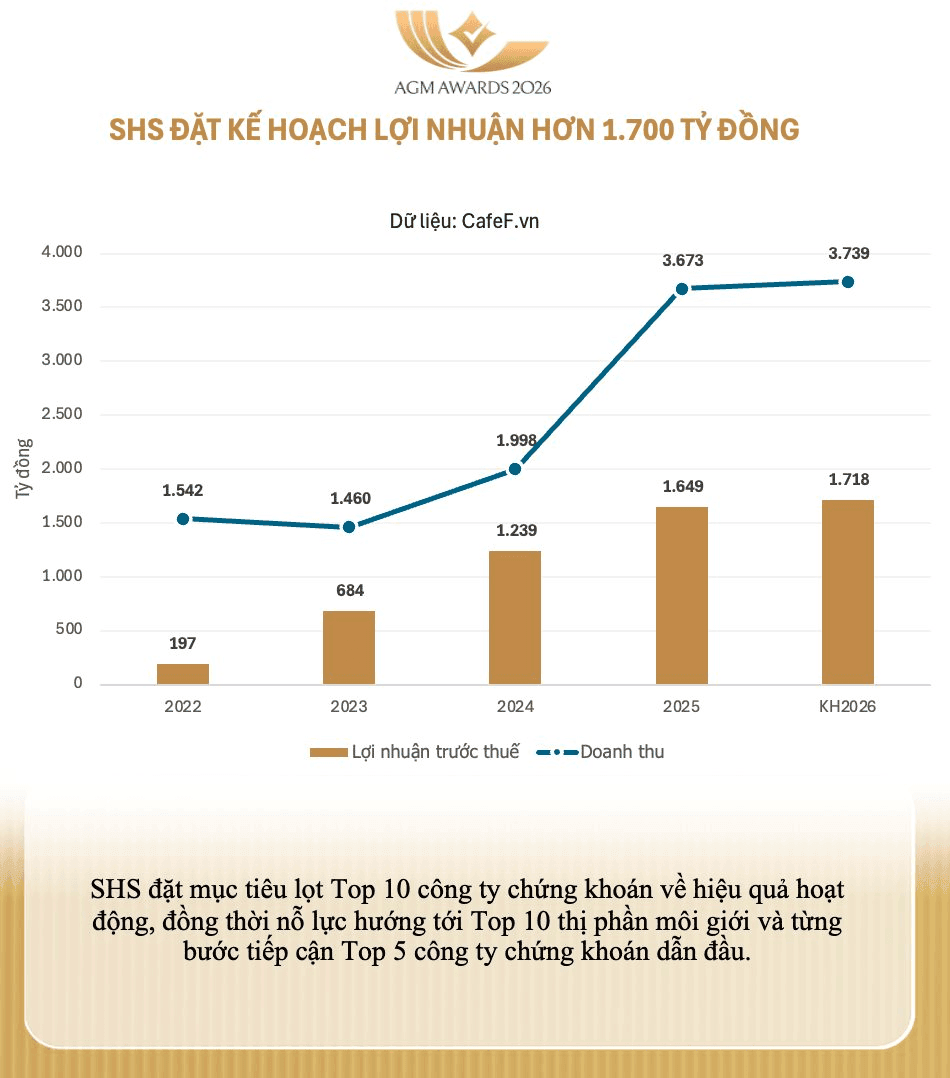
In 2025, SHS reported revenue of VND 3,673 billion and pre-tax profit of VND 1,649 billion, exceeding its plan by about 60% and more than 20%, respectively.
For 2026, SHS set targets of revenue at VND 3,739 billion and pre-tax profit at VND 1,718 billion. The company said the plan reflects caution toward geopolitical risks, input costs, interest rates, and inflation.
SHS said it aims to be in the Top 5 by market share by 2030, increase capital to over VND 10,000 billion, and restructure its growth drivers toward a sustainable, more predictable profitability base. The company also targets Top 10 positions in operational efficiency and market share, while gradually approaching the leading Top 5 brokerage firms.
In the long term, SHS aims to become a leading investment financial group in Vietnam, building an ecosystem of products and services for both individual and institutional clients.
Nguyen Duy Linh, SHS CEO, said: “This is an ambitious goal in a relatively competitive environment. Yet ambition is the motivation for us to push forward. We target reclaiming leading position in brokerage for both individual and institutional clients, through segmenting clients, building a fitting product suite, and enhancing specialized advisory capabilities.”
For its investment banking (IB) segment, SHS targets top customers such as enterprises seeking capital raising, financial restructuring, listing, issuance, or M&A.
The company cited several growth drivers, including:
SHS said it has built a deep IB team and completed key components including ECM (equity capital markets), DCM (debt capital markets), and M&A, leveraging its ecosystem to connect companies, investors, and distribution channels to improve implementation efficiency and revenue generation.
The AGM approved plans to increase charter capital from about VND 8,994 billion to more than VND 10,000 billion in 2026 through three methods, totaling an estimated 107 million shares.
SHS said the funding will prioritize margin lending, investments, and technology infrastructure upgrades to enhance competitiveness and scale.
The AGM also approved SHS’s 2025 profit distribution plan, including a 5% cash dividend and a 5% stock bonus.
In addition, the meeting approved the removal of board member Nguyen Chi Thanh from 17/4 and appointed Nguyen Duy Linh, SHS CEO, as a board member.
During the AGM, shareholders asked whether SHS’s 2026 plan would result in near-flat revenue and profit in a cautious market. SHS responded that the plan is designed as a cautious, transitional approach, with emphasis on expanding advisory and asset-management capabilities.
The CEO said SHS is evolving from a traditional brokerage into a partner in clients’ financial journeys, with an integrated model covering brokerage, asset management, investments, and other services. He also referenced SHS’s existing scale, including assets of around VND 23,000 billion and equity of around VND 13,000 billion.
SHS also discussed how it plans to grow market share without pursuing a broad “zero fee” race, instead applying fee policies aligned with client segments and focusing on service quality and brand strength.
Overall, the AGM set the stage for a multi-year restructuring aimed at driving sustainable profitability, scaling operations, and building an integrated financial-services ecosystem aligned with Vietnam’s ongoing capital market development.







Premium gym chains are entering a “golden era” that is ending or already in decline, as rising operating costs collide with shifting consumer preferences toward more flexible, community-based ways to exercise. Long-term memberships are shrinking, margins are pressured by higher rents and facility expenses, and competition from smaller, more personalized…




