•
•
•
•
•
•
•
•
•
•
•
•
•
•
•
•
•
•
•
•
•
•
•
•
•
•
•
•
•
•
•
•
•


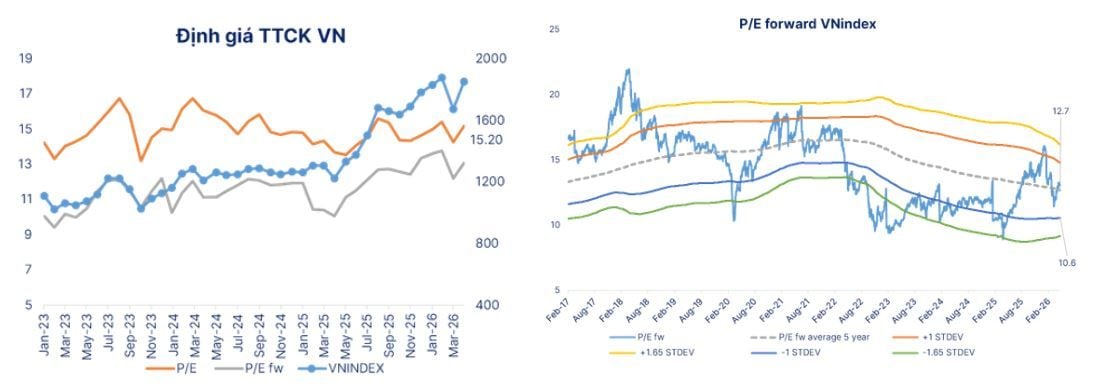
SHS Research: The market is in a reasonably valued zone for accumulation and value investing. According to SHS Research, if you strip out the Vingroup group, the remaining market capitalization is around $320 billion, with a price-earnings ratio of about 12.96 and a price-to-book ratio of about 1.8. This is a relatively reasonable valuation zone for the rest of the market as business results continue to grow. Investors can assess and consider opportunities for accumulation and value investing. In the newly published May strategy report, SHS Research's Research Department issued its market outlook for May. The market ended April during which companies held annual general meetings, announced 2026 business plans and Q1 2026 results. This is the stage when investors reevaluate valuations and growth prospects. After this stage the market will enter May, with macroeconomic data in April providing information on inflation, imports/exports, PMI, reflecting impacts on firms and the economy after the Middle East conflict. In May 2026, the market will be influenced by risk factors and uncertainty: (1) geopolitical tensions globally persist and shift to a new phase. (2) Credit growth slows. (3) An energy crisis, inflation, and rising costs begin to affect firms and the economy. (4) Margin loan leverage remains high. On the positive side, there are also many favorable factors: (1) Vietnam's economy continues to grow strongly. (2) Q1 2026 corporate results show positive growth. (3) Market capitalization size, excluding Vingroup, is reasonably valued after a period of decline and considering long-term growth potential. In April 2026, the VN-Index recovered due to leading stocks and moved back to around 1,900 points. By early May 2026, excluding Vingroup, the remaining market capitalization is about $320 billion (unchanged from end-March 2026), with a P/E around 12.96 and a P/B around 1.8. This is a relatively reasonable valuation zone for the rest of the market as earnings continue to grow. Investors can assess and consider accumulation and value investing opportunities. Source: SHS

Premium gym chains are entering a “golden era” that is ending or already in decline, as rising operating costs collide with shifting consumer preferences toward more flexible, community-based ways to exercise. Long-term memberships are shrinking, margins are pressured by higher rents and facility expenses, and competition from smaller, more personalized…