•
•
•
•
•
•
•
•
•
•
•
•
•
•
•
•
•
•
•
•
•
•
•
•
•
•
•
•
•
•
•
•
•


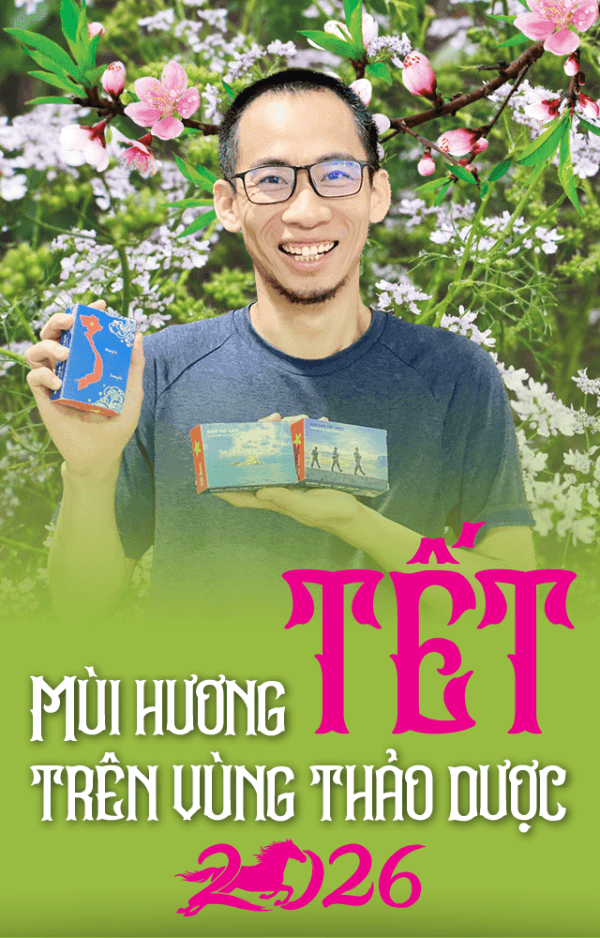
On a narrow road leading to the Sinh Dược Cooperative (Gia Viễn, Ninh Bình), bamboo groves shade the path while the scents of traditional herbs—such as bồ kết, dried roots, and fragrant rau—drift from sun-drying yards. Cooperative members harvest herbs, weave pictures, arrange bodhi leaves, and work on production. Internal bulletins periodically share family stories, such as a “one cow” household welcoming a new member, fields beginning to bear fruit, or Tet-scent soap rolling off the line.
“Hello Duc, this Mã Đáo Thành Công soap is so beautiful; when I pick it up, I can already smell Tet…”
For the cooperative, Tet herbal bathing is more than a seasonal ritual. It is linked to cleansing for the new year and the values of traditional medicine. In modern life, however, the habit has faded due to the inconvenience of preparation, storage, and transport. With existing strengths in infrastructure, machinery, and production equipment, Sinh Dược has incorporated the mùi già herb into soap and bathing oil.
Sinh Dược selects a Tet fragrance theme each year, connecting it to the zodiac and traditional culture. The Year of the Tiger is themed “Ông Ba Mươi,” the Year of the Snake is “Rồng rắn lên mây…,” and 2026 is “Mã đáo thành công!”—a familiar blessing signifying luck, smooth progress, and achievement.
A graduate of the Chemistry Department at Hanoi University of Science and Technology, Duc returned to his hometown with his wife to start a business. While “leaving the city for the countryside” may sound romantic, he describes it as a strategic decision: the “center” is where conditions are best for professional development.
He said his hometown offered abundant local materials, generations of accumulated herb knowledge, a community ready to accompany the project, and—most importantly—a gap between potential and actual economic value. Staying in an urban environment, he believed, would have meant remaining a small player in a crowded ecosystem. Returning home, by contrast, enabled him to act as a connector, organizer, and transformer—turning resources into concrete products, livelihoods, and a catalyst for community development.
Sinh Dược operates as a cooperative rather than a joint-stock company. Duc said the cooperative model fits rural contexts and the organization’s development philosophy. The assets Sinh Dược leverages—from herbal knowledge to local resources—do not belong to any single individual; they belong to the community. When assets are community-owned, the organization should also be community-based.
Under this structure, people can be workers, owners, and beneficiaries of the value they create. He believes this supports longer-lasting and more sustainable engagement than many other business models.
Beyond more than 20 existing products—including bath soaps, foot soak salts, dishwashing liquids, bath oils, and massage essential oils—Sinh Dược is also developing experiential tourism.
The cooperative diversifies across segments, from mass-market lines to products for hotels and resorts, and up to mid- and high-end ranges. Across segments, its guiding principle is to infuse the highest possible degree of local culture into each product. Duc described the HTX as aiming to become an “open museum,” where culture can be touched, felt, and carried away in each visitor’s own way.
Sinh Dược aims to welcome more than 10,000 visitors per year, contributing to the province’s tourism revenue. To attract travelers seeking deeper cultural immersion, it invites international friends to engage with heritage—from the thousand-year tradition of regional medicine to hands-on crafting of herbal soaps and health care using ancient remedies—so that stories, landscapes, and scents become memorable and meaningful.
Sinh Dược was established in 2014. Duc said the early journey began with exploring local materials, talking with residents, collecting traditional medicinal recipes, and testing sample product sets. He described a process of learning, adjusting, and refining.
In the early days, some products used herbal ingredients that were relatively new to consumers accustomed to imported natural products or industrial products at competitive prices. Over time, he said product quality and customer experience—supported by appropriate marketing—helped Sinh Dược gain wider recognition.
He reported that the HTX now has stable procurement partners and that revenues have grown year after year. Total revenue from products and services (including HTX trading and representation) reaches about 40 billion VND per year, creating jobs for around 70 local workers.
Over the past decade, many cooperatives in Ninh Bình that grow medicinal plants have developed effectively. Duc said Sinh Dược’s greatest advantage is a cohesive, dedicated membership eager to learn and unafraid of change. This attitude helps the HTX adopt new technologies, refine processes, and raise product quality quickly.
He also emphasized that herbal medicines passed down through generations can be developed into consumer products that meet modern demand. Product presentation and storytelling, he said, must align with local culture. Sinh Dược embeds QR codes so customers can access product narratives, animations, messages, and cultural values the cooperative wants to spread.
Duc said Sinh Dược remains relatively small and that what has been achieved so far is not “enormous,” but the cooperative set a crucial goal from the start: to create a stable, humane, and sustainable working environment for villagers and local laborers.
The HTX focuses on ensuring stable incomes, appropriate welfare, and limiting overtime to give workers more time for rest, family, and community activities. All members are local people who work alongside each other, and he said they are happy to have stable jobs and good incomes in their hometown.
On advice for young people pursuing startup dreams, Duc said the most important step is to know what you truly want to do, then push yourself and persevere. He described entrepreneurship as a long journey rather than a short path, requiring resilience, self-learning, and acceptance of failure as a natural part.
He advised young founders to pursue passion with a long-term plan and not to fear drawing insights from local customs to create distinctive products and define their own “brand.”
Duc said he believes the cooperative economy can be a major driver of rural modernization. He argued that rural modernization should not be measured only by poverty, but also across economic, cultural, happiness, and quality-of-life dimensions. More importantly, he said rural modernization must preserve local identity so that even a single story, scene, or scent can create lasting value.
The full content of the article was published in Tạp chí Kinh tế Việt Nam, issue 6-2026, released on February 9, 2026.








Premium gym chains are entering a “golden era” that is ending or already in decline, as rising operating costs collide with shifting consumer preferences toward more flexible, community-based ways to exercise. Long-term memberships are shrinking, margins are pressured by higher rents and facility expenses, and competition from smaller, more personalized…


