•
•
•
•
•
•
•
•
•
•
•
•
•
•
•
•
•
•
•
•
•
•
•
•
•
•
•
•
•
•
•
•
•


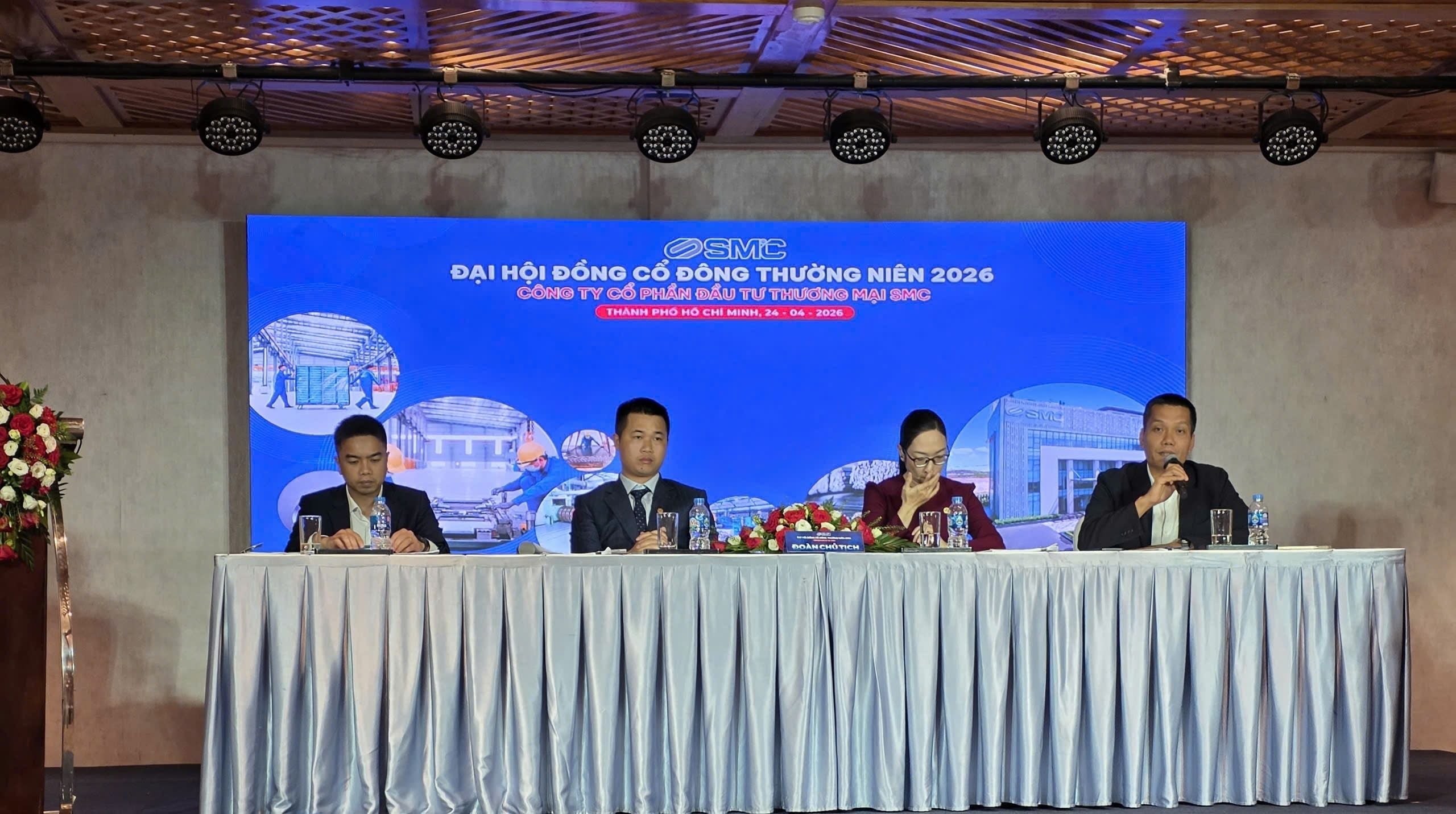
SMC Joint Stock Company for Investment and Trade (SMC) held its 2026 annual general meeting of shareholders on the morning of 24 April 2026 in Ho Chi Minh City, marking a milestone in the company’s transition into a comprehensive restructuring cycle for 2026-2031 after a turbulent period marked by bad debts and market volatility.
SMC said 2025 was a challenging year with mixed financial results. Net revenue declined by more than 21% to 7,010 billion dong, while net profit after tax reached 197.5 billion dong.
The company noted that the recovery was not driven by core business efficiency, as annual gross profit was only around 1.36 billion dong amid frozen steel and real estate markets.
Instead, profitability was supported by aggressive financial actions. SMC reported other income of 349.64 billion dong from liquidating fixed assets to recover capital and improve cash flow. The result was further reinforced by a reversal of provisions totaling more than 164 billion dong from receivables from the Novaland group.
For 2026, SMC outlined a cautious approach centered on strengthening its financial foundation and implementing restructuring rather than pursuing only top-line growth. The company set a target production volume of 420,000 tons and expected revenue of 7,000 billion dong.
SMC plans to move away from a traditional steel trading model toward a “Trading + Processing + Value-add” approach.
A key element of the revival is the Coil Center, where SMC leverages its Tier-1 supplier position to Samsung to penetrate deeper into the supply chains of foreign-owned enterprises. To optimize operations, SMC plans to liquidate an additional 2-3 underperforming assets and accelerate debt handling, with a focus on completing the handover of collateral assets from the Novaland group in 2026-2027.
SMC forecast net profit after tax for 2026 at 30 billion dong, attributing value primarily to core activities.
On capital management, the company maintained a zero-dividend policy to conserve resources. It aims to reduce debt-to-equity from 3.4x to 2x and bank debt-to-equity from 2x to 1x.
Despite improvements, SMC continues to face liquidity challenges. In its 2025 financial statements, the auditor flagged liquidity risk: consolidated operating cash flow was negative by 75.4 billion dong, and short-term liabilities exceeded current assets by 687.8 billion dong.
To address this pressure, the board proposed a total capital raise of over 368 billion dong through three strategic issuances.
The highlight is an offering of more than 36.8 million shares to existing shareholders at 10,000 dong per share, expected to raise about 368 billion dong. Of this amount, 168 billion dong is allocated to repay bank debt, and 200 billion dong is allocated to suppliers to secure supply.
Chairman Pham Hoang Anh said: “The form is to pay suppliers 200 billion, but after I negotiated with suppliers, they will re-extend the credit limit of 200 billion to support business operations… basically it is to support operations rather than paying off anyone.”
In parallel, the AGM approved a private placement to raise 150 billion dong to strengthen working capital for two subsidiaries: increasing equity by 50 billion dong for SMC Phu My Steel Processing Co. and 100 billion dong for SMC Phu My Precision Mechanics Co. to restore and expand the Coil Center core manufacturing.
The remaining 36.8 billion dong from the ESOP program will be used to recognize current staff. The company also stated that new leadership, including Chairman Pham Hoang Anh and CEO Nguyen Quang Trung, will not participate in the ESOP.
Chairman Pham Hoang Anh added: “If macro conditions worsen, we will inject more capital… but if macro conditions do not deteriorate, there is a 90% chance the private placement will not be carried out.”
SMC said the synchronized execution of the capital-raising measures is expected to unlock collateral assets, reduce financing costs (which totaled 148 billion dong in 2025), and directly address the short-term asset liquidity gap flagged by auditors. The company views this as a key driver to end the “defensive” phase, strengthen internal financial capacity, and prepare for a growth trajectory toward sustainable development.
The AGM also approved the election of the board of directors and the Supervisory Board for 2026-2031. The elected directors are Pham Hoang Anh, Kishimoto Hideki, Le Quang Hai, Nguyen Ngoc Dang Khoa, and Hoang Trung Dung. Supervisory Board members are Thái Thị Vân Anh, Dang Thi Thu Trang, and Le Thi Thanh Huyen.
Source: TV
Premium gym chains are entering a “golden era” that is ending or already in decline, as rising operating costs collide with shifting consumer preferences toward more flexible, community-based ways to exercise. Long-term memberships are shrinking, margins are pressured by higher rents and facility expenses, and competition from smaller, more personalized…