•
•
•
•
•
•
•
•
•
•
•
•
•
•
•
•
•
•
•
•
•
•
•
•
•
•
•
•
•
•
•
•
•


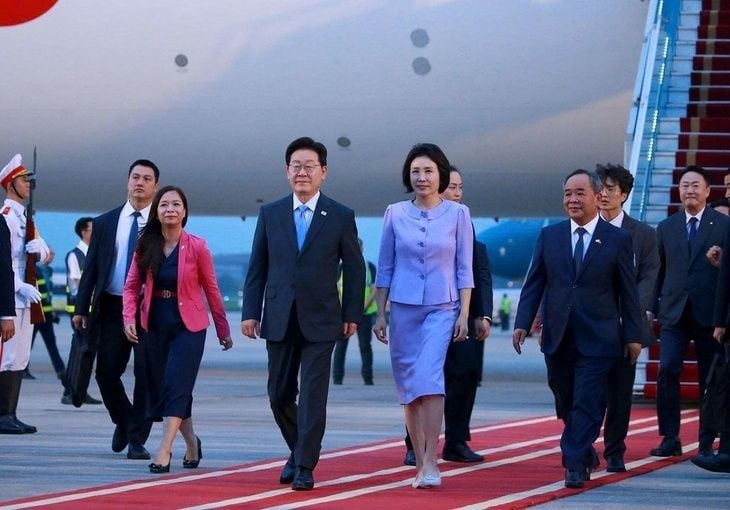
Evening of April 21, 2026, South Korea’s President Lee Jae Myung and his wife arrived in Hanoi to begin a state visit to Vietnam from April 21 to 24, 2026, at the invitation of General Secretary and State President Tô Lâm and his wife. On arrival at Noi Bai International Airport, the delegation was greeted by Lê Khánh Hải, Nguyễn Minh Vũ, Hanoi’s Chairman of the People’s Committee Vu Đại Thắng, and Vietnamese Ambassador to Korea Vu Ho.
Speaking to the press about the visit’s main contents and the long-term orientation of Vietnam–Korea relations, Ambassador Vu Ho said the trip goes beyond a routine bilateral visit and can be regarded as a strategic anchor for a new phase in the two countries’ relationship. He said the core content is to transform the scale of cooperation into deeper, higher-quality collaboration, with both sides shaping a long-term strategic vision for the bilateral relationship toward milestones 2030–2045, in line with each country’s development strategy amid a global economy undergoing rapid restructuring.
One key focus of the visit is to restructure the drivers of economic cooperation. The two countries aim to shift from a model reliant on capital and labor to one based on technology, innovation, and digital transformation. Priority sectors include semiconductors, artificial intelligence, and high-tech industries.
Ambassador Vu Ho said this approach is intended to enable Vietnam to participate more deeply in high value-added stages of the global value chain.
Ambassador Vu Ho also identified strengthening the social foundation of the bilateral relationship as another important objective. He cited the more than 350,000 Vietnamese living, studying, and working in Korea as a key bridge supporting the sustainability and depth of relations.
Looking ahead at Vietnam–Korea cooperation prospects, the ambassador said Korea is currently Vietnam’s largest foreign investor, with cumulative registered capital of about 85–90 billion USD. He also said Korea is among Vietnam’s leading trading partners, with two-way trade in 2025 estimated at 90–95 billion USD.
Ambassador Vu Ho said the goal of raising bilateral trade to 150 billion USD by 2030 is feasible if the two sides move from “economic cooperation” to “structural economic linkage.”
He said the focus would include increasing domestic content through developing Vietnam’s supporting industries; expanding exports of technology, processed agricultural products, and services; and enhancing connectivity among small and medium enterprises, described as an area with ample room for cooperation.
Beyond bilateral cooperation, the ambassador said there is room for coordination at multilateral forums. He cited Vietnam hosting APEC 2027 in Phu Quoc as an opportunity to bolster cooperation with Korea—after Korea successfully hosted APEC 2025—covering areas such as sharing organizational experience and promoting digital economy initiatives, green growth, and sustainable supply chains.





Premium gym chains are entering a “golden era” that is ending or already in decline, as rising operating costs collide with shifting consumer preferences toward more flexible, community-based ways to exercise. Long-term memberships are shrinking, margins are pressured by higher rents and facility expenses, and competition from smaller, more personalized…