•
•
•
•
•
•
•
•
•
•
•
•
•
•
•
•
•
•
•
•
•
•
•
•
•
•
•
•
•
•
•
•
•



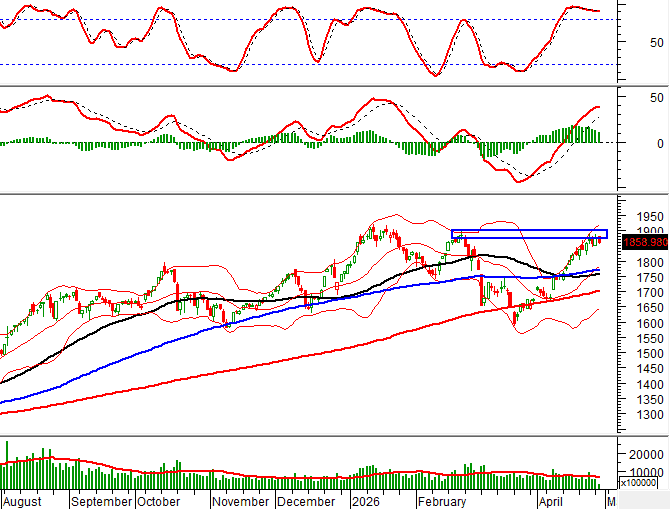
“Sell in May” is a famous stock market investment strategy that advises investors to sell stocks at the beginning of May and temporarily step away from the market. The strategy is based on the historical notion that markets tend to perform poorly, with weak growth or declines during the period from May. As the Vietnamese stock market was approaching the end of April, Mr. Nguyen Duy Hung, Chairman of SSI, noted that 'Sell in May' is a familiar saying, but the market does not operate on a calendar; it operates on expectations. “Understand what you are buying and why holding is more important than any convention. The rewards always belong to those who clearly understand what they are doing,” Hung said. Echoing the view on the 'Sell in May' effect, Mr. Luong Duy Phuoc, Director of Market Research at Kafi, also argued that this should not be treated as a rigid rule. May is often the period when quarterly earnings are announced and the annual general meeting occurs, which gradually reduces information support. When there is little catalyst and the index has risen thanks to a few large-cap stocks, short-term profit-taking pressure is normal. Therefore, May could be a period to test the resilience of money flow. If liquidity remains healthy and funds spread to other sectors, risk is not too large. In addition, the overall market valuation is not excessively high at present, except for a few blue-chip stocks, so a deep decline is not likely. On the other hand, experts also suggest there is potential for short-term volatility. Although the VN-Index has risen sharply, the gains have not spread evenly. The main contribution has come from the Vingroup stock group, while many other stocks remain in consolidation, flat, or range-bound. Thus, Kafi's analysts argue that if a correction occurs, upward pressure may be more evident in the index, particularly when large-cap groups stall. However, for the rest of the market, since it has not surged, the risk of a deep drop is not overly concerning. This period is characterized more by sector dispersion than by a broad-based decline.





Premium gym chains are entering a “golden era” that is ending or already in decline, as rising operating costs collide with shifting consumer preferences toward more flexible, community-based ways to exercise. Long-term memberships are shrinking, margins are pressured by higher rents and facility expenses, and competition from smaller, more personalized…