•
•
•
•
•
•
•
•
•
•
•
•
•
•
•
•
•
•
•
•
•
•
•
•
•
•
•
•
•
•
•
•
•

Total pretax profit of the securities sector in Q1 2026 is estimated at around 9.7 trillion VND, up 26% year-on-year from 2025. The figure suggests the sector’s income scale remains high versus the early-2025 period, although the short-term growth momentum appears to be waning.
Compared with Q4 2025, Q1 2026 pretax profit declined by about 19%, marking the second consecutive quarter of profit contraction for the entire sector. After reaching a record high of 19,000 billion VND in Q3 2025, the profit trend indicates a cooling of the overall market following the rally.
In Q1 2026, several large brokerage firms continued to post high profits and retained their leading positions. Firms with large scale and high market share, including SSI, VPS, and TCBS, remained among the profitability leaders.
Compared with Q1 2025, most of these firms recorded positive growth, supported by improvements in margin lending, proprietary trading, and investment banking services.
Among mid-sized brokers, VNDirect showed a rebound, posting pretax profit of 681 billion VND in Q1 2026, up 81% from Q4 2025 and up 42% year-on-year.
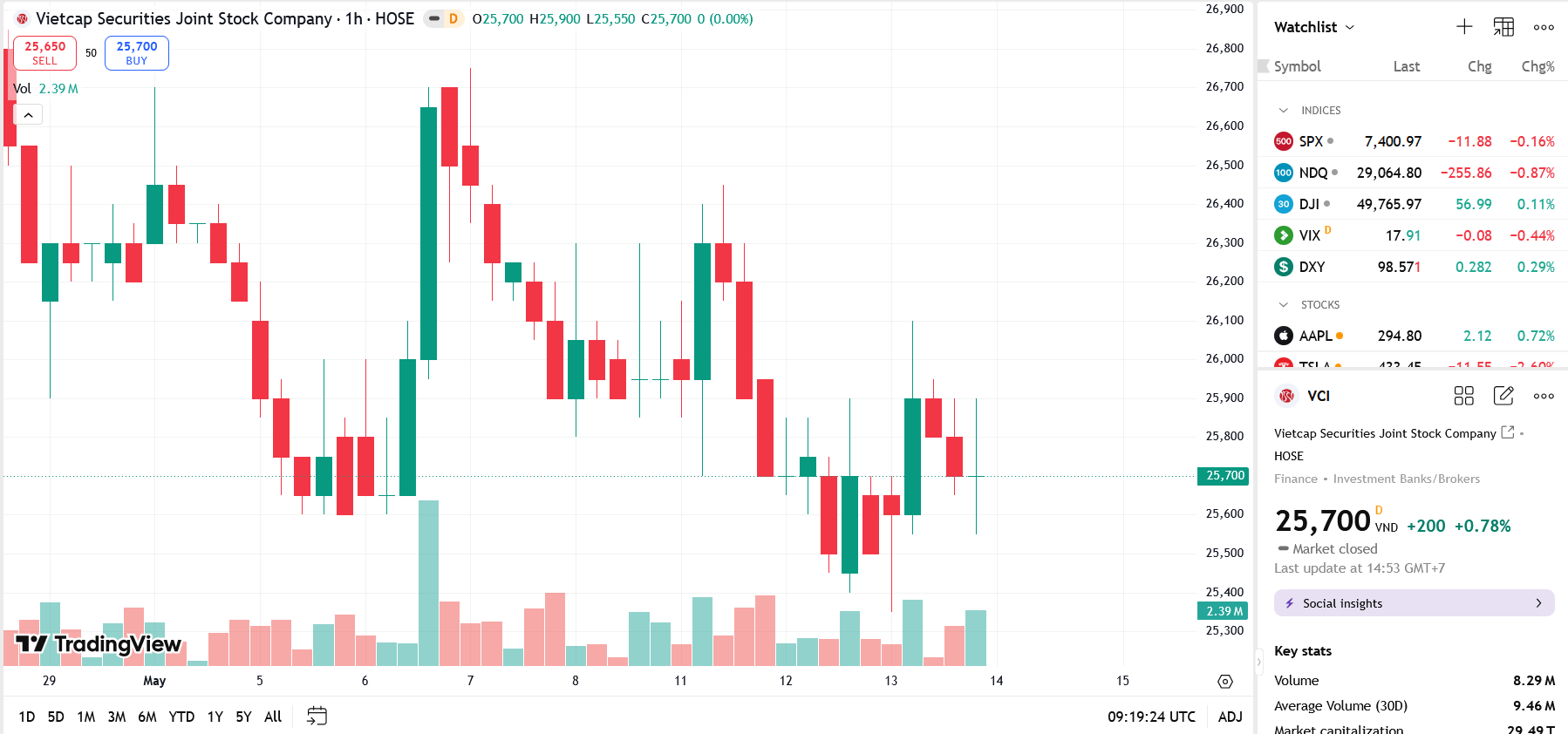
On the downside, VPBankS faced pressure as profits dropped to 514 billion VND, down nearly 58% from the prior quarter’s peak of 1,216 billion VND. VietCap Securities (VCI) also declined, earning about 404 billion VND, down 25% versus Q4 2025.
The article notes that the stock market has moved beyond the period of “cheap and easy money.” Liquidity signals a slowdown rather than a continuous surge. In addition, proprietary trading at many firms began to face pressure from volatility and differentiation among core stocks. Higher cost of capital also affected the effectiveness of margin lending, a key revenue source for brokerage firms.
Looking ahead, the development path of the capital market and the ability to upgrade the market by global ranking organizations such as FTSE Russell are cited as key drivers. In this context, brokerage firms are still expected to benefit from structural advantages linked to the momentum of active trading.
Bitcoin (BTC) investors who use steady dollar-cost averaging (DCA) may be underperforming versus strategies that adjust exposure to the market’s cycle, according to new research arguing that Bitcoin’s behavior differs from traditional long-duration assets.
In a report cited by Markus Thielen of 10x Research, Bitcoin’s market…