•
•
•
•
•
•
•
•
•
•
•
•
•
•
•
•
•
•
•
•
•
•
•
•
•
•
•
•
•
•
•
•
•


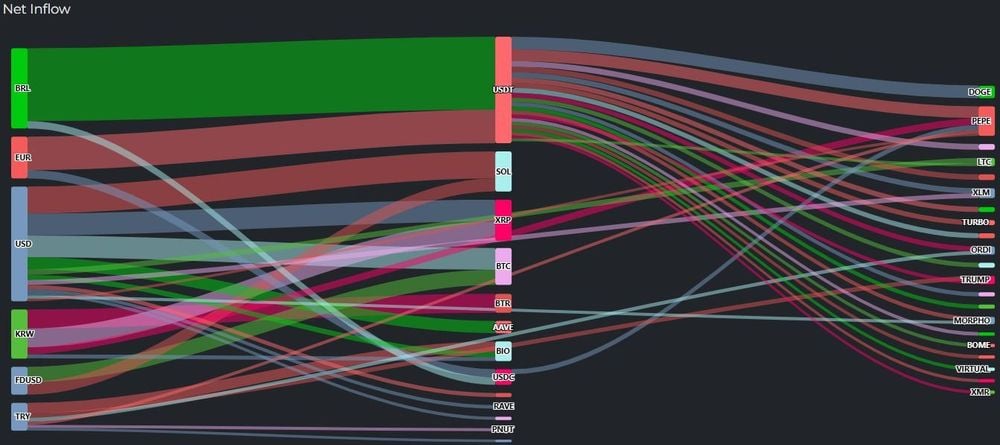
Capital rotated out of major cryptocurrencies over the past several hours, with traders shifting into stablecoins and fiat while selectively redeploying into a handful of altcoins, a pattern consistent with a more defensive move amid near-term uncertainty.
Cryptometer data compiled as of 11:30 a.m. KST on Wednesday (2:30 a.m. UTC) showed fiat inflows into the crypto market over the prior five hours were led by the U.S. dollar (USD) at $4.57 million. Other notable inflows included the Brazilian real (BRL) at $3.20 million, the South Korean won (KRW) at $1.94 million, the euro (EUR) at $1.68 million, and the Turkish lira (TRY) at $1.10 million.
Stablecoins also featured prominently in the rotation. Tether (USDT) recorded an initial inflow of $4.24 million before being dispersed across multiple cryptocurrencies, suggesting traders used USDT as a short-term parking asset before re-entering risk positions. First Digital USD (FDUSD) saw $1.12 million in inflows, split primarily between Bitcoin (BTC) and Solana (SOL).
On a token-by-token basis, the largest net inflows during the window went to:
Additional inflows were recorded in BIO at $787,000, BTR at $758,000, USD Coin (USDC) at $631,000, Dogecoin (DOGE) at $502,000, and Aave (AAVE) at $482,000.
Despite pockets of buying, the broader flow picture leaned risk-off. Over the same five-hour period, outflows were concentrated in Bitcoin (BTC) at $7.84 million and Ethereum (ETH) at $7.80 million. Solana (SOL) saw outflows of $1.81 million, XRP (XRP) $1.39 million, and Pax Gold (PAXG) $1.36 million, indicating sell pressure across both large caps and select hedging assets.
The clearest signal of market posture came from destination flows. Tether (USDT) absorbed $14.48 million, while USD Coin (USDC) drew $4.76 million, reinforcing stablecoins’ role as the primary refuge during short-term de-risking.
At the same time, investors also converted into fiat, with conversions totaling $5.25 million into USD, $1.47 million into EUR, $2.13 million into KRW, and roughly $786,000 into TRY.




Premium gym chains are entering a “golden era” that is ending or already in decline, as rising operating costs collide with shifting consumer preferences toward more flexible, community-based ways to exercise. Long-term memberships are shrinking, margins are pressured by higher rents and facility expenses, and competition from smaller, more personalized…