•
•
•
•
•
•
•
•
•
•
•
•
•
•
•
•
•
•
•
•
•
•
•
•
•
•
•
•
•
•
•
•
•


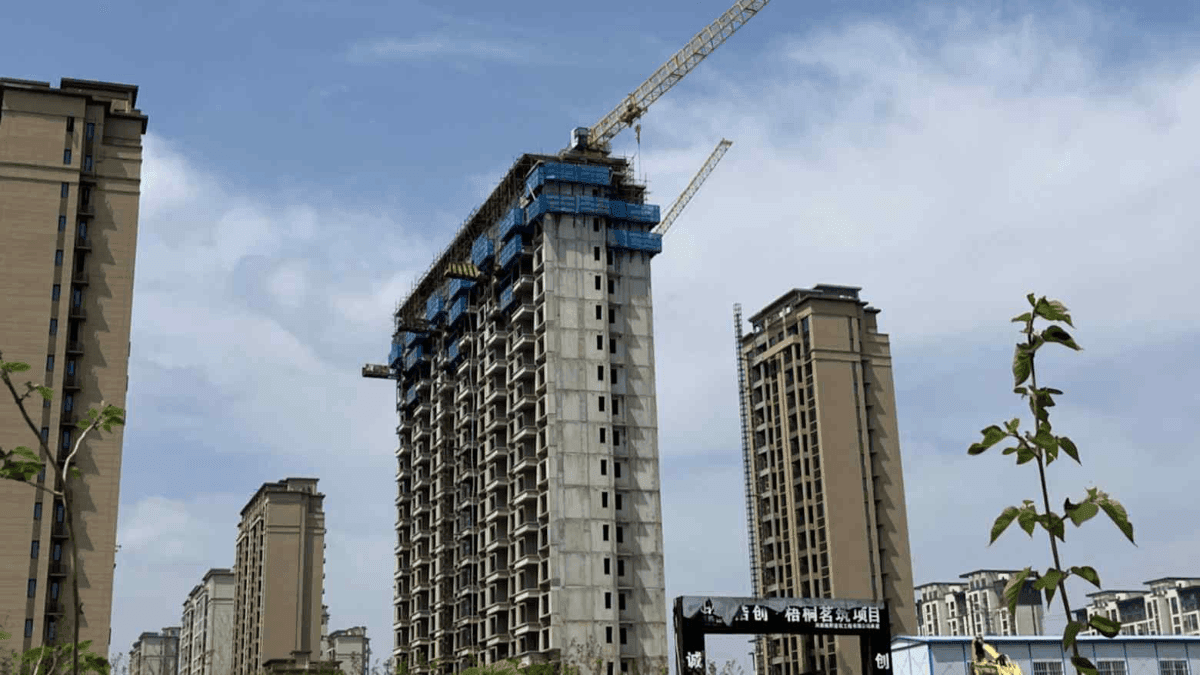
Despite measures by the Chinese government to support construction and completion of projects, many developments have been delivered only partially, while components and amenities remain incomplete. In Zhengzhou, the capital of Henan province in central China, an unfinished housing complex about a 30-minute drive from the city center was observed by Nikkei Asia in mid-April. Many buildings in the project still lack windows, walls are bare concrete, and steel beams and timber lay scattered across the site. The 11-building complex was initially slated for completion by the end of 2022. However, due to the developer’s financial difficulties, the completion now appears almost impossible. The root cause began in 2020-2021 when the Chinese government tightened financial rules for real estate developers to curb the housing bubble. Access to bank loans became harder, leaving many developers unable to finance further construction. As a result, numerous housing projects were left unfinished and could not be delivered to buyers who had signed contracts. This situation weakened demand for homes in China and prolonged the downtrend in sales. In Q1 2026, new housing sales by floor area fell 13% year-on-year from Q1 2025. This creates a vicious circle: developers cannot recoup the cash flow necessary to finance new projects, making it harder to start new ones. As stalled projects continue to weigh on the property market, the Chinese government has stepped up financial support programs for real estate firms to complete construction and hand over homes to buyers. According to the Ministry of Housing and Urban-Rural Development, about 3.96 million homes under the delivery-support program had been completed by the end of 2025. However, Beijing did not disclose specifically which projects are included in the program, and it remains unclear nationwide how many stalled projects still remain unresolved. In November last year, local media in Jinan, Shandong province, lauded a newly completed apartment project. The project originally was to finish in 2023 but had to halt construction due to the developer’s financial difficulties. The city later placed the project in a prioritized category to accelerate handovers and restart construction. The building stands out, at more than 30 stories, with additional playgrounds and bike parking. Nevertheless, accelerating handovers has also given rise to new problems. In a separate project in Zhengzhou, the structure had been completed in stages since 2023 and some buyers have moved in. However, some units still have elevators not operating and gas systems not functioning. A similar situation has occurred in many housing complexes across China. In some cases, contractually promised amenities—such as parking lots or waste-treatment facilities—have not been completed even though residents have moved in. On social media, posts complaining about this have become common, underscoring that handover does not guarantee buyers’ peace of mind. Analysts say that while acknowledging the housing market’s weakness is weighing on the economy’s recovery, the government has yet to present a fundamental, structural solution. Even at the latest National People’s Congress, officials largely repeated existing policy directions, such as accelerating the release of inventory and supporting supply for low- and middle-income groups.




Premium gym chains are entering a “golden era” that is ending or already in decline, as rising operating costs collide with shifting consumer preferences toward more flexible, community-based ways to exercise. Long-term memberships are shrinking, margins are pressured by higher rents and facility expenses, and competition from smaller, more personalized…




