•
•
•
•
•
•
•
•
•
•
•
•
•
•
•
•
•
•
•
•
•
•
•
•
•
•
•
•
•
•
•
•
•


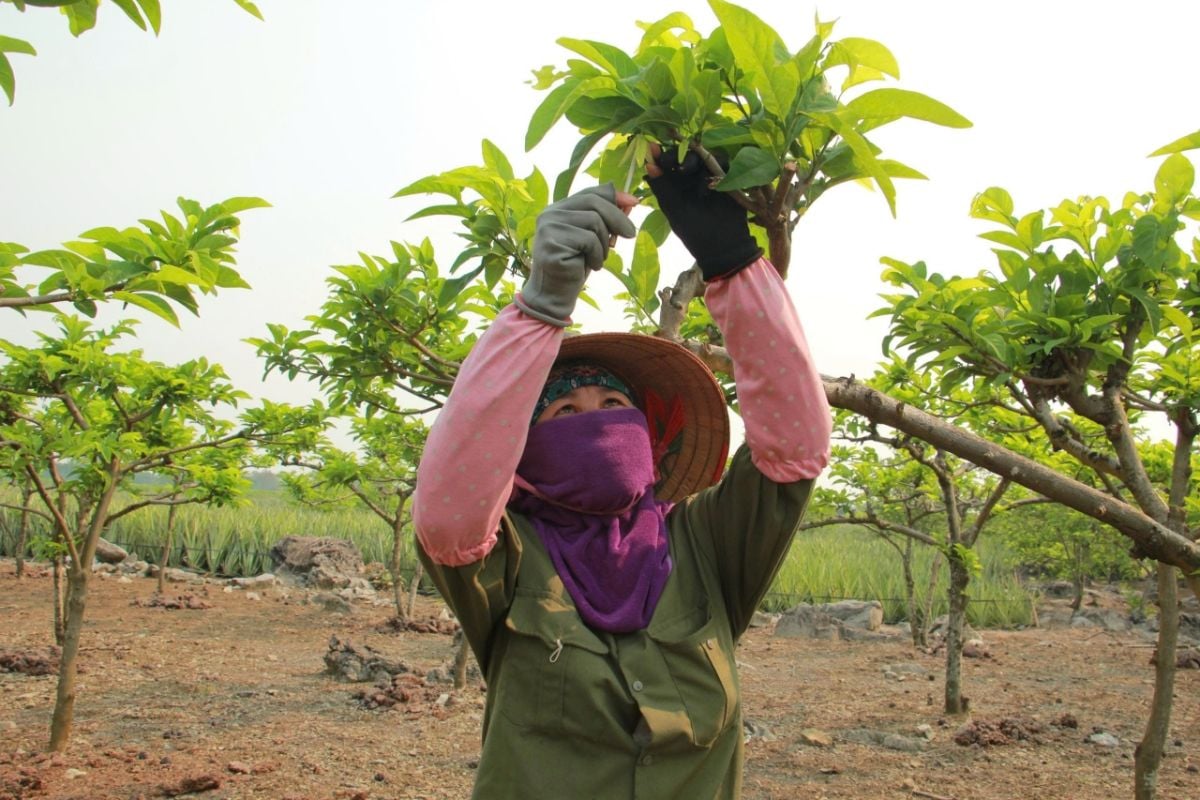
Amid the scorching sun over the foothills, custard-apple growers in Phú Long commune (Ninh Bình) enter the busiest time of the year. Regardless of the hour, they take every moment when the flowers bloom, pollinating in time to protect the harvest and secure the main income for the year.
At noon on a sunny April day, in the green custard-apple orchards, Ms. Vu Thi Huong (born 1981, living in Hamlet 4) continues her routine work. With a pollen box in her left hand and a small tube in her right, she inserts pollen into each newly opened blossom. The work is repetitive, but it requires meticulousness and accuracy, as the pollination window largely determines the outcome of the season.
Local growers describe caring for custard-apple during the pollination season as “raising a small child,” because they must manage thousands of blossoms and seize every hour and minute. Ms. Huong explains that if flowers pollinate naturally on their own, the fruit tends to drop, deform, and fail to meet market standards for appearance. Manual pollination, by contrast, helps produce round, well-formed fruits—an important factor for accessing major distribution systems.
“Doing it right from the start means higher prices later. Each blossom we tend is a sweet fruit afterward,” she said.
Beyond pollination, growers across Phú Long’s hills are also busy pruning, fertilizing, and spraying to prevent disease. The shared goal is to keep trees healthy, ensure flowers set well, and produce fruits of the highest quality.
Before today’s flourishing custard-apple orchards, the area was once stony, barren hills that were difficult to cultivate. Ms. Huong recalls that her family’s land—more than 1 hectare—was previously used to grow maize and then sugarcane, but returns were low.
“Back then it was tough. We grew maize with low yields and not enough to eat. When we switched to sugarcane, it wasn’t much better; we worked all year but earned little,” she said.
The turning point came when she decided to switch to custard-apple farming. She learned and applied new techniques, including canopy shaping and pruning, as well as pollination and care.
While the early days were challenging, perseverance paid off. Last year, Ms. Huong’s custard-apple orchard earned about 450 million VND, reflecting the effectiveness of the crop switch.
Across Phú Long, many households have also changed their production mindset. The limestone hills once viewed as a disadvantage are now seen as an advantage, helping custard-apple fruits develop sweetness and distinctive aromas.
According to Mr. Nguyen Dinh Quy, Deputy Director of the Phú Long Custard-Apple Off-Season Cooperative and Safe Fruit Marketing, the unit currently has 55 households participating in custard-apple cultivation across about 150 hectares. By applying production techniques, custard-apple quality has become more stable and meets market demand.
“Phú Long custard-apple has its own characteristics: large fruits, thick flesh, few seeds, sweet and fragrant. Many customers order early, especially at the start of the season,” Mr. Quy said.
Local growers also focus on sustainable production. Along orchard paths, packets of composted manure enriched with beneficial microbes are placed at the base of trees. This approach helps improve soil, reduce dependence on chemical fertilizers, and enhance product quality.
Using organic fertilizer is also described as an important requirement to maintain OCOP 4-star standards for Phú Long custard-apple, reflecting a commitment to market quality.
To date, the Phú Long region has more than 200 hectares of custard-apple. From barren slopes, it has developed into a dedicated fruit-tree belt with high economic value.
Brick houses and upgraded homes rising among the hills illustrate the change. With incomes potentially reaching hundreds of millions of dong per hectare, custard-apple trees have become the main livelihood for many households.
Premium gym chains are entering a “golden era” that is ending or already in decline, as rising operating costs collide with shifting consumer preferences toward more flexible, community-based ways to exercise. Long-term memberships are shrinking, margins are pressured by higher rents and facility expenses, and competition from smaller, more personalized…