•
•
•
•
•
•
•
•
•
•
•
•
•
•
•
•
•
•
•
•
•
•
•
•
•
•
•
•
•
•
•
•
•



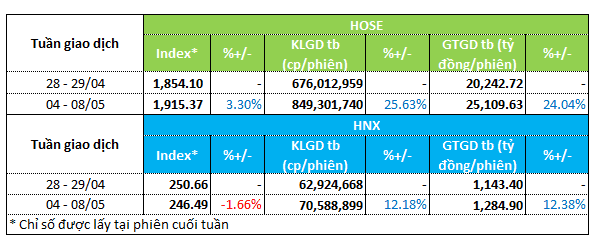
VN-Index reached a historic high during the week, with buying demand remaining strong in the afternoon session and pushing the main index to a new all-time peak. Active buying flowed into blue-chip stocks throughout the week, with buying pressure intensifying on May 7. By week’s end, VN-Index rose 54.91 points, or 2.96%, to 1,915.37 points.
Over the week, investor attention centered on Vin-family stocks, along with Gelex, NVL, CTD, PC1 and other names.
Foreign investors switched to net selling across the market over five sessions, with total net selling of 4,158 billion dong. By venue, foreigners sold 4,351 billion dong on HoSE, bought 256 billion dong on HNX, and sold 63 billion dong on UPCoM.
On the buying side, MSN led net purchases with about 609 billion dong, followed by POW (593 billion). Other net buyers included GEX (250 billion), VIX (208 billion), VRE (194 billion), MWG (192.5 billion) and BID (147 billion).
On the selling side, FPT was the largest net seller with about 1,707 billion dong, followed by ACB (-1,217 billion) and HPG (-804 billion). Additional outflows included KDH (-384 billion), VCB (-239.5 billion), KBC (-214 billion), NVL (-172 billion) and VHM (-148 billion).
Rồng Việt (VDSC) analysts said that, over the next three months, market performance will depend largely on developments in the Middle East. On valuation, VDSC cut the VN-Index target P/E for the 3–4 month horizon to 12.2–14x, reflecting the view that interest rates remain at a “new high floor” and are not expected to ease quickly.
VDSC also projected market EPS to rise from 133 dong to about 136–138 dong. Under that scenario, VN-Index is expected to trade in the 1,623–2,317 point range, implying a swing of -10.7% to +24.9% from the close on 29/04/2026.
Novaland (NVL) rose on 08/05 as buyers returned. At the close, NVL gained 3.93% to 17,200 dong per share, with matched volume of over 41 million shares. The rebound followed a period in which the stock price had fallen nearly 20% over four sessions. Earlier, over two sessions (06/05 and 07/05), more than 122 million shares changed hands, helping to cap the decline.
Coteccons (CTD) traded at 80,600 dong at the close, down the limit 6.93%, with unusual volume of more than 2.7 million shares—nearly four times the previous session. The decline was accompanied by a lack of demand, with over 300,000 shares on offer. Coteccons’ market capitalization fell to about 9,013 billion dong.
The move followed the company’s announcement that Nguyen Van Dua would be relieved of his position as Deputy General Director and Chief Financial Officer from 26/04/2026 for personal reasons. Coteccons also said it would repurchase 100,000 ESOP shares issued to Mr. Dua at 10,000 dong per share, totaling 1 billion dong.
ACBS reported that Gia Lai Electricity (GEG) posted Q1 2026 revenue of 767 billion dong, down 31% year-on-year. Net profit fell to 264 billion dong, down 57%. Despite the decline, ACBS said the results were still positive in context, noting GEG had completed about 69% of its annual profit plan and around 60% of the broker’s full-year projection.
ACBS maintained its 2026 profit guidance for GEG at 441 billion dong and set a target price of 18,400 dong per share. Compared with the current price around 14,450 dong (as of 07/05), this implies potential upside of about 27.3%.
According to an update on 8/5 by BSC, although KBC’s Q1 2026 results declined, the broker maintained a positive mid-term outlook due to a large land bank and its leading position in industrial park development. Based on current assumptions, BSC forecasts 2026 revenue of 10,456 billion dong and parent net profit of 2,843 billion dong, representing growth of 53% and 35% year-on-year.
BSC estimated forward EPS for 2026 at about 3,019 dong per share, corresponding to a forward P/E of about 9.8x.
Premium gym chains are entering a “golden era” that is ending or already in decline, as rising operating costs collide with shifting consumer preferences toward more flexible, community-based ways to exercise. Long-term memberships are shrinking, margins are pressured by higher rents and facility expenses, and competition from smaller, more personalized…