•
•
•
•
•
•
•
•
•
•
•
•
•
•
•
•
•
•
•
•
•
•
•
•
•
•
•
•
•
•
•
•
•



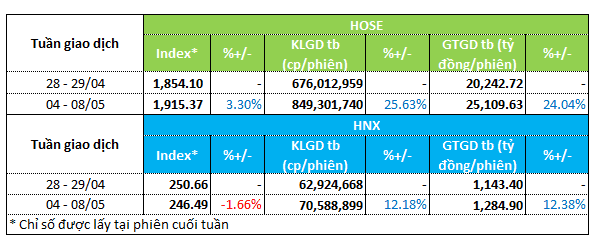
SHS said that in its newly released report, the VN-Index in April 2026 continued to move in line with the base scenario outlined in the 2026 strategic report. Driven by the leadership of mega-cap stocks—especially in the leading sector—the market rebounded strongly and returned to around 1,900 points.
Looking ahead to May, SHS noted that attention will be on April macroeconomic data, including inflation, imports and exports, and PMI. These indicators are expected to more clearly reflect the impact of the Middle East conflict on business activity and the broader economy.
SHS also pointed out that global geopolitical tensions remain ongoing and are entering a new phase. At the same time, credit growth shows signs of cooling, while energy crises, inflation, and rising input costs are beginning to affect businesses and the economy more distinctly. Margin lending on the market remains elevated.
On the positive side, SHS assessed that Vietnam’s economy continues to maintain strong growth. It said Q1 2026 business results for many companies continued to show favorable growth. Excluding the VinGroup group, SHS described the remaining market capitalization as relatively reasonable after the recent decline, particularly in light of long-term growth potential.
According to SHS, excluding VinGroup, the remaining market capitalization now stands at about $320 billion, nearly unchanged from the end of March 2026. The valuation metrics are reported at P/E of about 12.96x, P/B of about 1.8x, and P/S of about 1.4x. SHS said this is a relatively fair valuation range given that corporate earnings continue to grow, creating opportunities for investors to consider accumulation and value investing.
Despite the rebound, SHS flagged a risk that the VN-Index could form a short-term peak. After five consecutive weeks of gains—from around 1,600 points to near 1,900—the index is returning to levels seen before the sharp decline triggered by the Middle East conflict.
On sector liquidity, SHS identified several areas likely to attract funds in the short term in May, in the following order: securities, residential real estate, banking, fertilizers, and steel.
SHS said the securities sector could benefit in the medium term if FTSE Russell announces an upgrade for Vietnam’s market, which would attract additional foreign capital and support market liquidity. It also noted that the market is expected to be added to MSCI’s upgrade watchlist in the June review.
For residential real estate, SHS said some large enterprises are entering the launch phase and recording profits from large-scale projects. After a period of decline and consolidation, it expects stock prices in the sector to recover.
SHS described banking as the market’s core sector, noting that many banks have set high growth plans for 2026. With a large capitalization weight, the group is also expected to attract more foreign capital if Vietnam’s market is officially upgraded.
For fertilizers, SHS said high fertilizer prices create favorable conditions for companies in the sector to improve earnings.
In steel, SHS said the outlook is supported by increased public investment and trade protection policies. It referenced that the Ministry of Industry and Trade has imposed anti-dumping duties on wide HRC steel imports from China.
SHS added that although the VN-Index has returned to its historical peak, investor sentiment remains cautious because the market’s rise has been largely driven by VinGroup. It said this means market movements in April and the outlook for May still carry potential for volatility.
Premium gym chains are entering a “golden era” that is ending or already in decline, as rising operating costs collide with shifting consumer preferences toward more flexible, community-based ways to exercise. Long-term memberships are shrinking, margins are pressured by higher rents and facility expenses, and competition from smaller, more personalized…