•
•
•
•
•
•
•
•
•
•
•
•
•
•
•
•
•
•
•
•
•
•
•
•
•
•
•
•
•
•
•
•
•


Four months into the year, the Tax Department’s budget revenue surpassed the 1 quadrillion dong mark. In a report to the Minister, the Tax Department said it has fully met and exceeded the targets set by the National Assembly despite numerous difficulties and large-scale tax relief measures. Tax revenue continued to grow and remained a key source for mobilizing national resources.
In the 2021-2025 period, total NSNN revenue reached about 9.922 quadrillion dong, exceeding the target by 19.5%. The mobilization rate into NSNN stood at 18.8% of GDP, above the target of not less than 16% of GDP. Revenue from taxes and fees reached 7.77 quadrillion dong.
Revenue under the Tax Department’s management in this period totaled 8.527 quadrillion dong, exceeding the estimate by 24.1%. The share of NSNN revenue managed by the Tax Department increased over time, rising from 81% in 2011-2015 to 82.1% in 2016-2020, and to about 85.9% in 2021-2025.
The Tax Department said it has maintained a five-year streak of meeting and exceeding forecasted revenue, supporting resources for socio-economic development and national fiscal stability.
For 2026, the Tax Department is assigned a high revenue target of 2,242 trillion dong for total budget revenue. Of this, domestic revenue is 2,199 trillion dong, including domestic tax and fee revenue of 1,558 trillion dong.
In the first four months of 2026, revenue collected under the Tax Department’s management reached 1,006 trillion dong, equal to 44.9% of the forecast and up 16.7% year-on-year. Revenue from the production and business sector rose 28.3% year-on-year, continuing to be the main growth driver.
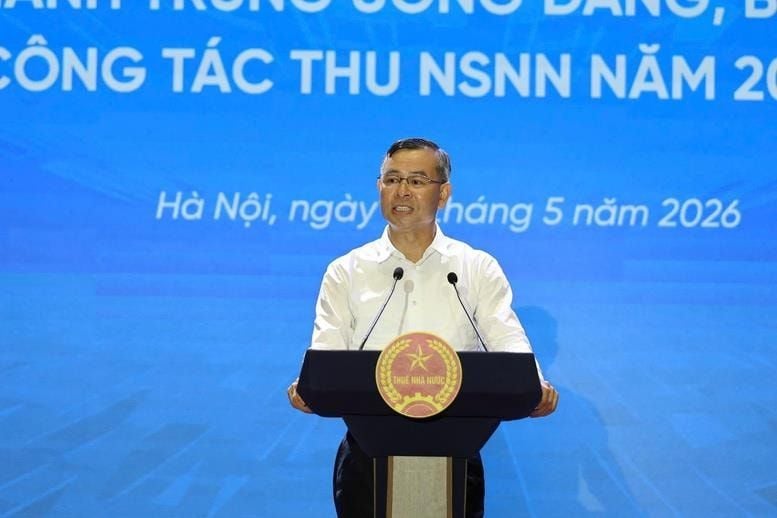
In a directive on strategic orientation and core tasks for 2026-2030, Finance Minister Ngô Văn Tuấn praised the tax sector’s results and highlighted four notable achievements.
First, the sector has consistently met and exceeded forecasts, including timely collection of revenues, particularly from online business and e-commerce.
Second, digital transformation has been accelerated through early implementation of information technology and vigorous digitization of tax administration processes. The Minister noted that the introduction of two technology solutions recently launched to support tax administration and help taxpayers demonstrates the sector’s digital transformation.
Third, administrative procedure simplification has delivered benefits for businesses and taxpayers.
Fourth, the Tax Department has implemented effective reorganization and streamlining of the apparatus, making the organization leaner and more efficient after multiple reorganizations.
The directive sets the 2026-2030 target for total budget revenue at at least 20% of GDP, with tax and fee revenue at least 17% of GDP. The Minister said the tasks ahead will be very challenging due to volatility and challenges in the global economy.
For 2026 specifically, the Minister said the Tax Department must strive to exceed the forecast across all revenue items, tax instruments, and revenue areas, while ensuring at least a 10% increase compared with 2025 results.
The guiding principle for tax work, the Minister said, is to implement President Hồ Chí Minh’s teaching: “Tax collection must win the hearts of the people.” The Minister also emphasized shifting from a mindset of “budget revenue” to “revenue governance,” focusing on nurturing and expanding the revenue base to ensure sustainable resources for the country’s two-numbers growth target for 2026-2030.
On policy and legal framework improvements, the Minister urged a comprehensive review of the tax law system from the enforcement agency perspective to propose timely adjustments, with tax policy serving as a macro tool to boost resources and support production and business development. Tax policy development and reform should aim to widen the tax base, foster development, and integrate into international frameworks.
The Minister called for tax administration to be aligned with advanced, developed countries, with a smart tax administration system as a key component of the national digital economy infrastructure.
In tax management, the Minister urged strengthening management and effectively tapping revenue sources, especially e-commerce, the digital economy, digital assets, and related-party transactions. He also called for decisive actions against invoicing fraud and tax refund fraud, tightening tax debt management, preventing bad debts, and working to reduce the tax arrears rate.
For taxpayer engagement, the Minister emphasized public communication and support guided by leadership, using the mottos “beauty dispels ugliness” and “the song drowns out the bomb.” The Tax Department should proactively identify risks, difficulties, and obstacles facing taxpayers to guide and support early and remotely, reduce violations and compliance costs, and build voluntary compliance—helping create a civilized taxpaying society.
Premium gym chains are entering a “golden era” that is ending or already in decline, as rising operating costs collide with shifting consumer preferences toward more flexible, community-based ways to exercise. Long-term memberships are shrinking, margins are pressured by higher rents and facility expenses, and competition from smaller, more personalized…