•
•
•
•
•
•
•
•
•
•
•
•
•
•
•
•
•
•
•
•
•
•
•
•
•
•
•
•
•
•
•
•
•


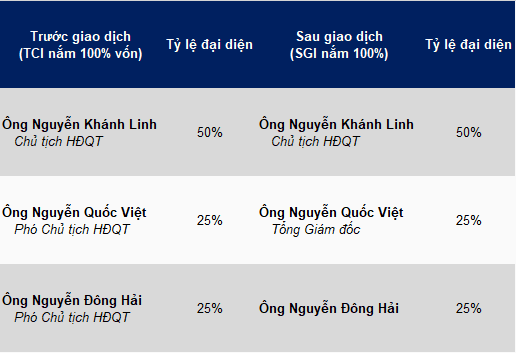
On April 23, Thanh Cong Securities Joint Stock Company (HOSE: TCI) completed the transfer of all equity interests in Thanh Cong Fund Management Company Limited (TCAM) to SGI Holdings Investment Joint Stock Company (UPCoM: SGI), the parent company and owner of 57.76% of TCI.
Following the transaction, SGI Holdings directly owns 100% of TCAM, with a charter capital of VND 200 billion, instead of previously holding 57.76% indirectly through TCI.
The transfer price was set at VND 196 billion, lower than the value of the contributed capital. TCAM’s total assets were just over VND 189 billion as of the end of Q1 2026, reflecting accumulated losses of more than VND 11 billion.
Despite the change in the ownership route, the transaction did not materially alter the ownership-representative structure at TCAM. SGI Holdings allocated the stake to three individuals as representatives: Chairman of the Board Nguyen Khanh Linh (50%), Chief Executive Nguyen Quoc Viet (25%), and Mr. Nguyen Dong Hai (25%).
These three individuals were also the same persons previously designated by TCI to represent the stake when TCI still owned TCAM. At TCI, Nguyen Khanh Linh serves as Chairman of the Board, while Nguyen Quoc Viet and Nguyen Dong Hai are both Vice Chairmen. The ownership-representative structure at TCAM remained unchanged after the transaction.
The deal followed SGI Holdings’ decision to have Saigon 3 Capital Investment Company Limited (a SGI-owned entity) exit nearly 63.4 million shares, representing 54.79% of TCI’s charter capital. The exit was estimated at not less than 768 billion dong, based on the year-end 2025 book value per share of 12,126 dong.
Recently, TCI’s stock has risen steadily from below VND 8,000 per share to above VND 10,000 per share, approaching book value.








Premium gym chains are entering a “golden era” that is ending or already in decline, as rising operating costs collide with shifting consumer preferences toward more flexible, community-based ways to exercise. Long-term memberships are shrinking, margins are pressured by higher rents and facility expenses, and competition from smaller, more personalized…