•
•
•
•
•
•
•
•
•
•
•
•
•
•
•
•
•
•
•
•
•
•
•
•
•
•
•
•
•
•
•
•
•


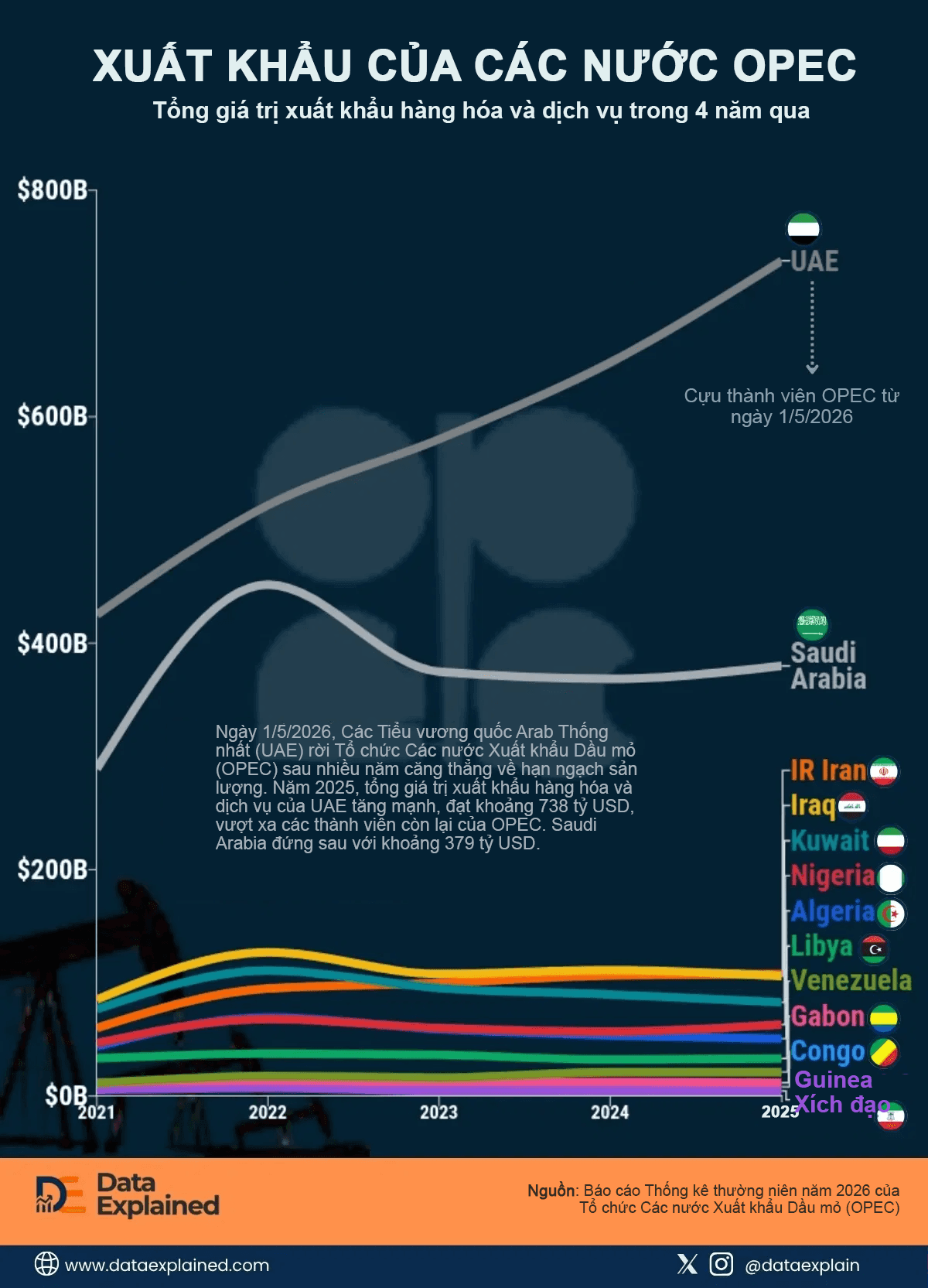
Based on data from the Organization of the Petroleum Exporting Countries (OPEC), the United Arab Emirates (UAE) recorded the largest export value among OPEC member countries over the 2021–2025 period, measured by the total value of exports of goods and services.
The figures are not oil-export data, but they indicate the UAE’s expanding economic role within a group closely linked to the global oil market.
Across OPEC, the total export value of member countries increased from about $1.1 trillion in 2021 to $1.61 trillion in 2025. However, the growth differed significantly from one member to another, widening gaps in relative export scale within the bloc.
The UAE maintained a consistent upward trajectory, with total exports of goods and services rising from about $425 billion in 2021 to $738 billion in 2025. On this basis, the UAE far surpassed most other OPEC members and became the country with the largest export value within the group.
The data also indicate that the UAE’s export growth outpaced the bloc’s average over 2021–2025.
Saudi Arabia, often viewed as the most influential OPEC member because of its central role in the oil market, followed a different path. Its exports rose sharply to about $452 billion in 2022, then declined and stabilized around $379 billion by 2025.
By the end of 2025, Saudi Arabia’s total export value was only about half that of the UAE.
The data suggest that the UAE’s withdrawal from OPEC is not only a change in membership status. It points to potential tension between the UAE’s rapidly expanding trade scale and OPEC’s oil production coordination mechanism.
As exports and revenue maximization become more important, OPEC’s oil production quotas could act as a constraint on the UAE’s growth strategy.
Premium gym chains are entering a “golden era” that is ending or already in decline, as rising operating costs collide with shifting consumer preferences toward more flexible, community-based ways to exercise. Long-term memberships are shrinking, margins are pressured by higher rents and facility expenses, and competition from smaller, more personalized…