•
•
•
•
•
•
•
•
•
•
•
•
•
•
•
•
•
•
•
•
•
•
•
•
•
•
•
•
•
•
•
•
•


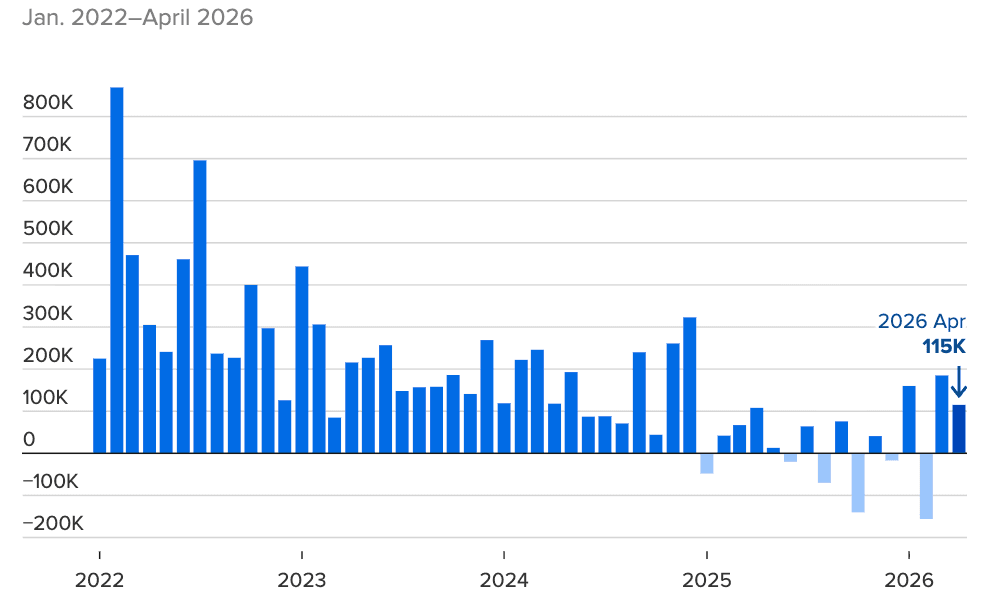
U.S. nonfarm payrolls rose more than expected in March, adding 115,000 jobs, well above the Dow Jones survey calling for 55,000. Yet behind the positive headline are signs that growth is slowing. Compared with February’s 185,000 jobs, the pace of increase has slowed significantly. The unemployment rate held at 4.3%, reflecting stability but not the boom seen earlier. Average hourly earnings also rose more slowly than expected, up 0.2% for the month and 3.6% year over year, below forecasts of 0.3% and 3.8% respectively. Monthly jobs growth in the United States [image not included] Notably, the labor force continued to shrink, while employment in the technology sector remained weak as the “hiring pause, layoffs pause” trend persisted from early 2025. According to Austan Goolsbee, President of Fed Chicago, the labor market has “basically been stable for about a year and a half.” He said, “I would describe this state as stable but not truly strong… Unemployment, hiring, layoffs and job openings are all fairly steady. Therefore, there isn’t much evidence the market is collapsing.” Stocks opened higher after the report, while Treasury yields fell. Scott Clemons, Chief Investment Strategist at Brown Brothers Harriman, called the report “evidence of the underlying resilience of the economy and the labor market in the United States,” despite concerns about the Middle East, inflation, or Fed policy. However, he noted, “One month isn’t enough to establish a new trend… If there are two or three more months of solid payroll growth, I would feel more confident.” Unemployment rate in the United States [image not included] By industry, healthcare continued to lead with 37,000 new jobs. Transportation and warehousing added 30,000, retail 22,000, and social assistance 17,000. In contrast, information services lost 13,000 jobs, extending a trend of declines totaling 342,000 since November 2022 — about an 11% drop. A broader measure including discouraged workers and those working part-time for economic reasons rose to 8.2%, up 0.2 percentage point. The household survey showed 226,000 fewer people employed, pulling the labor force participation rate down to 61.8% — the lowest since October 2021. Notably, the number of people working part-time for economic reasons rose sharply by 445,000 to 4.9 million. Earlier months’ data were revised: March payrolls were revised up by 7,000, while February was revised down by 23,000, resulting in a loss of 156,000 jobs. Dan North, North America Chief Economist at Allianz, commented: “This month’s report is solid, but overall not particularly impressive. I think the labor market is softening, though certainly not to the point of collapse.” The report comes as the Fed faces unusually divided policy debates. Last week the Fed voted 8-4 to hold rates — the widest dissent since 1992 — and officials remain split on the path forward. While layoffs remain at low levels, many economists argue that slower hiring is the main reason the labor market cooled. Real-time data remains fairly positive, but surveys show businesses are adopting a more cautious stance on hiring. Monetary policy has become more complex amid geopolitical tensions in Iran and tariff measures. The market currently expects the Fed to hold rates for the rest of the year as the economy faces high price pressures, while the labor market — though cooled — continues to show notable resilience.






Premium gym chains are entering a “golden era” that is ending or already in decline, as rising operating costs collide with shifting consumer preferences toward more flexible, community-based ways to exercise. Long-term memberships are shrinking, margins are pressured by higher rents and facility expenses, and competition from smaller, more personalized…



