•
•
•
•
•
•
•
•
•
•
•
•
•
•
•
•
•
•
•
•
•
•
•
•
•
•
•
•
•
•
•
•
•
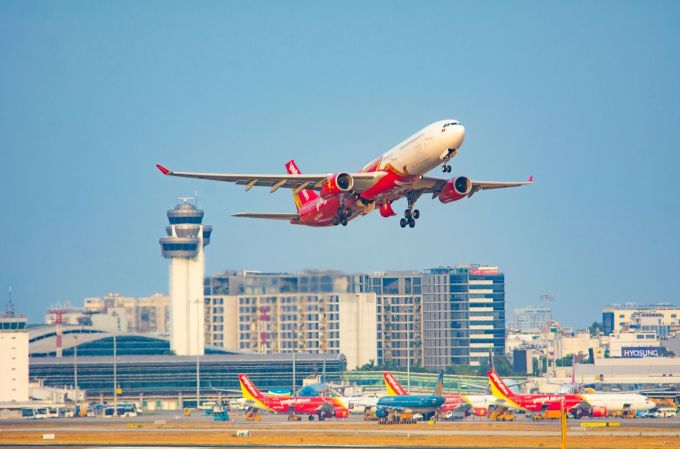
In the first three months of 2026, Vietjet’s consolidated net profit after tax reached 1,023 billion dong, up about 59.6% year-on-year, as the airline doubled its profit in the fourth quarter of 2025 on improved operating efficiency.
In its Q1 2026 business results report, Vietjet Aviation Joint Stock Company (VJC) reported consolidated revenue of 21,021 billion dong, up 17.1% year-on-year. Consolidated pre-tax profit rose to 1,142 billion dong, up 36.5%.
Net profit after tax was 1,023 billion dong, up 59.6% year-on-year from Q1 2025 (640 billion dong) and double the profit of the first three months of 2025 (510 billion dong).
Separately, the parent company’s revenue from sales and services reached 19,473 billion dong, up 8.7% versus the same period last year. Pre-tax profit was 1,020 billion dong, while net profit after tax was 922 billion dong, up 24.5% and 47%, respectively.
The company said revenue and profit continued to grow due to stronger cost control, optimization of operating performance, progress in digital transformation, and a newer and more modern fleet designed to help save fuel.
As of the end of Q1 2026, Vietjet’s total assets were 143,534 billion dong. The net debt-to-equity ratio stood at 2.1x, and the liquidity ratio at 1.5x, both within the industry’s safe range. In the first three months, Vietjet contributed 1,941 billion dong to the state budget.
During Q1, the airline carried 7.2 million passengers, up 5.1% year-on-year. It operated 39,903 flights, up 3.3% year-on-year, while cargo volume reached 23,344 tons.
Vietjet currently operates 186 routes, including 45 domestic and 141 international. The airline also opened additional routes connecting Vietnam with China.
Alongside operational growth, Vietjet continued investing in its fleet through major deals, including engine orders from Pratt & Whitney for 44 Airbus A320neo aircraft worth about USD 5.4 billion, a financing agreement for 6 Boeing 737-8 aircraft worth USD 965 million, and a lease-purchase agreement for 10 Comac C909 aircraft.
The airline also advanced artificial intelligence and fuel-optimization solutions through partnerships with Open Airlines and Safran.
In Q1, Vietjet trained 34,727 students through the Vietjet Aviation Academy and expanded international training cooperation to support its long-term development strategy. During the period, the company received international recognition in various categories, including being named the world’s best low-cost airline and among the top safe airlines.
An official said that with government support on tax policies, Vietjet is confident in entering a new growth phase with international scale and long-term growth momentum.
Premium gym chains are entering a “golden era” that is ending or already in decline, as rising operating costs collide with shifting consumer preferences toward more flexible, community-based ways to exercise. Long-term memberships are shrinking, margins are pressured by higher rents and facility expenses, and competition from smaller, more personalized…