•
•
•
•
•
•
•
•
•
•
•
•
•
•
•
•
•
•
•
•
•
•
•
•
•
•
•
•
•
•
•
•
•



Vietnam and China issued a joint statement on continuing to deepen their comprehensive strategic partnership and promoting the construction of the Vietnam–China Community of Shared Future with strategic significance at a higher level in the new era.
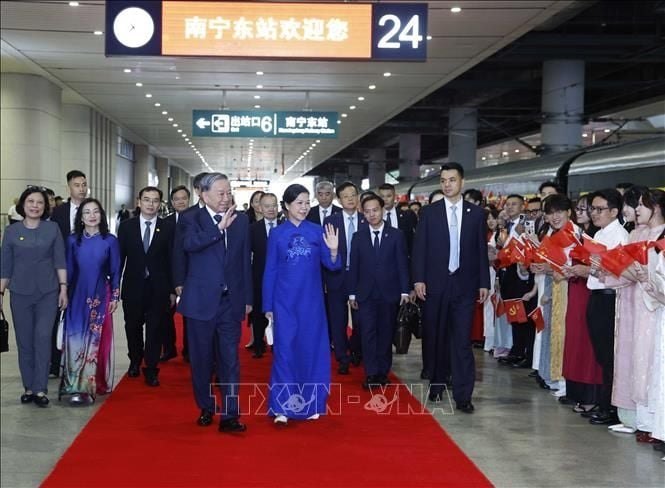
At the invitation of Chinese General Secretary and President Xi Jinping, Vietnamese General Secretary and President Tô Lâm paid a state visit to China from April 14–17, 2026. The two sides released the joint statement following the visit.
The two sides reaffirm that the Communist Party of Vietnam and the Communist Party of China share a historic mission for the happiness of the people, the development of their countries and the progress of humanity.
They also state that maintaining the comprehensive leadership of the two parties is the fundamental guarantee for the modernization of socialist society in each country and for healthy, stable, long-term development of Vietnam–China relations.
The two sides agree to maintain regular contacts between leaders of the two parties and nations through various channels, and to fully leverage party channels and bilateral coordination mechanisms, including the Bilateral Cooperation Steering Committee and the Strategy Dialogue “3–3.”
Vietnam reiterates its firm adherence to the “One China” policy and its position not to develop official relations with Taiwan. China supports Vietnam in ensuring social stability, security and national development.
The two sides commit to strengthening strategic development connectivity and implementing the framework of “Two Corridors, One Belt” under the Belt and Road Initiative. The focus includes connecting infrastructure, logistics, border gates and cross-border economic corridors.
Railway cooperation is highlighted as a new focus, including standard-gauge routes connecting Vietnam–China and regional interconnectivity. China says it is ready to cooperate with Vietnam in capital, technology, training and industrial capacity in rail.
The statement also says both sides will keep trade and investment open, build safe and stable supply chains, and encourage enterprises from both countries to invest and cooperate on a market-based and mutually beneficial basis.
Cooperation is set to expand into digital economy, green development, artificial intelligence, semiconductors, high technology, and finance–monetary affairs. The statement also references cross-border retail payments via QR codes and expanded use of domestic currency.
Science and technology cooperation, innovation, technology transfer, intellectual property protection and training of high-quality human resources are also expected to be strengthened.
In addition, the two sides plan to deepen cooperation in agriculture, health, water resources, environment, climate change response and humanitarian projects.
The two sides agree to strengthen publicity and education about traditional friendship, and to promote people-to-people exchanges in culture, media, education, tourism and sports, alongside local cooperation.
They launched the “Vietnam–China Tourism Cooperation Year 2026–2027,” describing tourism as an important bridge to foster people-to-people exchanges and socio-economic development.
Education and training cooperation will continue to expand, including vocational training, student exchanges, scholar exchanges and language training. The statement also encourages localities—especially border provinces—to strengthen substantive cooperation.
The two sides reaffirm the international system centered on the United Nations, with international law as the foundation. They say they will strengthen coordination in multilateral and regional mechanisms, support ASEAN centrality, and promote Mekong–Lancang cooperation.
On maritime issues, both sides stress better management of disagreements, maintain peace and stability in the South China Sea, and comply with international law including UNCLOS 1982. They also call for negotiations to delineate the maritime boundary beyond the Gulf of Tonkin and for cooperation for development.
The statement says both sides will fully implement the DOC and strive for the COC to take effect soon.
During the state visit, the two sides signed numerous cooperation documents covering political, security, economic, science–technology, supply chain, humanitarian and local cooperation areas.
The two sides assess General Secretary Tô Lâm’s visit to China as successful and constructive, contributing to deepening Vietnam–China relations and promoting the Vietnam–China Community of Shared Future with strategic significance in the new era.





Premium gym chains are entering a “golden era” that is ending or already in decline, as rising operating costs collide with shifting consumer preferences toward more flexible, community-based ways to exercise. Long-term memberships are shrinking, margins are pressured by higher rents and facility expenses, and competition from smaller, more personalized…


