•
•
•
•
•
•
•
•
•
•
•
•
•
•
•
•
•
•
•
•
•
•
•
•
•
•
•
•
•
•
•
•
•


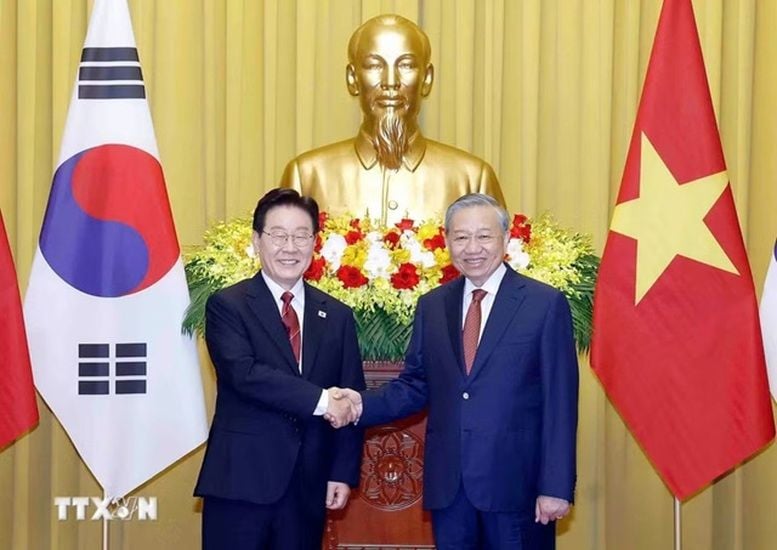
On the afternoon of April 22, immediately after a state-level welcome ceremony at the Presidential Palace, General Secretary and State President To Lâm held talks with South Korean President Lee Jae Myung, who is visiting Vietnam on a state visit.
General Secretary To Lâm warmly welcomed President Lee and the high-level Korean delegation, noting that President Lee is the first head of state to visit Vietnam since Vietnam completed leadership changes following the 16th National Assembly elections. He described the visit as a vivid testament to the all-round strategic partnership, robust political trust, and high political confidence between the two countries.
President Lee Jae Myung expressed pleasure at returning to Vietnam and said he had personally witnessed its dynamic development. He congratulated To Lâm on the National Assembly’s confidence in him and his election as state president, and said he is confident that, under the leadership of the Communist Party of Vietnam, Vietnam will continue to achieve major socio-economic milestones.
The two sides agreed to continue strengthening political trust and strategic cooperation at a high level, implement existing mechanisms and cooperation agreements effectively, and expand substantive cooperation in areas including diplomacy, defense, and security.
They also agreed to reinforce coordination to address non-traditional security challenges, including transnational crime, cyber security, climate change, and issues related to sustainable development.
In discussions on economic cooperation, the leaders emphasized implementing the strategic vision for economic linkage in the new context. They committed to reaching a bilateral trade target of $150 billion by 2030, while continuing to facilitate trade and open markets for each other’s goods.
To Lâm highlighted the positive contributions of Korean enterprises to Vietnam’s socio-economic development and welcomed Korean investment in priority areas such as infrastructure development, smart urban development, semiconductors, large-scale AI data centers, smart port collaboration, and the construction of next-generation ports.
President Lee Jae Myung called on the Vietnamese government to continue addressing difficulties facing Korean-invested projects. He also reaffirmed Korea’s willingness to cooperate with Vietnam on implementing funds from the Economic Cooperation Promotion Fund (EDCF) and the Economic Development Cooperation Fund (EDPF), with a focus on strategic infrastructure projects.
The two sides agreed to strengthen science and technology cooperation, innovation, and digital transformation as a key driver of bilateral cooperation. To Lâm proposed enhanced R&D and technology transfer and continued support for Vietnam’s VKIST (Vietnam–Korea Institute of Science and Technology) project.
Beyond economic and technology cooperation, both leaders stressed expanding cultural, educational, and people-to-people exchanges to build a foundation for sustainable, long-term relations.
They also agreed to safeguard the legitimate rights and interests of their communities living and working in the other country and to enhance subnational cooperation to promote people-to-people exchanges.
On multilateral cooperation, To Lâm affirmed Vietnam’s readiness to cooperate with Korea to implement the ASEAN–Korea Action Plan for 2026–2030 and to coordinate with Mekong countries to advance the Mekong–Korea Summit in 2026.
The two sides shared a common vision of maintaining peace and stability in the South China Sea, upholding rights and interests under international law and UNCLOS 1982, and stressed the importance of promoting peace on the Korean Peninsula.
After the talks, the two leaders witnessed the signing of 12 cooperation documents across ministries and sectors.
In the evening, To Lâm and his wife hosted a state banquet to welcome President Lee Jae Myung and his wife.
Separately, Vietnam and South Korea held a formal ceremony in Hanoi to strengthen the comprehensive strategic partnership, highlighting the resolve to deepen cooperation across diplomacy, economy, technology, and culture.




Premium gym chains are entering a “golden era” that is ending or already in decline, as rising operating costs collide with shifting consumer preferences toward more flexible, community-based ways to exercise. Long-term memberships are shrinking, margins are pressured by higher rents and facility expenses, and competition from smaller, more personalized…




