•
•
•
•
•
•
•
•
•
•
•
•
•
•
•
•
•
•
•
•
•
•
•
•
•
•
•
•
•
•
•
•
•


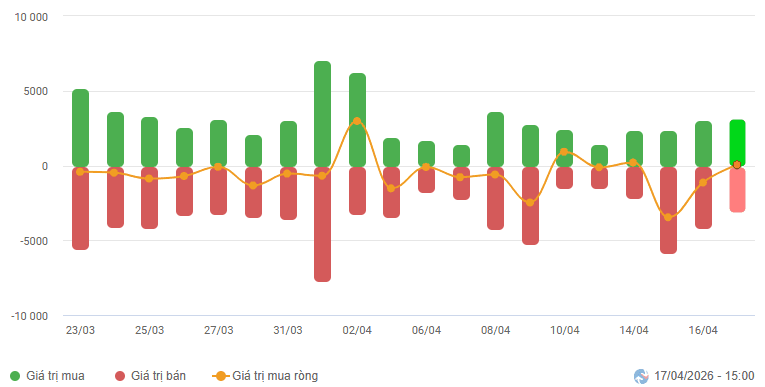
Vietnam’s stock market week from 13–17 April 2026 showed a strong divergence across sectors. The VN-Index paused its advance in the final session but extended its recovery for the fourth consecutive week. Gains, however, were driven mainly by a handful of leading stocks, while most sectors remained range-bound, leaving market breadth and liquidity as key factors for sustaining the trend.
On 17 April, major indices closed mixed. The VN-Index fell 0.15% to 1,817.17 points, while the HNX-Index rose 1.37% to 260 points. Over the full week, the VN-Index increased by 67.17 points (+3.84%), and the HNX-Index rose by 8.09 points (+3.21%).
The VN-Index advanced on four of five sessions, but momentum was largely supported by large-cap stocks. The index returned above 1,800 points, helped by a few pillar names, while the rest of the market did not show a comparable improvement as most sectors stayed clearly separated in performance.
In the last session, declines in VHM, VIC and VPL weighed most on the VN-Index, reducing it by a total of 9.66 points. On the other hand, MWG, GVR and VPB were the largest positive contributors, adding 4.17 points to the overall index.
Energy was a standout, with demand broadening across several names: BSR (+3.49%), PLX (+2.17%), PVS (+1.04%), PVT (+2.35%), PVD (+1.22%) and PVP (+6.94%).
Real estate lagged, down 1.3%, pressured by VHM (-5.17%), VIC (-0.74%), CEO (-1.70%), VRE (-3.38%), TCH (-2.56%), DXG (-1.65%), PDR (-1.52%) and DIG (-1.37%).
Other sectors fluctuated within a narrow band, with gains and losses mixed. In consumer discretionary and financials, divergence was evident: MWG hit limit up, while DGW (+1.66%), PNJ (+1.93%) and PET (+2.02%) also rose. Financials were supported by VPB (+2.36%), TCB (+1.1%), SSB (+1.2%), VIB (+1.17%) and TCX (+1.18%).
Conversely, several stocks faced selling pressure, including VPL (-3.83%), HUT (-1.19%), VVS (-3.85%), HHS (-2.88%), SHB (-1.61%), SHS (-1.63%), SSI (-1.04%), VIX (-1.69%), LPB (-2.75%) and BVH (-1.22%).
Foreign investors were net sellers of about 4.4 trillion dong across both exchanges during the week. They sold nearly 4.5 trillion dong on HOSE but bought 20 billion dong on HNX.
Top weekly performers included VIC, up 23.86%, with four of five sessions in the green and the stock approaching the upper Bollinger Band. MACD widened away from the Signal line after a buy signal, while the Stochastic Oscillator weakened in the overbought zone as VIC tested the January 2026 high, suggesting potential near-term volatility.
The week’s biggest decliner was DCL, down 11.83% after four of five sessions of declines and a break below the 200-day SMA. The Stochastic Oscillator signaled a buy again in the oversold region, indicating that the near-term outlook could improve if the signal persists.
Market breadth and turnover dynamics were highlighted in the charts (not included in the source text). The commentary emphasized that while the VN-Index firmed and the HNX-Index also ended higher, breadth remained uneven, with large-cap leadership still outpacing broader participation.
Overall, the week ended with the VN-Index closing higher and the HNX-Index higher as well, but improving market breadth and liquidity were identified as essential for the sustainability of the current recovery.







Premium gym chains are entering a “golden era” that is ending or already in decline, as rising operating costs collide with shifting consumer preferences toward more flexible, community-based ways to exercise. Long-term memberships are shrinking, margins are pressured by higher rents and facility expenses, and competition from smaller, more personalized…




