•
•
•
•
•
•
•
•
•
•
•
•
•
•
•
•
•
•
•
•
•
•
•
•
•
•
•
•
•
•
•
•
•


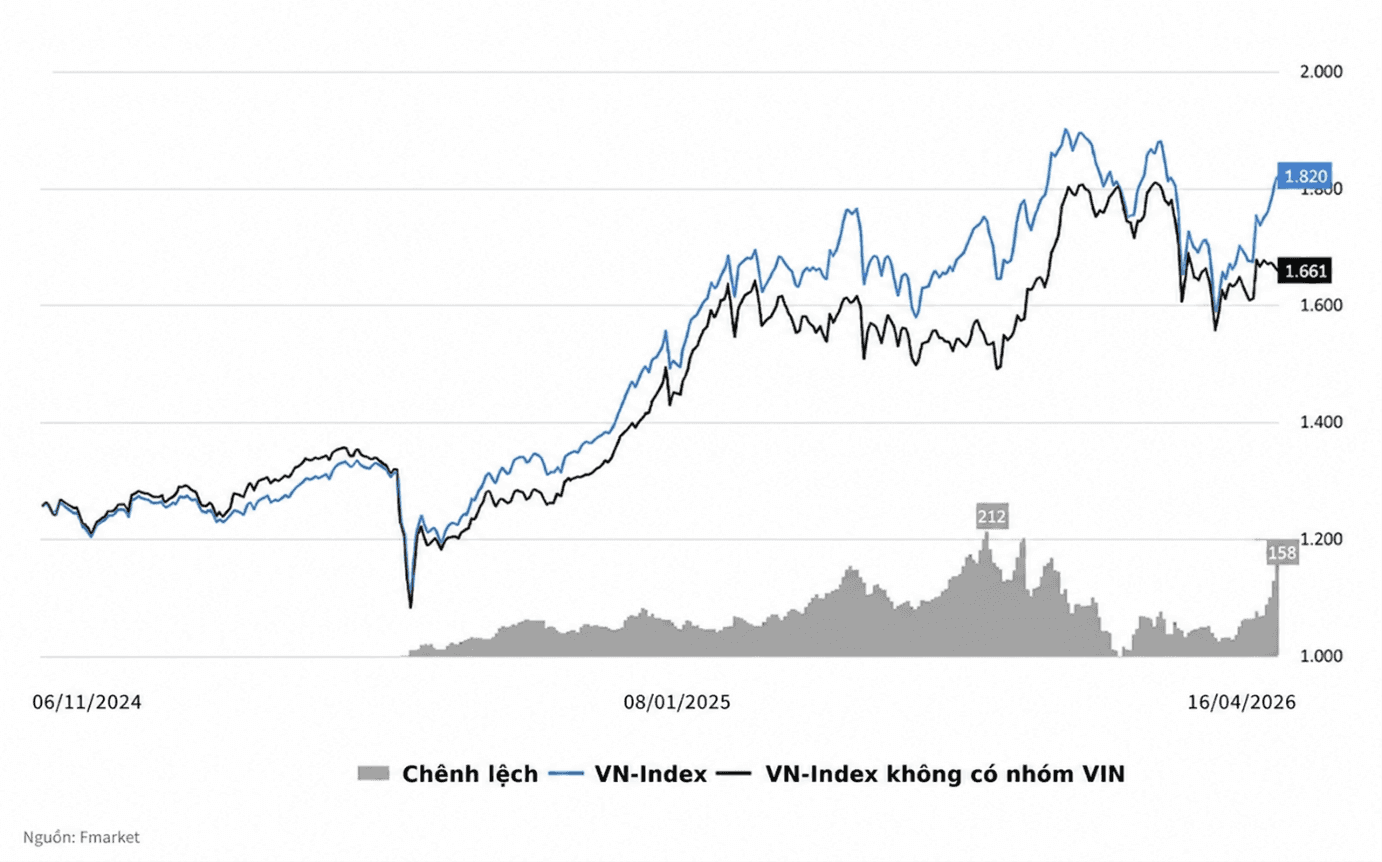
Vietnam’s stock market rose more than 10% in April 2026, but the gain did not fully translate into returns for most investors. The widening gap between index performance and investors’ realized results suggests that market profits were driven more by stock selection and portfolio allocation than by a broad-based rally.
April began with a key catalyst: Vietnam’s stock market was upgraded by FTSE Russell to a secondary emerging market, effective September 21, 2026. The upgrade follows years of anticipation and is expected to influence capital allocation toward more selective and professional strategies.
The VN-Index closed April at 1,854 points, up over 10.7% from the end of March. Despite the positive headline performance, the rally was bifurcated. Index gains were concentrated in a few large-cap names, with the Vingroup group contributing more than 186 points. By contrast, many other stock groups were mostly flat or down.
Market liquidity did not keep pace with the index rise. Average daily turnover in April was about 26.3 trillion dong, down 22% from the previous month. This pointed to cautious investor sentiment and a more selective investment trend rather than broad participation.
As a result, investors’ actual returns diverged from the index. Even though the market increased sharply in points, not many investors benefited proportionately.
As Vietnam moves toward secondary emerging status, money has begun shifting toward stricter criteria and higher selectivity rather than broad-based exposure. For self-directed retail investors, the new environment is described as challenging—not due to a lack of information, but due to a lack of systems to process and act on that information.
One-year data from equity mutual funds on the Fmarket platform—Vietnam’s largest open-ended fund distribution platform—still show returns of 30% to 49%, well above the market’s actual gains if the leading stocks are excluded. Many funds posted one-year returns above 30%.
The top five funds by one-year return were:
These results were attributed to a systematic approach, including flexible allocation across sectors, active weight adjustments, and a focus on companies with solid fundamentals. In an interview on Fund Insider, Ms. Tran Thi Hong Tuoi, Head of Portfolio Management at Mirae Asset Vietnam, said that beyond holding blue-chip stocks long term, the fund also allocates a portion to momentum stocks—mid and small-cap companies showing positive momentum in earnings and supported by market conditions.
Looking ahead, Vietnamese stock allocations into FTSE index baskets will be officially implemented in just over four months. According to VNDirect, Vietnam could attract foreign capital of about 1 to 1.5 billion USD from open funds and ETFs tracking FTSE indices.
Ms. Nguyen Hoai Thu, Deputy General Director of VinaCapital, said the upgrade is not only a technical milestone but also an important step for capital structure and market quality. She emphasized that the upgrade will deepen the stock market by addressing the current dominance of individual investors, who account for about 90% of trading. She added that greater participation from institutional investors with stable capital inflows should help reduce volatility and improve trading sustainability and quality.
As the market increasingly operates under institutional standards, the article notes that the real competitive edge will come from the systems used for analysis and discipline in portfolio management. Investors without the necessary tools may see the gap between index movements and realized returns widen further.

Premium gym chains are entering a “golden era” that is ending or already in decline, as rising operating costs collide with shifting consumer preferences toward more flexible, community-based ways to exercise. Long-term memberships are shrinking, margins are pressured by higher rents and facility expenses, and competition from smaller, more personalized…