•
•
•
•
•
•
•
•
•
•
•
•
•
•
•
•
•
•
•
•
•
•
•
•
•
•
•
•
•
•
•
•
•
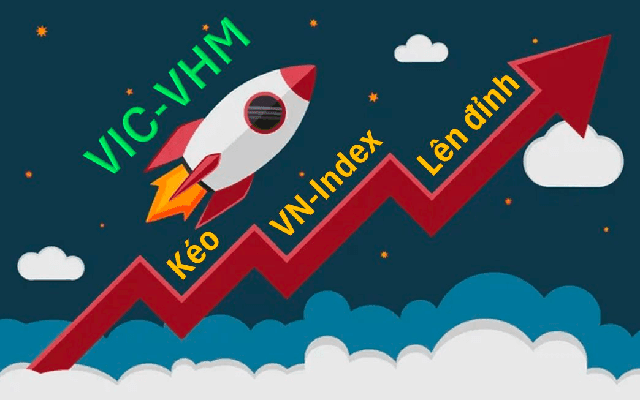
After a period of adjustment, Vietnam's stock market has been steadily rising, led by VinGroup, particularly VIC and VHM. VIC has recently breached a new high, while VHM is approaching its all-time high. The VN-Index is nearing historical highs, even as there is clear divergence among stock groups.
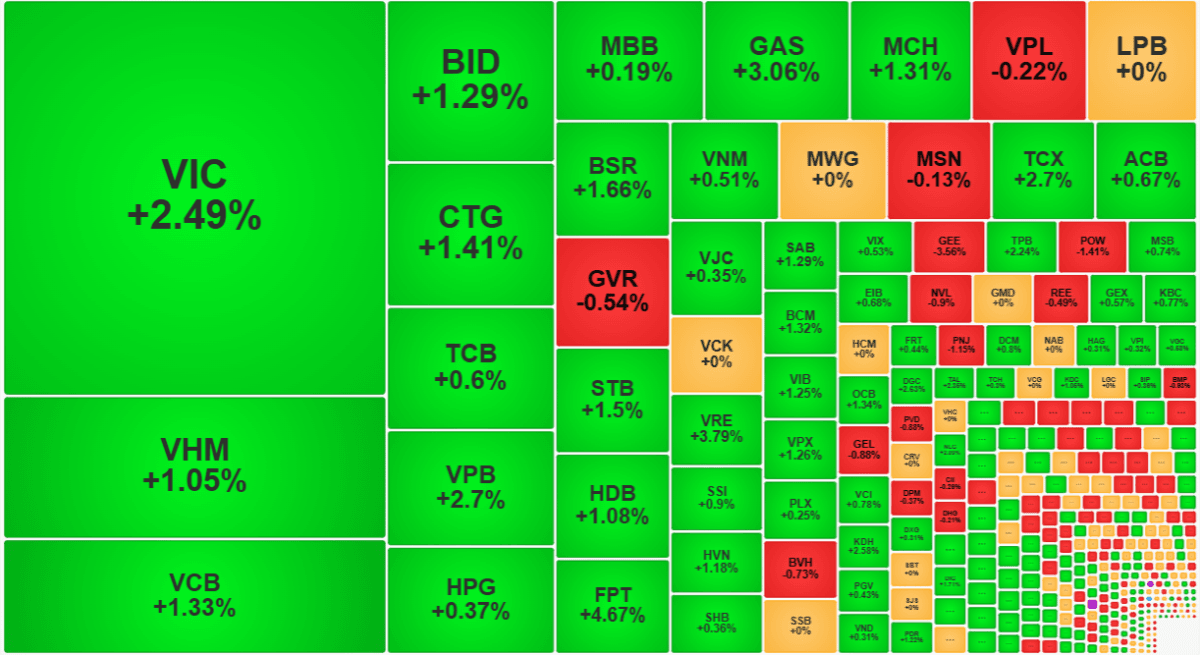
From the beginning of the year to date, the VN-Index has risen by 93 points. VIC alone contributed 131 points, and VHM added another 46 points. As a result, just two VinGroup stocks have added a total of 177 points to the VN-Index—nearly double the index’s actual increase.
The contribution breakdown shows a wide gap between VIC, VHM and the rest of the market. Beyond these two, large contributors such as BSR, LPB, GAS, VCB, and GVR each add roughly 10–15 points. Meanwhile, several large-cap stocks including MCH, FPT, GEE, and CTG have detracted from the index.
In many trading sessions since the start of the year, VIC and VHM have nearly determined overall market movement. In some sessions, these two stocks contributed nearly all of the VN-Index’s gain, while the number of decliners on the exchange still outnumbered gainers.
VinGroup-related stocks are influential enough that, according to multiple statistics, VIC alone accounts for nearly 20% of the market-cap weight on HOSE. If VHM, VRE, and VPL are included, VinGroup-related enterprises account for about 30% of total market capitalization. This means that movements within the group can cause significant changes to the VN-Index.
In a report released earlier in June, Michael Kokalari—Macro Economic Analysis and Market Research Director at VinaCapital—said the VinGroup stock rally this year is supported by three main factors: VinFast’s restructuring plan, the Green SM IPO plan, and positive earnings results from Vinhomes. These factors are seen as supporting VIC’s stock price and contributing to the market’s growing divergence.
Earlier, at the Fund Insider program organized by Fmarket in mid-May, Võ Nguyễn Khoa Tuấn—Senior Vice President, Securities at Dragon Capital—also assessed VinGroup stocks. He said returning to VinGroup names this year for the fund is a correct move, based on objective views and market sensitivity.
Mr. Tuấn compared Vietnam’s VinGroup rally with Korea’s stock market over the past three years, where Hyosung surged 55-fold, while HD Hyundai Electric and SK Hynix rose about 25-fold. He argued that a roughly 10-fold rise from the bottom is not unreasonable for a company operating with high intensity and aggressiveness like VinGroup.
He also cited Vinhomes, a real estate company with annual profits exceeding USD 2 billion this year. He noted that Vinhomes’ current stock price is only about 100% above its five-year high, and that—based on profit scale and growth potential—this price level cannot be considered too hot.
With risk of concentration, Mr. Tuấn said this is not only a Vietnamese issue but a phenomenon seen in many markets worldwide, where large firms increasingly influence index movements. He pointed to developed markets such as the US and Australia as examples where concentration in a handful of large stocks is also evident.
David Rabinowitz, Global Index and Asia-Pacific Market Structure Analysis Director at UBS, said that to reduce concentration risk, Vietnam’s market needs to continue widening depth by adding more quality stocks to the index basket. This would provide investors more choices and support portfolio diversification.
The stock market is reflecting the economy. VinGroup is currently the most valuable listed Vietnamese company, with a market capitalization of nearly 1.7 quadrillion dong (equivalent to over USD 60 billion). The group’s size exceeds the combined market value of the six leading banks.
VinGroup operates across multiple sectors beyond real estate, including infrastructure development, manufacturing, electric vehicles, energy, technology, and services. Its ecosystem, founded by billionaire Pham Nhat Vuong, has generated hundreds of thousands of direct and indirect jobs and supported development across several sectors.
In real estate, Vinhomes remains the market leader. In industry, VinFast is expanding as Vietnam’s largest electric vehicle brand and is growing internationally. In infrastructure, VinSpeed and other VinGroup members are implementing major urban metro projects with multi-trillion-dong scale.
Overall, the influence of VIC and VHM on the VN-Index partly reflects VinGroup’s role in Vietnam’s economy. In the context of Vietnam’s stock market approaching an upgrade to emerging market status by FTSE Russell, the role of large-cap firms like VIC and VHM becomes even more important. Global investment funds typically favor stocks with large market capitalization, liquidity, and the capacity to absorb billions of dollars of flows.






The crypto bear market remained in force on Wednesday, with bitcoin slipping back toward the $60,000 area. Sharp pullbacks in gold and oil also weighed on the 2025 “debasement trade,” which had supported hard assets amid concerns about government debt and fiat currencies. Meanwhile, tech—particularly the AI boom—continued…