•
•
•
•
•
•
•
•
•
•
•
•
•
•
•
•
•
•
•
•
•
•
•
•
•
•
•
•
•
•
•
•
•



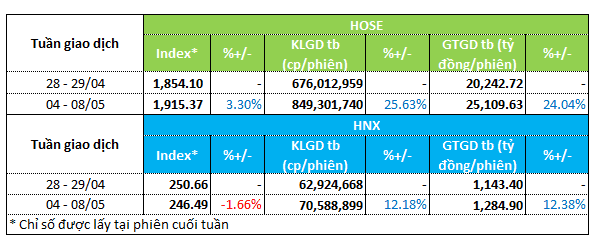
Following a strong market rally in April 2026, the VN-Index is approaching a formidable resistance near the historic high of around 1,910 points (+/- 30). In a recent strategy report, VNDirect (VND) said that while the rally has been impressive in terms of points, money-flow indicators have not fully aligned, as liquidity shows no clear breakout. Market breadth is also not convincing, with gains concentrated in a few large-cap stocks.
On valuation, the VN-Index’s 12-month trailing P/E has fallen to about 13.8x, below the 10-year average of 15.4x. VNDirect attributed the improvement to positive earnings growth among listed companies in Q1/2026.
VNDirect noted that although the market is not yet in a “cheap” range, current valuations are supported by expectations of market upgrades and a positive earnings growth outlook for 2026. Specifically, VNDirect projects that listed companies on HSX will record around 14% earnings growth in 2026. Based on this, the projected 2026 P/E for the VN-Index would be around 13x, keeping Vietnam’s stock market valuations relatively attractive.
From a technical perspective combined with money-flow dynamics, VNDirect presented two scenarios for the market in May:
VNDirect also highlighted that the market may face profit-taking pressures near the old high around 1,910 points (+/- 30) in May 2026, alongside unresolved tensions in the Middle East. The VN-Index could shift into a consolidation phase while waiting for supportive factors, including inflation cooling and improved banking liquidity.
In this context, VNDirect recommended that investors adopt a flexible trading approach: capitalize on profit-taking opportunities near the 1,910 level (+/- 30 points), and consider redeploying capital if the index returns to the 1,820 support area. The firm also advised prioritizing stocks with solid fundamentals, high liquidity, and potential to benefit from ETF-driven capital inflows.
Premium gym chains are entering a “golden era” that is ending or already in decline, as rising operating costs collide with shifting consumer preferences toward more flexible, community-based ways to exercise. Long-term memberships are shrinking, margins are pressured by higher rents and facility expenses, and competition from smaller, more personalized…