•
•
•
•
•
•
•
•
•
•
•
•
•
•
•
•
•
•
•
•
•
•
•
•
•
•
•
•
•
•
•
•
•


Analysts at several Vietnamese stock brokerages have issued updated recommendations for Viet Nam Dairy Joint Stock Company (VNM), Mobile World Investment Corp (MWG) and PetroVietnam Power (POW), citing earnings growth, dividend expectations and changes in operating performance.
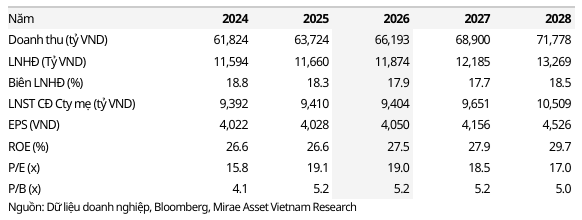
Brokerage analysts recommend buying VNM, with a target price of 76,800 dong per share. Mirae Asset (Vietnam) said it expects VNM to maintain a stable cash dividend policy, projecting a dividend of around 4,000 dong per share in 2026.
As of the end of April, global skim milk powder (SMP) and whole milk powder (WMP) prices remained high at 3,448 USD/ton and 3,666 USD/ton, respectively. Mirae Asset noted milk powder prices continued rising as supply tightened following the Southern Hemisphere production cycle (New Zealand and Australia) passing its peak. The exchange rate stayed around 26,350 dong per USD in April.
Domestic demand improved in Q1, with total retail sales of goods up 10.9% year-on-year. However, inflation concerns emerged as fuel prices rose amid prolonged US-Iran tensions. By end-March, food CPI increased 4.69%, compared with 4.26% in January and 4.54% in March 2025.
In Q1 2026, VNM reported strong growth in both domestic and overseas markets. Revenue rose nearly 25% to 16,178 billion dong, including domestic revenue of 12,071 billion dong (up 20.4%) and overseas revenue of 4,069 billion dong (up over 39%). Net profit after tax reached 2,458 billion dong, up 54%.
Mirae Asset projects for 2026 that domestic revenue will grow 2.5% year-on-year, while foreign revenue is expected to maintain 10% growth. The forecast assumes an average input milk powder price of 2,600 USD/ton. Under the base case, VNM revenue is projected at 66,193 billion dong (up 4%) and net profit at 9,500 billion dong (up nearly 1%).
For valuation, Mirae Asset uses FCFF, with a required return of 11% and a long-term growth rate of 2% after 2036. The target price remains 76,800 dong per share, with a Buy rating.
Brokerage Shinhan Securities Vietnam maintained a Buy recommendation for MWG, setting a target price of 107,500 dong per share. The firm highlighted that Q1 2026 performance reflected a shift from scale-driven growth to improved profitability, supported by multiple business lines.
Shinhan Securities said MWG’s Home Electronics segment revenue reached 32.4 trillion dong in Q1 2026, up 34%, while net profit rose to 2.2 trillion dong, up 49%. Revenue growth was broad across MWG’s store brands: The Gioi Di Dong up 34%, Dien May Xanh up 30%, and TopZone up 42%.
Newer business lines—including Thợ Điện Máy Xanh (logistics, installation, repair, maintenance and after-sales service), online channels and overseas markets—showed positive growth, though they still represent a small share of the overall business. In product groups, Apple phones rose 65%, household appliances and refrigerators rose 45%, accessories rose 35%, and laptops and TVs rose 30%.
MWG plans to complete an IPO for Dien May Xanh in 2026. The company will not focus on expanding store counts; instead, it will emphasize service quality. A key strategy is growing the workforce of “Thợ Điện Máy Xanh” to provide full-service solutions from sales to installation, repair and maintenance. Over the long run, the model could also serve customers outside MWG’s own network, creating a more stable revenue stream.
For the B2B/progressive segment, Bách Hóa Xanh (a MWG subsidiary) recorded Q1 2026 revenue of 13.1 trillion dong (up 19%) and net profit of around 400 billion dong.
In Q1, MWG accelerated store openings to about 280 new outlets, with a substantial share in the North and Central regions. Operational efficiency improved across all three store formats. Many new stores began operations in March and still generated positive store-level profits in the first quarter. Stores opened in 2025 remained profitable even after allocating warehousing costs, while existing stores opened since 2024 improved efficiency through cost controls, waste reduction and higher productivity.
Based on FCFF and PS methods, SSV updated MWG’s target price to 107,500 dong and maintained a Buy rating.
MWG’s 2026 business results projection indicates continued growth, with Q1 revenue around 46.4 trillion dong and net profit around 2.7 trillion dong. Annual guidance expects 2026 revenue around 47 trillion dong and net profit around 3.1 trillion dong, supported by ongoing efficiency gains across MWG’s store network.
SSI downgraded POW from Buy to Neutral after the stock price rose about 10% since the prior report dated April 13, 2026. SSI kept its 12-month target price at 16,000 dong per share.
SSI said domestic gas supply is expected to remain the most reliable input for power generation in 2026 amid the potential return of El Niño. It also noted that the Nhon Trach 3 & 4 project’s minimum contractual energy delivery (Qc) target remains at 65%.
In Q1 2026, POW reported revenue up 51% year-on-year and net profit nearly tripled. The improvement was supported by higher electricity production of 5.7 billion kWh (up 33%), largely from Nhon Trach 3 & 4, Vietnam’s first LNG-fired plant project scheduled to commence operation in 2026.
SSI also cited improved collection quality, which reduced bad debt to 5% of total receivables (from 7% in Q1 2025). Selling and administrative costs declined by about 30%, supporting profit growth.
POW is coordinating with PV GAS to secure LNG input for Nhon Trach 3 & 4 from June through year-end 2026 to meet peak demand in Q2–Q3 2026.
SSI maintained its 2026 forecast: revenue around 47 trillion dong (up 37%) and net profit around 3.1 trillion dong (up 27%), driven by efficient operations in the gas-fired segment. Key risks cited include technical incidents, geopolitical instability, and LNG/coal supply constraints.
Premium gym chains are entering a “golden era” that is ending or already in decline, as rising operating costs collide with shifting consumer preferences toward more flexible, community-based ways to exercise. Long-term memberships are shrinking, margins are pressured by higher rents and facility expenses, and competition from smaller, more personalized…