•
•
•
•
•
•
•
•
•
•
•
•
•
•
•
•
•
•
•
•
•
•
•
•
•
•
•
•
•
•
•
•
•
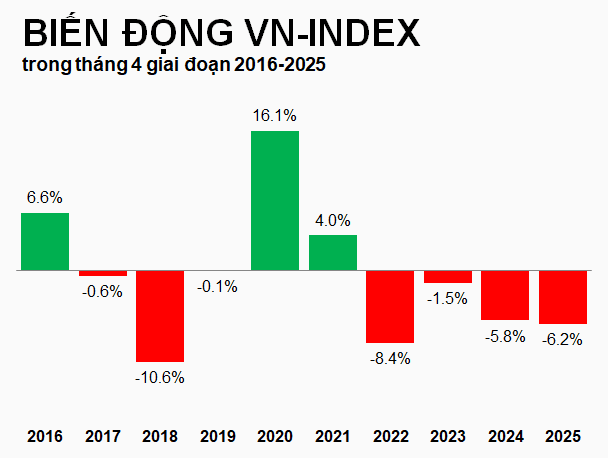
April has not been a favorable month for stock prices in recent years, according to statistics from VietstockFinance. The VN-Index has fallen notably in these months, a pattern partly linked to major macro events that occurred in April—such as in 2025 when US authorities announced a very high tariff policy, in 2024 when exchange-rate pressures peaked, and in 2022 when major stock-market scandals were disclosed. In April 2023, negative volatility was somewhat more balanced, partly because the market had already experienced a very sharp decline earlier.
On HOSE, the trading environment in April during 2023–2025 was overall less favorable. The data show that the number of stocks that fell in every April across these years (65) far outnumbered those that rose (8).
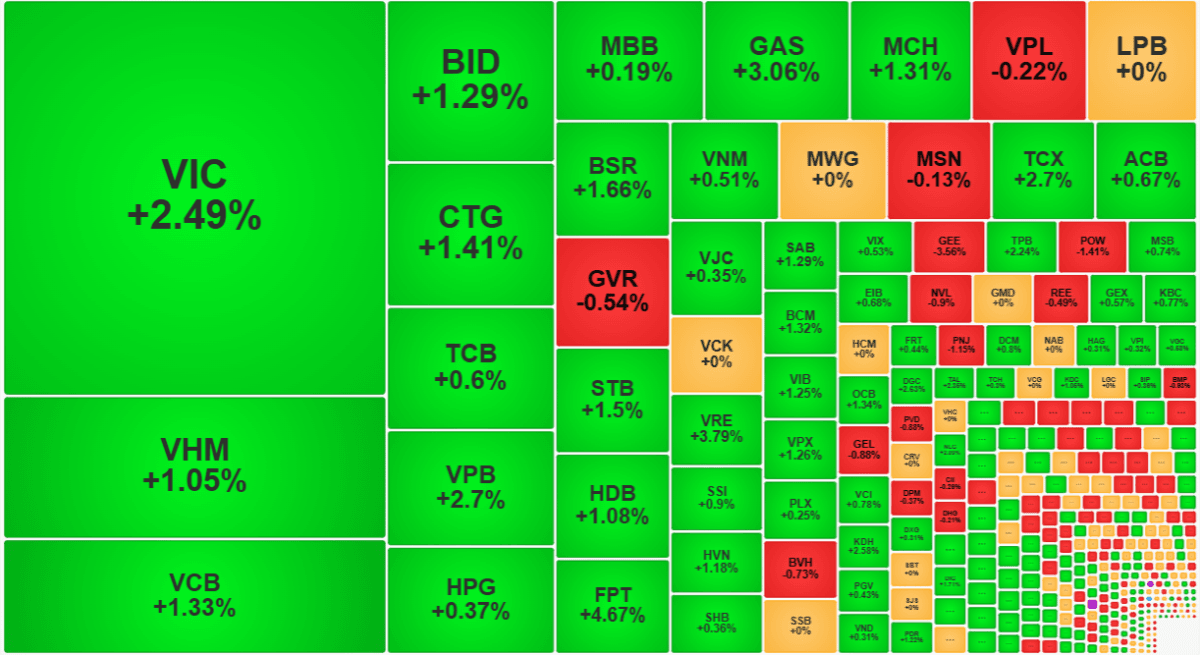
Among the stocks that declined in every April, the list includes small- and mid-cap names as well as blue chips. Examples cited include industrial real estate companies BCM and SIP, retail firm PNJ, insurance BVH, and banks VPB, BID, VCB, and CTG—indicating that when large market moves occur, multiple segments can be affected.
HOSE stocks declined in all Aprils from 2023 to 2025.
On HNX, a similar pattern appears. As many as 43 stocks were down in every April from 2023 to 2025, while only 8 stocks rose over the same period.
Looking ahead to April 2026, the market enters the season of annual shareholder meetings, when management must address how firms will navigate an increasingly complex geopolitical and financial environment. The practical focus for companies is to strengthen financial resilience, as interest rates have already been trending higher.
What distinguishes April this year from previous years is that the market had already undergone a sharp adjustment in March 2026, with an 11% decline—large enough to create short-term trading opportunities for investors who remain optimistic.
If corporate profit outlooks are indeed eroded by macro changes, early market reactions may reflect not only technical adjustments but also signals of a tougher cycle ahead.
Thừa Vân
Bitcoin (BTC) investors who use steady dollar-cost averaging (DCA) may be underperforming versus strategies that adjust exposure to the market’s cycle, according to new research arguing that Bitcoin’s behavior differs from traditional long-duration assets.
In a report cited by Markus Thielen of 10x Research, Bitcoin’s market…