•
•
•
•
•
•
•
•
•
•
•
•
•
•
•
•
•
•
•
•
•
•
•
•
•
•
•
•
•
•
•
•
•
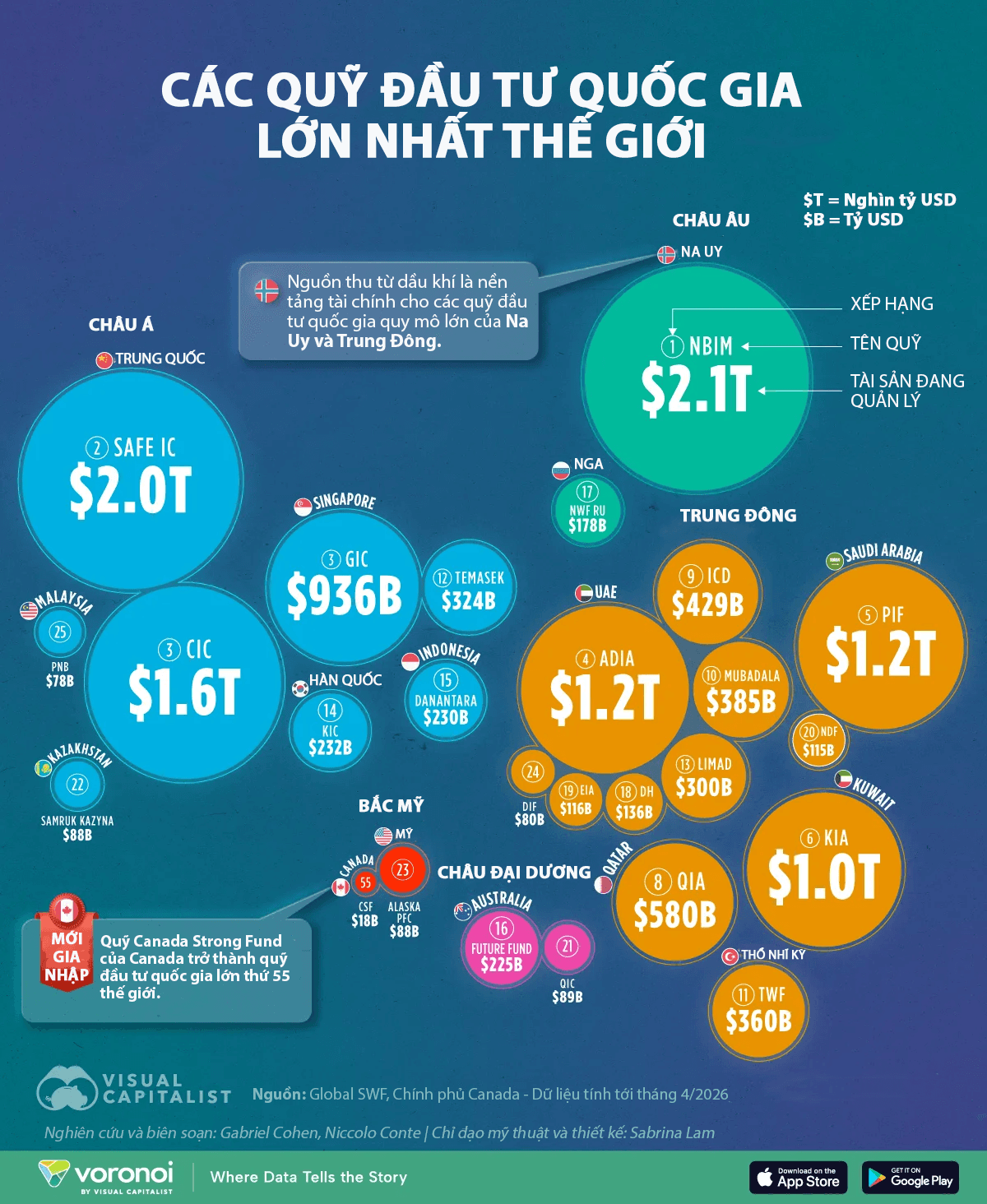
Most of the world’s large sovereign wealth funds are concentrated in Asia and the Middle East, where oil, mining and energy export revenues are substantial. Based on 2026 data from Global SWF, an infographic ranks the world’s largest sovereign wealth funds, led by Norges Bank Investment Management (NBIM).
NBIM, established in 1990, invests Norway’s excess oil revenue for the long term. As of 2026, it manages more than $2.1 trillion in assets, making it the largest sovereign wealth fund in the world. With a population of about five million, NBIM’s asset base is roughly $350,000 per Norwegian citizen.
The government uses NBIM as a tool to help the economy avoid the “resource curse,” the tendency of resource-rich economies to struggle to sustain growth. Rather than spend immediate oil and gas revenues, Norway channels these funds into a globally diversified asset portfolio to build long-term financial capacity for public investment and development.
Norway is not alone in placing oil revenues into government-managed funds. In the Middle East, Saudi Arabia, Kuwait and Qatar also manage large sovereign wealth funds, with assets of about $1.3 trillion, $1 trillion and $580 billion respectively. In the United Arab Emirates (UAE), sovereign wealth funds are developed at both federal and emirate levels. As of 2026, these funds manage a total of more than $2.6 trillion in assets.
Some neighboring countries in the region have established sovereign wealth funds in recent years. Turkey’s Turkey Wealth Fund (TWF), created in 2016, now manages more than $360 billion in assets.
Canada is the latest member to join. In April 2026, Prime Minister Mark Carney announced the creation of the Canada Strong Fund with $18 billion. This will be the 55th largest sovereign wealth fund in the world. The government expects the fund to support domestic strategic priorities, particularly as the country seeks to diversify trading partners and reduce dependence on the United States.
Revenues from oil, mining and gas are likely to contribute to the Canada Strong Fund, similar to the operation of the Alaska Permanent Fund in the United States, a state sovereign wealth fund that pays annual dividends to Alaska residents.
The world’s largest sovereign wealth fund earned nearly $250 billion in 2025. In late January 2026, Norway’s NBIM reduced exposure to U.S. Big Tech stocks as part of a portfolio rebalancing effort.
Premium gym chains are entering a “golden era” that is ending or already in decline, as rising operating costs collide with shifting consumer preferences toward more flexible, community-based ways to exercise. Long-term memberships are shrinking, margins are pressured by higher rents and facility expenses, and competition from smaller, more personalized…