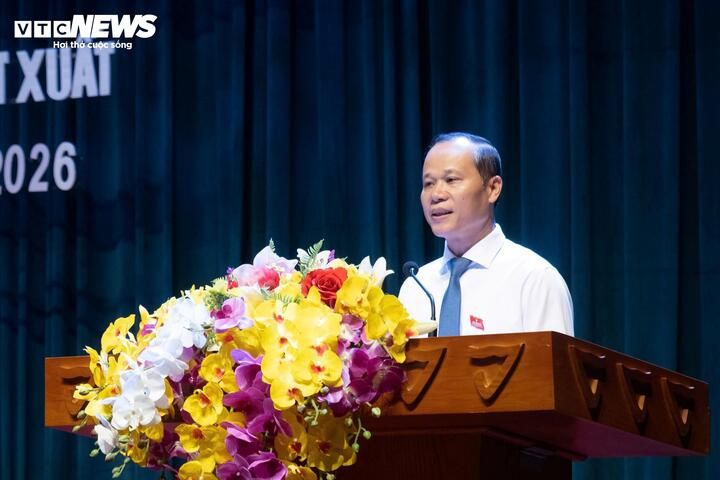
The Bac Ninh Provincial People’s Council approved a Resolution recognizing the province as meeting Class I urban criteria, establishing the basis for forming Bac Ninh City under central administration. The decision was adopted at the council’s fifth session of the term XX (2026-2031), held on June 30, with broad consensus.
On June 20, 2026, the Politburo issued Conclusion No. 52-KL/TW approving the policy to establish Bac Ninh City within the provincial boundaries. Previously, on June 1, 2026, the Minister of Construction issued Decision No. 836/QD-BXD approving adjustments to the overall planning of the urban and rural system for 2021–2030 with a vision to 2050. The orientation for Bac Ninh’s urban development is to be a Class I national urban center, serving as a national hub, a composite function, and a growth pole of the Red River Delta. Therefore, recognizing Bac Ninh as meeting Class I urban criteria is essential, in line with current regulations and providing a legal basis for the procedures to establish Bac Ninh City under central administration.
After administrative reorganization, the province has 99 administrative units, including 33 wards and 66 communes, with a population close to 4 million. Urban population accounts for about 45.09%, and the urbanization rate reaches 60.96%. There are currently 3 Class II urban areas (Bắc Giang Ward, Kinh Bắc, Tu Sơn); 22 Class III urban areas; 11 wards achieving Level II urban development and 22 wards at Level III.
Under the urban classification standards for cities, Bac Ninh meets the required criteria in several areas; in terms of position, role, and socio-economic development, the province meets 5 of 6 standards, ranking among the leading localities in attracting foreign direct investment (FDI) with more than USD 5.7 billion in 2025 (second nationwide); GRDP growth is strong, it does not rely on central budget supplementation and has hosted many international events. The unmet standard is that average per-capita income in the most recent three years is not higher than the national average. In the urbanization group, Bac Ninh meets 3 of 4 standards, with nearly 4 million urban residents, 60.96% urbanization rate, and urban II-scale populations over 945,000. The unmet criterion is the absence of 50% or more wards achieving Level II urban development.
The resolution recognizing Bac Ninh as meeting Class I urban criteria is viewed as an important step in the roadmap to establishing Bac Ninh City under central administration.
The available information describes the resolution as an important step in the roadmap to establishing Bac Ninh City under central administration. No additional expert opinions are provided in the source.