Get the latest crypto news, updates, and reports by subscribing to our free newsletter.
Giấy phép số 4978/GP-TTĐT do Sở Thông tin và Truyền thông Hà Nội cấp ngày 14 tháng 10 năm 2019 / Giấy phép SĐ, BS GP ICP số 2107/GP-TTĐT do Sở TTTT Hà Nội cấp ngày 13/7/2022.
© 2026 Index.vn
Hanoi has submitted an important proposal to the Pacific Construction Group (China) regarding the Văn Cao – Hòa Lạc metro line, a project with total investment of 72.3 trillion dong. On the afternoon of April 9, a Memorandum of Understanding on cooperation was signed between the Hanoi Department of Construction…

The profit growth trajectory of Big Tech has been inversely related to the welfare of the younger generation. The World Happiness Report 2026 argues that the economic model increasingly centers on “trap products,” and highlights a paradox in which users will pay to remove social media—an outcome the report links to erosion of human capital and risks for ESG investment strategies.
Over more than a decade, global market capitalization for major tech firms has risen alongside the spread of smartphones and online connectivity. The World Happiness Report 2026 says this has come with a drain on an intangible asset: overall social welfare, particularly for people under 25.
In developed markets including Western Europe and the NANZ group (the United States, Canada, Australia, and New Zealand), life-satisfaction indicators for youths have declined systematically. The report states that NANZ recorded welfare declines for those under 25 by as much as 0.86 points when comparing 2023–2025 with the baseline 2006–2010, pushing the group toward the bottom of rankings for changes in life quality.
The report says the decline began to unfold and accelerate from 2012, coinciding with the rise in social media users and the tightening grip on global advertising revenue. It frames the pattern as a misallocation of resources: private commercial gains are maximized while risk is transferred to the social ecosystem.
The report cites PISA 2022 results for 15-year-olds across 47 countries, showing a boundary in life-satisfaction levels based on screen time. Teenagers using social media at high intensity—over 7 hours per day—experience the most significant welfare declines across measures.
In Western Europe, the report notes that female students using social media at high frequency show nearly a 1-point decline on a 10-point scale compared with those limiting online time to under 1 hour per day.
Beyond psychological effects, the report describes erosion of social capital. It says real-world networks, community ties, and belonging are being replaced by shallow, highly quantifiable online interactions driven by engagement metrics.
The report also states that restoring real-world community engagement—such as in school environments—can raise life satisfaction by up to six times the fluctuations caused by changes in online time. It further notes a sharp rise in the frequency of negative emotions such as sadness and anxiety among youths in English-speaking countries, reducing the positive emotional range seen in earlier generations.
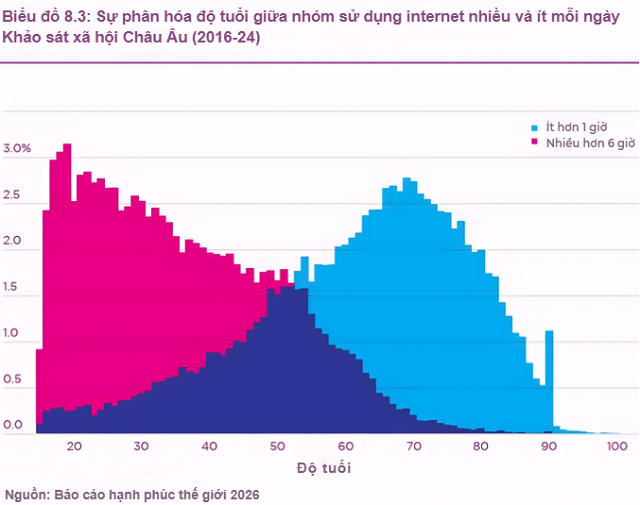
Source: World Happiness Report 2026
The report argues that social media dominance is not only about delivering consumer surplus, but about building psychological manipulation structures. It describes “trap products” as goods that keep users in consumption loops not because of intrinsic value, but due to fear of missing out (FOMO) on social information streams.
It links this to “negative externalities toward non-users,” where disconnecting can mean direct losses in status and communication opportunities. The report contrasts this with the Coase theorem’s implication that willingness to pay (WTP) and willingness to accept compensation (WTA) should not differ greatly in a perfectly competitive market.
Instead, the report cites evidence of a “super-ownership effect,” with a disparity up to 20 times that breaks standard consumer-surplus pricing models. When asked for a monthly price they would pay to continue using social media, the median offered by consumers is $1, with nearly half unwilling to pay any fee. But when the question is reversed—asking for compensation to deactivate accounts for four weeks—the price rises to $59.
The report interprets this asymmetry as structural dependence on a platform users do not value highly in isolation. It also describes a “collective action trap” using university-student survey results: students were asked for $59 and $47 to pause using TikTok and Instagram, indicating high switching costs and fear of losing social connections. Yet when users were willing to pay $28 and $10 only if everyone in their network also deleted the apps, the report says this reflects dependence on others’ continued participation.
The report frames the “consumer paradox”—paying cash to eliminate the existence of a product used daily—as evidence that Big Tech’s revenue rests on social-welfare deficits created by dense constraints that protect corporate profits despite anxiety amplification and worsening well-being.
The report says the attention economy does not affect all groups evenly and instead widens gaps in economic position and asset capacity. Analysis of WHR 2026 data across 43 countries finds that problematic social media use (PSMU) erodes the welfare of vulnerable youths more severely.
It states that the risk of welfare decline due to PSMU among low-income groups has risen, with a negative impact coefficient moving from -0.18 (2018) to -0.22 (2022). The report adds that this welfare erosion tends to spread across economic strata.
On resource allocation, it says asset-poor families face disadvantages in providing access to high-quality alternative entertainment or extracurricular spaces. With digital access acting as a low-cost escape, the report describes a “toxic social-compare loop.” By contrast, families with stronger financial resources can buffer and guide children toward tangible interactions, which the report says helps protect quality of life.
The report also links social media use to trust structures. In a digital environment where youth usage exceeds 90%, it says Gen Z women experience declines in interpersonal trust and trust in macro institutions. It reports that youth score 1.35 points lower on a 10-point scale than highly connected peers.
It contrasts this with the Baby Boomer generation, saying that those who built assets and stable positions continue to show positive community engagement. The report suggests internet access may even provide positive externalities for older adults by reducing isolation.
The report argues that declining social welfare and human capital quality create direct risks for the attention-economy business model. It says mental energy and focus of the next generation are drained by performance metrics and engagement systems.
It cites “leaks” from major tech firms describing deliberate incorporation of a staggered random-reward mechanism similar to gambling to sustain compulsive engagement. The report says endless scrolling can create a dopamine deficit that reduces the ability to analyze context, form memories, and exercise empathy.
As evidence, it references a randomized controlled trial called Project Mercury, conducted by an internal top platform. The report states that stopping app use for one week produced large, immediate improvements in users’ anxiety and substantially reduced harmful social comparisons. It adds that the findings were buried to protect advertising revenue, raising ethical risk in the report’s framing.
From an ESG perspective, the report says the shift in digital consumption behavior reveals cracks in how future cash flows are valued. It also states that dismantling empirical data from Latin America shows platform architecture matters: simple messaging apps show a positive correlation with satisfaction, while algorithm-driven content and influencer-driven platforms are the main drivers of welfare decline. It concludes that a profit model based on negative externalities faces regulatory risk.
The report says global regulatory frameworks are tightening, citing Australia’s under-16 social-media ban effective late 2025, along with actions in France and Spain. It argues that valuations built on erosion of human capital are unsustainable cash flows and that compliance with stricter rules will require re-pricing the entire technology-asset basket.



Premium gym chains are entering a “golden era” that is ending or already in decline, as rising operating costs collide with shifting consumer preferences toward more flexible, community-based ways to exercise. Long-term memberships are shrinking, margins are pressured by higher rents and facility expenses, and competition from smaller, more personalized…


