•
•
•
•
•
•
•
•
•
•
•
•
•
•
•
•
•
•
•
•
•
•
•
•
•
•
•
•
•
•
•
•
•


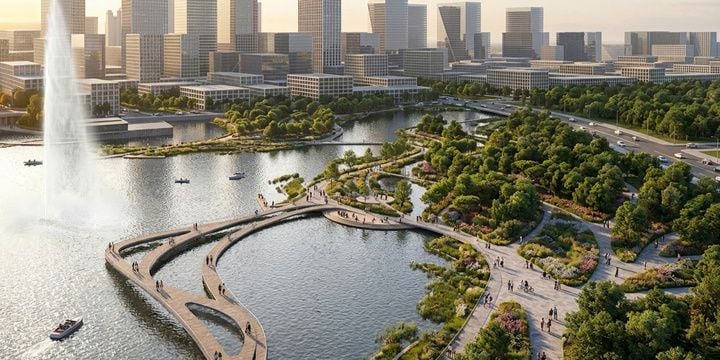
Ho Chi Minh City is entrusting a series of large-scale infrastructure investments to domestic private economic groups, with recent landmark projects launched to mark the 51st anniversary of liberation and reunification. The projects, with total investment of over 140,000 billion VND, do not use state-budget funds and include major works expected to upgrade the Thu Thiem New Urban Area.
Among the key projects are the Central Square and the Ho Chi Minh City Administrative Center, public works providing administrative services. The two projects have total investment of nearly 30,000 billion VND and cover nearly 47 hectares. Investors have volunteered to implement them, with objectives extending beyond administrative space to include cultural space, public space, and urban landscape—supporting the development of a modern city center connected to surrounding areas.
The Rạch Chiếc National Sports Complex is also being invested by private enterprises. It is expected to open public spaces and modern urban facilities.
The Ben Thanh – Thủ Thiêm Metro is described as the deepest underground rail project in Ho Chi Minh City to date, with high technical requirements because it runs beneath the Saigon River bed. The tunnel is planned at a depth of 41 meters from the water surface, nearly twice the depth of the Thu Thiem tunnel.
According to the feasibility study, among six stations, Ham Nghi Station—near the Ham Nghi–Tôn Đức Thắng intersection—is designed about one meter deeper than Ben Thanh Station on the Ben Thanh–Suối Tiên line. Ham Nghi Station is planned with four underground levels and is intended as a transfer point for the tunnel under the river.
For the first time in Vietnam, the project will apply tunnel boring under balanced pressure fluid to cross the Saigon River and the initial section in Thu Thiem. The approach is intended to manage landslide risks, limit water intrusion, and protect existing structures above.
In January, Ho Chi Minh City also began a series of strategic infrastructure projects, largely structured as PPP investments by Sun Group and Masterise. These include the Can Gio Bridge worth about 13,200 billion VND and Phú Mỹ Bridge 2 at around 23,185 billion VND.
Another notable project is the Rạch Chiếc National Sports Complex, with total capital over 145,000 billion VND and built on nearly 187 hectares, expected to provide public spaces and modern urban facilities.
Other modern infrastructure projects with investment in the tens of trillions have also started or are expected to start with private sector participation, including:
Dang Minh Trường, Chairman of Sun Group, said investing in these projects is a responsibility of a strategic investor committed to long-term development and to accompanying the city, aiming to create sustainable values for future generations and contribute to the city’s beauty.
He also noted that within just over a year, Sun Group has participated in multiple large projects, including Ly Thái Tổ Park; the Rạch Chiếc Sports Complex; the Central Square and the Ho Chi Minh City Administrative Center; and the refurbishment of the Ben Nghe Wharf–Khánh Hội area.
Meanwhile, Tran Ba Duong, Chairman of THACO, said participating in metro projects is a mission to develop alongside the country and an opportunity to leave lasting marks in Ho Chi Minh City, where he studied and found success.
The city’s reliance on private sector involvement reflects a broader policy to mobilize social resources for national infrastructure.

Premium gym chains are entering a “golden era” that is ending or already in decline, as rising operating costs collide with shifting consumer preferences toward more flexible, community-based ways to exercise. Long-term memberships are shrinking, margins are pressured by higher rents and facility expenses, and competition from smaller, more personalized…