•
•
•
•
•
•
•
•
•
•
•
•
•
•
•
•
•
•
•
•
•
•
•
•
•
•
•
•
•
•
•
•
•


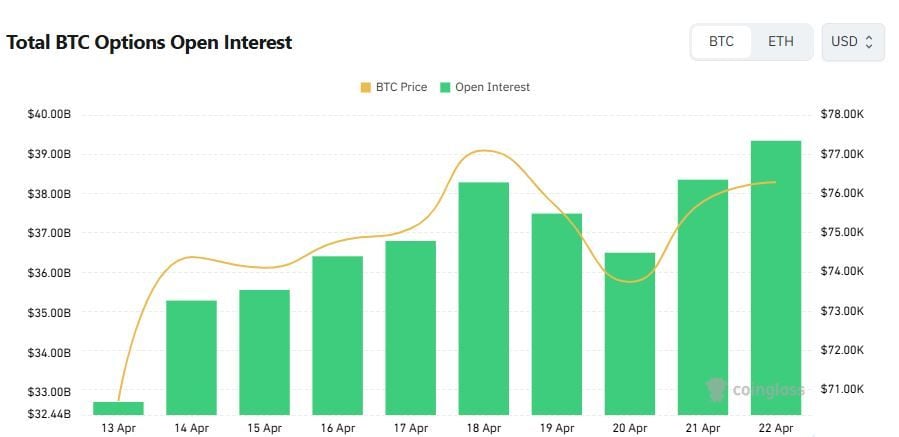
Bitcoin options traders increased short-term downside hedging, with $74,500 put contracts leading volume even as longer-dated positioning remains modestly bullish.
Data compiled by Coinglass as of April 22 (00:00 UTC) showed total Bitcoin options open interest (OI) at $39.35 billion, up about 2.53% from $38.38 billion a day earlier. By outstanding positions, calls accounted for 55.75% of OI versus 44.25% for puts, indicating longer-dated positioning still leans modestly bullish.
Options trading volume over the last 24 hours totaled roughly $3.867 billion, led by Deribit at $2.11 billion. By venue, activity was distributed across Bybit ($793 million), Binance ($502 million), OKX ($409 million), and CME ($54.67 million), highlighting that liquidity remains heavily concentrated offshore while regulated U.S. participation continues to build gradually through CME.
In the most recent 24-hour window, puts made up 56.89% of volume, outpacing calls at 43.11%.
The top-traded contracts were all near-term puts on Deribit: $74,500 puts expiring April 24, $74,000 puts expiring April 25, and $75,000 puts expiring April 24. The clustering around nearby strike levels suggests demand concentrated in “key hedging zones” that could become more influential if spot volatility accelerates.
By contrast, the largest pools of outstanding positioning were concentrated in higher-dated, higher-strike calls and deep-out-of-the-money protective puts. The biggest OI stood in an $80,000 call expiring May 29 on Deribit, followed by a $120,000 call expiring December 25, and a $60,000 put expiring December 25. This mix indicates the market is maintaining upside exposure for a potential later-year breakout while also holding tail-risk insurance.
Options are derivatives that allow traders to express leveraged views on price direction or hedge existing exposure. A call option gives the right to buy at a preset price, while a put option gives the right to sell at a preset price. Open interest measures how many option contracts remain outstanding, reflecting cumulative positioning rather than just daily turnover.
Overall, the divergence between call-heavy open interest and put-heavy short-term volume suggests positioning is becoming more two-sided: investors appear to be keeping longer-term upside structures intact while buying near-dated downside protection into end-of-week expiries.
Premium gym chains are entering a “golden era” that is ending or already in decline, as rising operating costs collide with shifting consumer preferences toward more flexible, community-based ways to exercise. Long-term memberships are shrinking, margins are pressured by higher rents and facility expenses, and competition from smaller, more personalized…