•
•
•
•
•
•
•
•
•
•
•
•
•
•
•
•
•
•
•
•
•
•
•
•
•
•
•
•
•
•
•
•
•


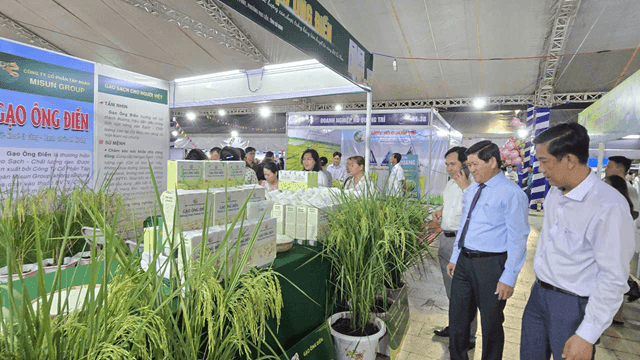
Ca Mau is strengthening linkages across the rice value chain to raise the value of rice grains as the sector shifts toward high-quality production. The province says the move is aimed at reducing emissions and expanding market connections in a market with increasingly stringent requirements.
On 26 April, the provincial People’s Committee held a conference to connect production and rice output, bringing together regulatory agencies, enterprises, cooperatives and farmers. The event focused on reviewing the full value chain from production to output and identifying more efficient operating methods.
Local data show Ca Mau has more than 185,000 hectares of rice cultivation annually, with a total planted area of over 311,000 hectares across multiple seasons and rice-shrimp models. Average production exceeds 1.8 million tons per year, underscoring rice’s role as a pillar of the agricultural economy.
A key development is the rapid expansion of the linkage model. By 2025, 27 enterprises had linked with 50 cooperatives across more than 53,000 hectares, consuming over 320,000 tons of rice. The province reports that this has helped stabilize outputs, lower costs, and improve rice value.
Ca Mau also cites price improvements of about 200 dong per kilogram for safe rice and 500-1,000 dong per kilogram for organic rice.
Alongside linkage, the adoption of technology is changing farming practices. The province highlights row-sowing tractors, drones, and alternating flooded and dry irrigation processes, which it says reduce seed use, fertilizer and pesticides.
Under the Mekong Delta’s 1 million hectares of high-quality rice program, Ca Mau reports that seedling use decreases by 20-40%, nitrogen fertilizer by about 20%, and the number of spray events by 2-4 times. These changes reduce production costs by 2-3.5 million VND per hectare, while yields increase by 0.3-0.5 tons per hectare. Profits are reported to rise by more than 2-8 million VND per hectare compared with traditional methods.
The conference also noted that farmers are adjusting their mindset, accepting lower sowing rates and inputs to optimize costs. Even in periods when rice prices fall, profits are said to be sustained due to cost savings and reduced emissions.
Speaking at the conference, Deputy Chairman Le Van Su said rice is not only a leading production sector but also closely tied to livelihoods, particularly in the shrimp-rice belt. He said sustainable development requires reorganizing the value chain toward closer linkages.
From experts’ perspectives, Dr. Tran Minh Hai, Vice Rector of the School of Public Policy and Development, emphasized the role of cooperatives as bridges between farmers and enterprises. He said that when cooperatives are strong, the supply base becomes more stable and enterprises are more willing to invest long-term.
However, the conference highlighted remaining bottlenecks, including:
Experts proposed policy improvements, removing capital obstacles, redesigning linkage areas, boosting cooperative capacity, and accelerating digital transformation.
On the technology side, Mr. Huynh Hung Dung, Deputy Director of the Ca Mau Department of Science and Technology, said export-market requirements for traceability and environmental considerations are rising, requiring comprehensive upgrades across the rice sector.
The province is testing salt-tolerant rice varieties CAMAU3 with a budget of nearly 3.9 billion VND and is building intellectual property for the product. Ca Mau currently has the geographical indication “Gao mot bui do Hong Dan” and two brand names: “Lua sach Thoi Binh” and “Lua sinh thai Ca Mau,” which the province says help raise value and brand recognition in the market.
From cooperatives’ perspectives, Mr. Nong Van Thach, Chairman of the Board and General Director of Ba Dinh Mixed Agriculture Cooperative, said the use of drones, cluster seeding machines, and origin-tracing software helps reduce costs, limit pests, and better control output.
He also noted that linkage to buyers remains unstable due to market fluctuations.
The conference further recorded memoranda of understanding and supply contracts signed between enterprises and cooperatives, contributing to expanding raw-material areas and stabilizing outputs.
Overall, the conference described Ca Mau’s rice sector as gradually moving toward a modern, sustainable and higher-value model across production, technology and linkage organization.







Premium gym chains are entering a “golden era” that is ending or already in decline, as rising operating costs collide with shifting consumer preferences toward more flexible, community-based ways to exercise. Long-term memberships are shrinking, margins are pressured by higher rents and facility expenses, and competition from smaller, more personalized…



