•
•
•
•
•
•
•
•
•
•
•
•
•
•
•
•
•
•
•
•
•
•
•
•
•
•
•
•
•
•
•
•
•


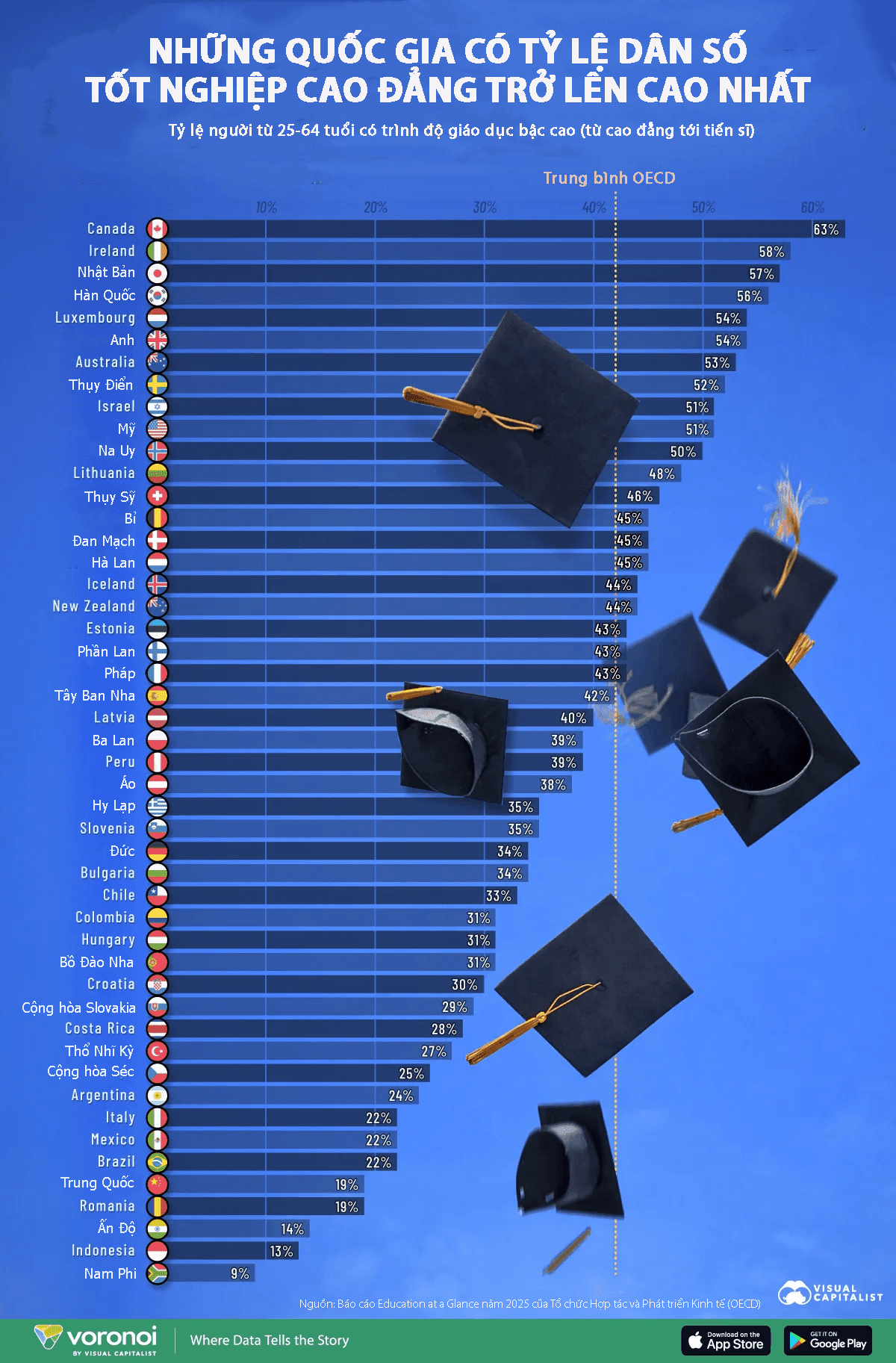
In some countries around the world, pursuing higher education beyond college has become a common standard. However, in many other places, access to higher education remains limited.
Based on data from the OECD’s Education at a Glance 2025 report, the ranking below shows the share of adults aged 25–64 who have education from college level up to doctorate.
Canada leads with 63% and is the only country in the list with nearly two-thirds of its adult population reaching this level. Many developed economies have also surpassed the 50% threshold, suggesting that higher education is increasingly common among the global workforce.
Ireland, Japan, and South Korea also fall into the group where more than half of adults have completed college or higher education. The pattern points to a labor market shift toward higher-skilled work.
In the United States, the share of adults with college degrees and above is 51%, above the OECD average of 42%.
Despite high attainment in some places, gaps among developed countries remain large. In Europe, Ireland is among the global leaders with 58%, while Italy reaches 22%, highlighting uneven access to higher education across the region.
Some large economies have much lower shares of adults with college degrees than the OECD average. China records 19%, India 14%, and Indonesia 13%.
Analysts say these figures reflect decades of investment in higher education and sustained demand for skilled workers in the labor markets of developed economies.
They also note that as major economies continue to grow, expanding access to higher education is expected to play a crucial role in productivity, income, and workers’ competitiveness, amid rising demand for skilled labor.
Premium gym chains are entering a “golden era” that is ending or already in decline, as rising operating costs collide with shifting consumer preferences toward more flexible, community-based ways to exercise. Long-term memberships are shrinking, margins are pressured by higher rents and facility expenses, and competition from smaller, more personalized…