•
•
•
•
•
•
•
•
•
•
•
•
•
•
•
•
•
•
•
•
•
•
•
•
•
•
•
•
•
•
•
•
•


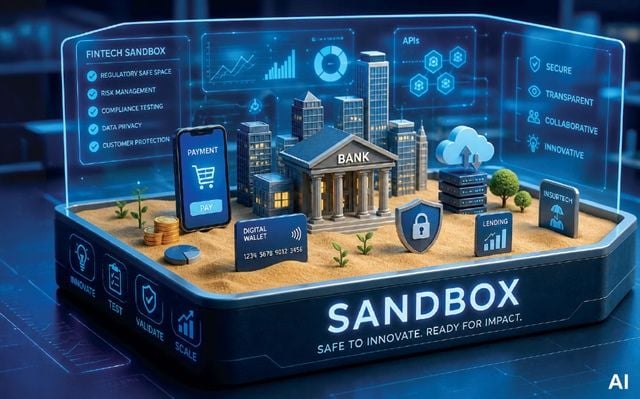
The Government Decree 94/2025/ND-CP introduces a controlled experimentation mechanism, commonly referred to as a “sandbox,” for the financial technology (FinTech) sector. The decree’s approach aligns with broader innovation and science-technology policy frameworks in Vietnam, including Resolution 68-NQ/TW of the Politburo, the Law on Science, Technology and Innovation 2025, and the AI Law 2025.
This article explains what a sandbox is, its role in FinTech, and key challenges that may arise when operating such a mechanism.
Although the concept existed before Decree 94, the decree itself does not provide an official definition. The 2025 Law on Science, Technology and Innovation offers the definition used in the current policy context.
Under the law, a sandbox can be understood as a state authority allowing organizations and enterprises to conduct trials of new technologies, processes, solutions, products, services, or business models that are not yet regulated or differ from existing legal provisions, within practical constraints on scope, time, and space. The concept is described as consistent with the global understanding of regulatory sandboxes.
FinTech refers to the application of technology to provide financial products and services, typically delivered by both banks and technology firms. These solutions can improve convenience and efficiency and support broader access to financial services, including financial inclusion. In some cases, they can outperform traditional banking operations.
The article notes that traditional banks must also function as tools for regulating the economy, which requires compliance with stringent capital and product standards. In addition, many banking systems rely on core infrastructure built decades ago, making modifications difficult and costly.
Scalability is another key consideration. A model that works in a small testing environment may fail at market scale if infrastructure, resources, or policy alignment are insufficient.
Because FinTech solutions are new, they often share three characteristics: (1) existing regulations may not provide detailed guidance for specific products or services; (2) FinTech offerings can affect the banking and monetary system and related exchanges; and (3) they can affect consumer rights.
Against this background, the sandbox is presented as a tool for lawmakers to balance regulating FinTech activities while still enabling innovation and creative freedom. The sandbox idea was first proposed by Sir Mark Walport, the UK Government’s Chief Scientific Adviser, in 2015 and has since been adopted by multiple jurisdictions, including Singapore and Hong Kong.
While implementing a sandbox is viewed as an important policy step in Vietnam, the article emphasizes that sandbox is not a universal solution. If designed or operated inappropriately, it may produce outcomes contrary to the original objectives.
One concern is that regulators may grant ad hoc exemptions to FinTech firms participating in the sandbox. The article argues this could erode the principle of equality before the law, which is described as a foundation of the rule of law.
In Vietnam’s context—where the FinTech legal framework remains limited—the article warns that a misused sandbox could become a “backdoor” for certain firms rather than driving broader regulatory reform.
Another risk arises when the regulator simultaneously acts as policy designer, guide, and supervisor for startups in the sandbox. The article notes that this can blur the line between support and favoritism, creating transparency risks and potentially distorting competition in the market.
The article also cautions that sandbox mechanisms can unintentionally become barriers to innovation if regulators act as gatekeepers too strictly. Stringent criteria or lengthy approval processes can slow testing and deployment of new products—an especially serious issue in FinTech, where speed of innovation affects competitiveness.
In some jurisdictions, sandbox has been criticized as a performative exercise when implementation stops at demonstrations and does not include sufficient investment in resources, expertise, or evaluation mechanisms.
The article highlights that rapid changes in FinTech may limit regulators’ ability to understand real business needs, potentially leading to ineffective decisions.
It further notes that when there are no clear metrics to measure effectiveness, regulators may struggle to determine whether sandbox trials truly add value—affecting decisions to continue, adjust, or terminate trials.
Finally, the article states that sandbox should be a supplementary tool rather than the sole approach to spur innovation. It suggests that, alongside sandbox, markets may be allowed to develop freely in early stages with regulation introduced later, provided the objective of developing the FinTech market is maintained.
China’s experience is cited as an example that this approach can still achieve high effectiveness, including China becoming a global leader in mobile payments even without sandbox initially.
For Vietnam in the long run, the article argues that policy should focus on building a clear and flexible legal framework that can adapt to technology development and ensure scalability. It reiterates that a model that works in a small trial environment may fail when scaled due to insufficient infrastructure, resources, or policy alignment.
Premium gym chains are entering a “golden era” that is ending or already in decline, as rising operating costs collide with shifting consumer preferences toward more flexible, community-based ways to exercise. Long-term memberships are shrinking, margins are pressured by higher rents and facility expenses, and competition from smaller, more personalized…