•
•
•
•
•
•
•
•
•
•
•
•
•
•
•
•
•
•
•
•
•
•
•
•
•
•
•
•
•
•
•
•
•


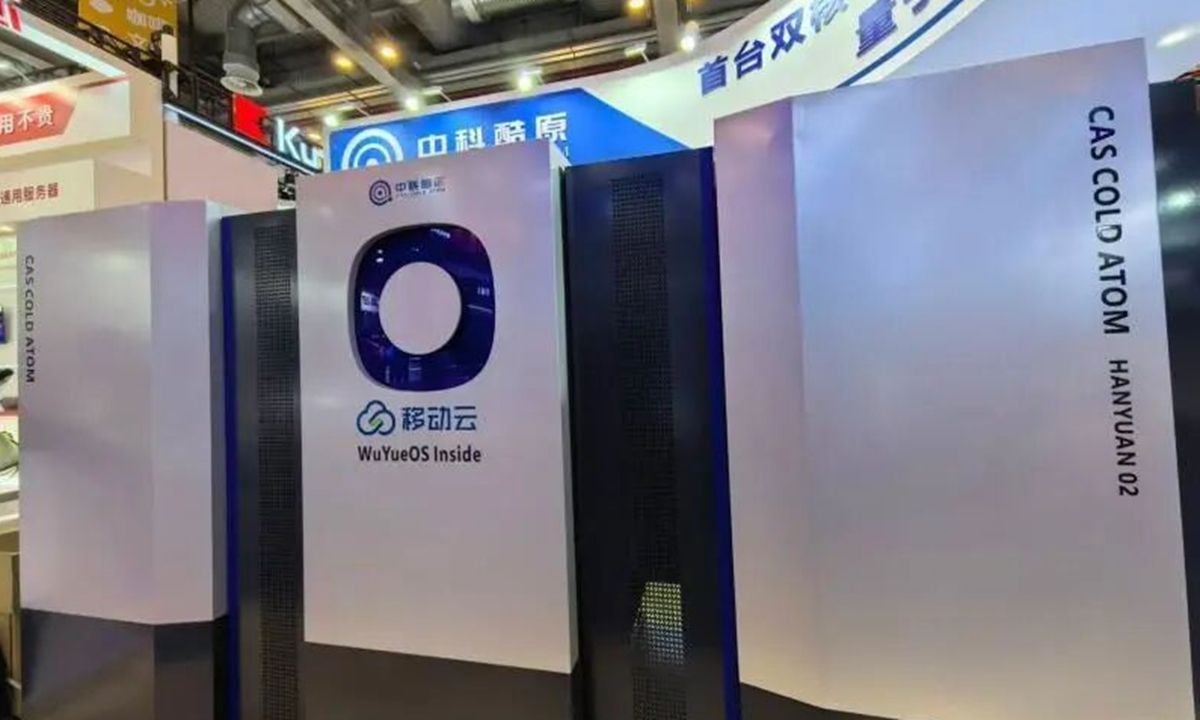
CAS Cold Atom Technology, an entity affiliated with the Chinese Academy of Sciences, has announced what it calls the world’s first dual-core quantum computer. The system, named Hanyuan-2, integrates two independent neutral-atom arrays within a single device, combining 100 rubidium-85 atoms and 100 rubidium-87 atoms to form a dual-core system with a total of 200 qubits.
A qubit, or quantum bit, is the basic unit of information in quantum computing. Unlike classical bits that take values of 0 or 1, qubits can exist in both states simultaneously through quantum superposition, enabling quantum systems to tackle certain complex problems more efficiently.
The company said the dual-core architecture is intended to allow parallel operation to share computational load, or to run in a “one core, one auxiliary core” mode. In that configuration, one array is used for real-time error correction while the other focuses on quantum computations.
Hanyuan-2 is based on neutral-atom technology, rather than approaches such as trapped ions, photons, or superconducting qubits. In this architecture, atoms are neutral and are held and controlled using highly precise laser systems. The company said the absence of a cryogenic superconducting environment helps reduce power consumption and simplifies the operating infrastructure.
Mr. Ge Guiguo, a senior expert at CAS Cold Atom Technology, told Science and Technology Daily that this is the first time a quantum processor has moved from a single-core to a dual-core architecture.
CEO Tang Biao said Hanyuan-2 is designed in a standard integrated cabinet form and requires only a small laser cooling system to operate. The company stated power consumption is below 7 kW, and that the system does not require the ultra-cold environments used by many other quantum computing platforms.
According to Science and Technology Daily, the design could enable faster deployment in ordinary indoor spaces and reduce costs and technical barriers to commercialization of quantum computing.
International experts have raised questions about the system because CAS Cold Atom Technology has not yet disclosed key technical specifications, including gate fidelity, coherence time, or actual error rates.
In the West, IBM is pursuing interconnection of superconducting chips using both quantum channels and conventional signal cables. QuEra and Pasqal have expanded single-atom arrays and are developing module interconnects. Atom Computing and Microsoft are building systems around multiple linked quantum processors in a network.
Compared with these network-based architectures, CAS’s approach places both arrays in a single device. Whether this tighter integration provides practical advantages over scaling up a single larger array remains unresolved, and will depend on standardized performance metrics and detailed technical data once they are released.

Premium gym chains are entering a “golden era” that is ending or already in decline, as rising operating costs collide with shifting consumer preferences toward more flexible, community-based ways to exercise. Long-term memberships are shrinking, margins are pressured by higher rents and facility expenses, and competition from smaller, more personalized…