•
•
•
•
•
•
•
•
•
•
•
•
•
•
•
•
•
•
•
•
•
•
•
•
•
•
•
•
•
•
•
•
•


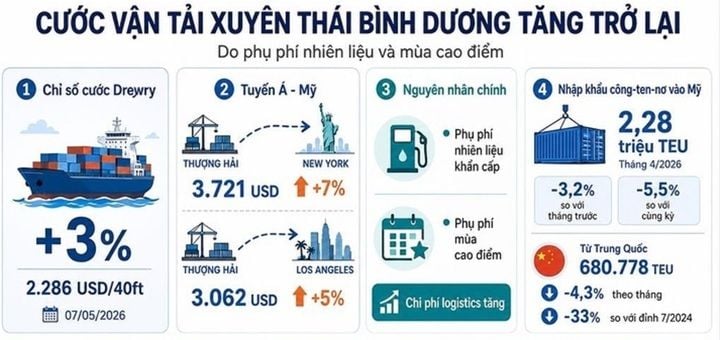
At the start of May, container freight rates on the Asia–U.S. route unexpectedly reversed, rising after several carriers implemented emergency fuel surcharges and peak-season surcharges. According to the Vietnam Association of Seafood Exporters and Producers (VASEP), the world container freight index published by Drewry on May 7 showed the average rate for transporting a 40-foot container increased by 3% to 2,286 USD, ending a three-week streak of declines.
The upturn was mainly driven by transpacific routes as carriers began applying additional emergency fuel surcharges and peak-season surcharges. VASEP cited the following changes for 40-foot containers:
Carrier actions also contributed to the increase. MSC raised the emergency fuel surcharge on the Asia–U.S. East Coast route to 644 USD per 40-foot container and on the Asia–U.S. West Coast route to 467 USD. Separately, CMA CGM implemented a peak-season surcharge of 2,000 USD per container from May 1.
Notably, the price movements occurred even as imports of containerized goods into the United States showed signs of slowing. In April, containerized imports reached about 2.28 million TEU, down 3.2% from March and down 5.5% from the same period in 2025. Year-to-date, total imports were down about 5% versus the same period last year.
By origin, goods from China reached 680,778 TEU in April, down 4.3% from March and about 33% below the peak recorded in July 2024. While imports from other Asian countries such as Thailand and Japan rose, the gains were not enough to offset declines from China. As a result, total imports from the 10 leading supplier countries to the United States fell by 3.1%.
On the Asia–Europe freight lane, price levels were more stable. VASEP reported the following Drewry figures for 40-foot containers:
Drewry cautioned that carriers’ ability to implement further freight-rate hikes in May may face challenges due to weak demand and persistent oversupply in the fleet.
In response, VASEP advised exporters—especially those heavily dependent on routes to the United States—to closely monitor any freight-rate increases, noting that surcharges can arise from both supply–demand factors and carrier-imposed charges. The association recommended reviewing shipment schedules, freight terms, and surcharges in transport contracts, and working proactively with freight forwarders to help mitigate potential costs during peak seasons.
Premium gym chains are entering a “golden era” that is ending or already in decline, as rising operating costs collide with shifting consumer preferences toward more flexible, community-based ways to exercise. Long-term memberships are shrinking, margins are pressured by higher rents and facility expenses, and competition from smaller, more personalized…